
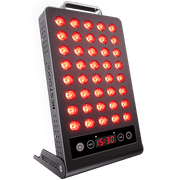
Use one documented setup each time: keep the same contact condition or measured device-to-skin position, stabilize the device or your body, and divide a larger target area into repeatable sections when one placement will not cover it evenly.
Distance is not a universal setting for portable red-light devices. Moving a non-contact device changes both the practical area illuminated and the intensity delivered to the skin. A larger visible footprint may look like better coverage, but it does not prove that the light is equally distributed from the center to the edges.
Distance Changes More Than the Size of the Lighted Area

Irradiance is the optical power delivered over a given area, usually expressed in mW/cm². It is not a fixed property of a device regardless of where or how it is used. The same device can produce a different measurement at contact, a short distance away, or farther from the body.
That is why the manufacturer's stated treatment distance should be treated as part of the setup---not as a loose suggestion. The useful question is not simply, "How much skin can I see illuminated?" It is, "Can I reproduce the same device-to-skin position for this target area every session?"
As portable-device irradiance guidance explains, distance-related changes depend on factors such as optics, beam angle, and how output was measured. A single center-field or peak irradiance figure also does not establish that the entire visible field receives the same level of light.
This has two practical implications:
- Do not substitute a generic distance rule for your device's instructions.
- Do not assume that moving farther away creates evenly expanded coverage.
If the instructions state an operating distance, use a simple way to reproduce it: a stable chair position, a consistent body landmark, a permitted stand or mount, or a measured gap.
Match the Positioning Method to the Device Format

Different portable formats create different repeatability challenges. The goal is not to make every device behave like a panel or a wrap; it is to use the type of distance control the format is designed to support.
| Device Format | Main Distance-Control Method | Coverage Consideration | Repeatability Check |
|---|---|---|---|
| Handheld or spot device | Maintain the instructed gap while holding or moving the device | A small field may require multiple placements on a broad area | Start from the same landmark and follow the same section sequence |
| Flexible wrap or pad | Maintain consistent contact or near-contact fit | Curves, folds, shifting, and gaps can change the area covered | Center the wrap on the same landmarks and confirm it lies evenly |
| Small portable panel | Keep the panel and body in a stable, non-contact relationship | A flat field may not match a curved or irregular body area | Use the same chair, support, panel height, and body position |
Handheld and Spot Devices
Handheld and spot formats offer flexibility, but they place more responsibility on the user to control distance, orientation, and movement. Small changes in wrist angle or body posture can alter the gap between the device and skin.
For a localized area, it may be possible to hold the device stationary at the instructed position. For a wider area, define a movement pattern before starting rather than improvising during the session. Use visible, repeatable body landmarks---such as the edge of a muscle area, a joint line, or the center of the target---to establish where each section begins and ends.
The key is not a universal sweep speed or overlap percentage. Those details must come from the device instructions when provided. Your repeatable routine should instead preserve the same distance, orientation, section order, and session timing.
Flexible Wraps and Pads
Flexible contact or near-contact formats solve a different positioning problem. Rather than holding a rigid device at a measured gap, you are trying to maintain stable alignment and even contact across the intended surface.
This can be particularly useful on curved regions. A rigid non-contact device may leave practical gaps around a curve, while a wrap can conform more closely when it remains centered and lies flat. As guidance on flexible-wrap placement notes, consistent coverage depends on alignment and contact---not on tightening the wrap as much as possible.
For a repeatable wrap setup:
- Use the same body landmarks to center it.
- Check that it has not ridden up, shifted, folded, or arched away from the body.
- Aim for even contact rather than excessive pressure.
- Recheck comfort after fastening it, especially if posture changes during use.
A wrap that has shifted is no longer treating the same area, even if the session timer and device setting remain unchanged.
Masks and Portable Panels
For masks, follow the device-specific instructions for fit, eye precautions, and session settings. For small panels, using a support such as a chair or table can help maintain a fixed distance. However, a fixed panel position does not automatically mean a curved body area is evenly covered. Check whether the documented treatment field matches the shape and size of the area you intend to position in front of it.
Map Large Areas Instead of Chasing Coverage in One Pass

Before each routine, compare the device's documented treatment area with your intended target. If one placement does not clearly cover the area, divide the target into sections rather than trying to stretch the field by moving the device farther away.
A simple section map can be enough:
- Identify stable body landmarks that define the target area.
- Divide the area into a small number of named sections.
- Start at the same section each session.
- Keep the same device orientation and distance or contact condition.
- Complete the sections in the same order.
- Record the timing and settings used for each session.
For example, a broad or irregular area might be treated as upper, middle, and lower sections, or left and right sections, based on landmarks you can find again without guesswork. The labels are less important than their consistency.
Avoid inventing a universal overlap percentage, section size, or hand-motion pattern. The right coverage approach depends on the actual treatment field at the stated distance, the device's emitter arrangement, and the instructions for that model.
If you are using a handheld device, pause briefly at each section boundary rather than relying on memory alone. If you are using a panel, reposition your body deliberately between placements instead of gradually drifting closer or farther away. If you are using a wrap, confirm its edges remain aligned before starting the timer.
Record the Setup That Makes Your Routine Repeatable
A short log turns an approximate routine into a repeatable one. It does not need to be complicated. Record the variables that could change coverage or distance:
- Device setting or mode
- Device-to-skin distance, or contact condition
- Body position
- Device support or mounting position
- Target-area section map
- Section sequence
- Session time
- Movement pattern, if applicable
- Comfort observations, including excess warmth or irritation
This record is especially useful when you change locations, use the device while traveling, switch from standing to sitting, or treat a different body area. A setup that worked in one posture may not reproduce the same gap or alignment in another.
Check Safety Before Making the Setup Routine
A positioning method should be both repeatable and permitted by the device instructions. Stop and reassess if the planned position causes excessive warmth, irritation, discomfort, or difficulty remaining still.
Use the device-specific eye guidance and any required eye protection. Do not assume that one eye-safety approach applies to every format, especially when the device is worn close to the face or positioned near the eyes.
People with photosensitive conditions, those taking photosensitizing medications, or those with open wounds, active implantable devices, or metallic implants in the treatment area should seek appropriate medical guidance before use.
Repeatability Checklist
Before repeating a session, confirm that you can answer "yes" to each point:
- I checked the verified instructions for my device's distance or contact guidance, settings, timing, and eye precautions.
- I will use the same fixed position or consistent contact condition.
- My target area is covered by one documented placement, or I have mapped it into sections.
- I will use the same timing, body position, and movement sequence.
- I will log the distance or fit, settings, section order, and comfort notes.
For the next step, review your verified device manual and format-comparison resources before changing distance, mounting, contact condition, or session routine.


