
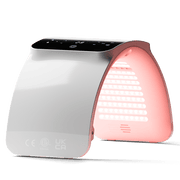
Usually, the lowest-uncertainty approach is to use red light therapy on clean, dry, bare skin---unless the device instructions say otherwise---and apply moisturizer or serum afterward.
A basic hydrating serum or moisturizer is not proven to be universally unsafe before red light therapy. However, there is limited evidence on how different formulas affect light delivery, heat comfort, or individual skin response. Keeping the treatment surface free of skincare, sunscreen, makeup, and oils makes the routine simpler and reduces uncertainty.
Use a Simple Before-and-After Routine

When a device manual does not give different preparation instructions, use this sequence:
- Cleanse gently to remove makeup, sunscreen, excess oil, and other surface products.
- Pat skin fully dry. Do not treat over a wet face unless the device labeling specifically permits it.
- Complete the session exactly as directed for your device, including distance, duration, positioning, and eyewear instructions.
- Apply serum and moisturizer afterward if your skin feels comfortable.
- Use sunscreen afterward during the daytime. Red light therapy does not replace everyday UV protection.
This is a conservative routine, not proof that every pre-applied moisturizer blocks treatment or creates a safety problem. A lightweight hydrating serum, including one made with hyaluronic-acid-style humectants, is not automatically hazardous. But treating on bare skin makes it easier to follow device instructions and identify what may be causing a reaction if your skin becomes irritated.
If your device manufacturer specifically instructs you to use a conductive gel, topical product, or another preparation method, follow that labeling instead.
What to Leave off Before Treatment
The main reason to remove products before a session is consistency of light delivery---not an established risk that skincare products will cause burns.
| Product or Product Type | Practical Pre-Treatment Approach | Why |
|---|---|---|
| Heavy makeup | Remove before treatment | Makeup can create an uneven surface layer and add uncertainty about light reaching the skin. |
| Sunscreen | Apply after the session, when needed for daytime UV protection | Sunscreen is designed to interact with light; using it after treatment avoids uncertainty about whether it affects the session. |
| Facial oils and rich occlusive creams | Save for afterward | Surface oils and heavier formulas may interfere with consistent light delivery. |
| Moisturizer or simple hydrating serum | Usually save for afterward | Not automatically unsafe, but bare skin is the lower-uncertainty default. |
| New active serum or treatment | Do not introduce it at the same time as a new device or new device setting | Changing one variable at a time makes it easier to identify irritation or intolerance. |
Do not assume that an ingredient is dangerous simply because it is "active." The available guidance does not establish that retinoids, exfoliating acids, benzoyl peroxide, vitamin C, or hydrating ingredients universally interact dangerously with red or near-infrared light.
The more relevant question is whether the product already makes your skin dry, stinging, peeling, inflamed, or unusually sensitive. If it does, using the device over that irritation can make it harder to tell whether symptoms come from the topical routine, the light session, or both.
Handle Active Products as an Irritation Question
If you use a retinoid, acid exfoliant, benzoyl peroxide treatment, prescription topical, or high-strength vitamin C product, do not treat red light therapy as automatic clearance to combine everything at once.
A cautious approach is to:
- keep your pre-treatment skin bare;
- introduce a new active product and a new device separately;
- avoid increasing device frequency while your skin is adjusting to a topical product;
- pause if you develop persistent redness, tenderness, itching, unusual warmth, or worsening dryness.
A patch test can help assess whether a new skincare product irritates your skin, but it does not confirm how you will respond to the product-and-device combination.
Photosensitivity, Skin Conditions, and Procedures Need Extra Caution
Red light therapy is not ultraviolet therapy. Still, "not UV" does not mean every person, medication, skin condition, or light-based device is automatically compatible.
Ask a dermatologist or prescribing clinician before starting or continuing treatment if any of the following apply:
- You take a medicine your prescriber has identified as photosensitizing.
- You use a prescription topical and are unsure whether light exposure is appropriate.
- You have a diagnosed light-sensitive condition.
- You have melasma or another pigment concern and are considering a new light-based routine.
- Your skin is actively irritated, peeling, sunburned, broken, infected, or healing from a procedure.
- You recently had a cosmetic procedure and have not received aftercare clearance for light exposure.
- You have eczema, acne, or another skin condition that is currently flaring or painful.
This is not because red light therapy is known to worsen every one of these conditions. Rather, the evidence does not support a one-size-fits-all answer, and an individual clinician can account for your diagnosis, medication, procedure, and skin barrier status.
Stop and Seek Advice for Concerning Reactions
Stop treatment and contact a clinician if you experience persistent or worsening redness, burning, pain, swelling, rash, pigment change, or eye symptoms.
Facial swelling, breathing difficulty, or other signs of a severe reaction need urgent medical attention rather than a simple adjustment to your skincare routine or treatment frequency.
Follow the Device Rules: Dose, Heat, and Eye Protection

Skincare preparation is only one part of safe use. The device's own instructions are the operational authority for treatment time, distance, frequency, contraindications, and protective measures.
Photobiomodulation is commonly described as using red and near-infrared wavelengths, primarily in the 600--1100 nm range, and its response can vary with wavelength, power, treatment duration, and total dose. It also has a biphasic dose-response pattern: more exposure is not necessarily better. The Frontiers in Ophthalmology review of photobiomodulation underscores why general "red light" advice cannot substitute for a device-specific protocol.
Use these safeguards:
- Follow the labeled session length and frequency. Do not extend sessions to compensate for missed days or to pursue faster results.
- Treat warmth as feedback. A device may feel warm in use even though photobiomodulation is often described as nonthermal. Stop if heat becomes uncomfortable.
- Use eye protection if the manufacturer requires it. Requirements vary by device, treatment area, intensity, and design.
- Do not stare into LEDs or direct light toward your eyes unless the device is specifically intended and labeled for eye use.
- Keep the device clean according to its instructions, especially if it contacts skin.
- Do not use a damaged device or improvised accessories.
A Low-Uncertainty Safety Checklist
Before your next session:
- Check your device instructions and listed contraindications.
- Start with clean, dry skin if the instructions do not specify another method.
- Apply moisturizer, serum, oils, and daytime sunscreen after treatment rather than before.
- Introduce new skincare actives and a new red light routine one at a time.
- Follow the device's time, distance, heat, and eye-protection directions.
- Ask a dermatologist or prescriber about medications, diagnosed sensitivity, melasma, active irritation, or procedure recovery.


