
Use the least painful, most stable knee position that exposes the surface you want to treat. Neither a bent nor a straight knee has been established as universally better for red light therapy. Change position only when it improves access to the front, side, or back of the knee---not to force range of motion.
Available guidance does not compare knee-flexion angles or prescribe a required bend for treatment. Knee angle is therefore best treated as a comfort and surface-exposure decision, not as a proven way to make red and near-infrared light reach deeper joint structures. The dosage guidance for certain clinical 904 nm pulsed lasers also should not be converted into instructions for consumer LED panels, wraps, or belts.
Choose Your Knee Angle by the Surface You Want to Expose

A relaxed position is usually more useful than an "ideal" angle. If you tense your thigh, brace against pain, or have to hold the knee in place, adjust the setup rather than pushing through.
| Treatment Surface | Practical Knee Position | Positioning Goal |
|---|---|---|
| Front of the knee or kneecap | Varies based on comfort; no required angle | Face the kneecap and surrounding front surface toward the device. |
| Inner knee | Varies based on comfort; no required angle | Make the inner joint-line area easier to face toward the light. |
| Outer knee | Varies based on comfort; no required angle | Expose the outer surface without twisting or straining. |
| Back of the knee | Varies based on comfort; no required angle | Turn or reposition your body so the back surface faces the device. Do not force full extension. |
A slight bend may make the contours around the kneecap or joint line easier to expose. A straighter leg may be more relaxing if bending aggravates stiffness or discomfort. Neither approach has been shown to be inherently superior.
If you want to expose another surface, reposition your body or rotate the leg gently. Do not assume that bending the knee makes light reliably reach every structure deeper inside the joint.
Use a Stable Setup, Then Change Position Only for Coverage

The best setup is one that keeps the knee relaxed and the intended surface consistently facing the device.
Sitting
Sitting can work well for the front or sides of the knee.
- Support the foot on the floor, a stool, or another stable surface.
- Keep the knee comfortably straight or softly bent rather than holding it at an uncomfortable angle.
- For an inner or outer surface, turn the whole leg slightly if that is comfortable; avoid twisting through pain.
- Use a chair with back support if standing up from a low seat or holding the knee position is difficult.
Lying Down
Lying down may be the easiest option when fatigue, stiffness, or limited mobility makes sitting uncomfortable.
- Lie on your back with the leg supported for front-of-knee exposure.
- Place a pillow or rolled towel under the leg only if it makes the position more comfortable and does not conflict with rehabilitation instructions.
- Turn onto your side or reposition carefully if you need access to a side surface.
- Avoid trying to hold the knee rigidly straight if that creates pain or pulling.
Standing
Standing can make it easier to orient the knee toward a panel, but it is not necessary.
- Use this option only if your balance is secure.
- Keep a hand on a stable support if needed.
- Do not stand on an unstable or painful leg simply to get a different treatment angle.
- If you need to twist, squat, or balance awkwardly to reach a surface, choose a seated or lying setup instead.
Some knee-use guidance describes exposing the front and both sides rather than treating only the front. That does not mean every knee concern needs multiple angles, or that side exposure is better for everyone. Reposition only when you have a clear surface-coverage reason.
Match Positioning to Your Device Instructions
Knee angle is only one part of setup. Device type and your device's setup and session instructions influence how light is delivered.
With a Panel
A panel's intensity at the skin changes with distance. Once you have selected a comfortable knee position, keep the knee at the distance specified in your device instructions rather than moving closer or farther away based on a generic online protocol.
A stable position matters because repeatedly shifting the leg changes both the angle of exposure and the distance from the panel. If the front of the knee is your target, arrange the chair, bed, or panel stand so you do not need to hold your leg in place.
With a Wearable Wrap or Belt
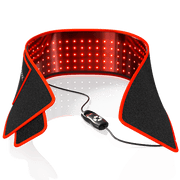
Wraps and belts have different placement characteristics from panels. Use them only as their instructions allow, including directions about fit, clothing or skin contact, session use, and movement.
Do not assume that a wearable must be tightened over a painful, swollen, recently injured, or postsurgical knee. Comfort and the manufacturer's instructions take priority.
Do Not Transfer Protocols Between Devices
Clinical photobiomodulation protocols may specify a particular laser type, output, dose, timing, and target depth. Those details are not interchangeable with consumer guidance on how to evaluate light-device distance, coverage, and timing.
For home use, follow the verified instructions for your exact device. Do not create a longer session, closer distance, or additional treatment angle merely because another device or clinical protocol uses different parameters.
Do Not Force a Painful Knee
Red light therapy positioning is not an exercise program and should not be used to test or increase knee range of motion.
Stop adjusting and choose a less demanding position if bending, straightening, rotating, or supporting your weight causes a meaningful increase in pain. This is especially important with an acute injury, marked stiffness, or limited motion.
After knee surgery or joint replacement, follow the surgeon's and rehabilitation team's movement restrictions. A light session is not a reason to bend farther, straighten harder, or depart from the rehabilitation plan. If you are unsure which positions are allowed, ask the clinician managing your recovery.
If you have a condition associated with photosensitivity or take a medication that may increase light sensitivity, check with a qualified clinician before using a light device.
When Self-Positioning Should Give Way to Clinical Care
Pause self-treatment and seek clinical guidance rather than trying to find a better knee angle if you have:
- Significant knee swelling, redness, or heat
- Knee pain after a high-impact trauma or fall
- Shooting pain, numbness, or weakness traveling down the leg
- No improvement after 6 weeks of consistent use
These signs do not identify the cause of the problem, but they are reasons not to rely on device positioning alone.
A Simple Knee-Positioning Check Before Each Session
- Target the surface: Decide whether you want to expose the front, inner side, outer side, or back of the knee.
- Choose the least painful stable angle: Use a relaxed straight or gently bent position based on comfort and access.
- Follow device instructions: Use the specified distance, fit, placement, and session guidance for your exact device.
- Reposition only for coverage: Change angles to face another surface---not to force the joint into more bend or extension.
For panel distance, wearable fit, and session-use details, consult the relevant BestQool setup or device-instructions resource. Persistent, severe, swollen, or postsurgical knee symptoms need clinician guidance rather than a more aggressive home setup.


