
For a target that includes both posterior shoulders and the upper-back/trapezius region, a broad-area stationary BestQool format is a plausible starting point for comparison. However, the available BestQool information does not verify that any named model can expose that entire area in one placement. The listing provides no illuminated treatment-area dimensions, treatment-distance guidance, or rear-body positioning instructions needed to confirm it. BestQool's available product listing should therefore be treated as a starting point for format screening---not proof of simultaneous shoulder-to-upper-back coverage.
Define the Coverage Test Before Comparing Formats

"Both shoulders and upper back" is a wider and more complex target than a single central-back area. A one-placement setup would need to reach:
- The left and right posterior shoulder areas
- The upper-back region between the shoulders
- The trapezius area, depending on how high the intended target extends
The relevant question is not whether a device is described as large, half-body, or full-body. It is whether its documented illuminated footprint at the intended treatment distance spans the width and height of the area you want to expose while you are positioned with your back toward the device.
The available BestQool material does not publish illuminated treatment-area measurements for BQ40, BQ60, BQ60Pro, BQ150, Pro100, Pro200, or Pro300. It also does not establish simultaneous coverage of both shoulders and the upper back for any individual model.
Before treating a device as a one-placement option, look for all three of these model-specific details:
- Illuminated width and height at a stated distance
- Recommended treatment distance
- Rear-facing placement or mounting guidance
Without those details, external device size, LED count, product imagery, and format labels are not enough to verify coverage.
Use Format Labels as a First Filter, Not Coverage Proof
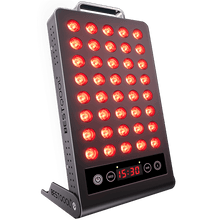
The available listing distinguishes several BestQool formats: portable BQ40, BQ60, clamp-type BQ60Pro, BQ150, half-body Pro100, and full-body Pro200 and Pro300 devices. Those labels can help narrow the comparison, but they do not establish an anatomical treatment footprint.
| BestQool Format or Model Label | What the Listing Documents | What It Does Not Establish for Both Shoulders and Upper Back |
|---|---|---|
| BQ40 portable | A portable format | Device dimensions, illuminated footprint, or one-placement rear-upper-body coverage |
| BQ60 | Listed device | Physical size, beam footprint, or coverage geometry |
| BQ60Pro clamp-type | A clamp-type device with a six-wavelength label | Clamp range, treatment-area dimensions, or simultaneous bilateral shoulder coverage |
| BQ150 | A four-wavelength device | Illuminated width, distance-specific footprint, or posterior shoulder coverage |
| Pro100 half-body | A half-body device with 100 dual-chip LEDs | Whether its illuminated area spans both shoulders and the upper back at once |
| Pro200 full-body | A full-body product label | Panel dimensions, beam spread, or rear-facing shoulder-to-upper-back positioning |
| Pro300 full-body | A four-wavelength full-body product label | The actual coverage width and height for this specific target area |
For this use case, half-body and full-body labels are useful screening clues because they point toward broader formats than portable or clamp-type listings. They are not a basis for concluding that one placement will cover the entire shoulder-to-shoulder upper-back region.
A broad stationary format may be the relevant category to investigate, but the coverage decision still depends on published geometry and setup details.
Plan the Rear-Facing Setup Before Assuming One Placement Works

Even a broader-format device cannot be assumed to cover the target area unless it can be placed behind the body at the documented distance and aligned with the upper back.
The available listing gives only limited setup information:
- BQ150 is described as usable with an included door hook for upper-body-focused treatment.
- BQ60Pro is identified as a clamp-type format.
- BestQool lists both a Universal Stand and an Adjustable Mobile Stand.
These references show that mounting and support options exist in the listing, but they do not provide the information needed to verify a rear-facing shoulder-and-upper-back setup. There is no documented compatibility table, height range, reach specification, clamp range, or positioning instruction showing that a particular device can sit behind a seated or standing user with both shoulders and the trapezius region inside its illuminated area.
For a rear-body setup, check the following before relying on one placement:
- Can the device be positioned directly behind the upper back?
- Is the panel or light source high enough to include the shoulder line rather than only the mid-back?
- Can you maintain the manufacturer's stated treatment distance?
- Does the documented footprint include the outer shoulder areas, not only the center of the back?
- Does the mounting method support the specific model you are comparing?
A door hook, stand listing, or clamp-type label describes a possible setup route. It does not independently demonstrate full posterior-shoulder coverage.
Keep Wavelength, Timer, and LED Details Separate From Coverage
Published specification differences can matter when comparing models, but they should not be confused with physical coverage evidence.
| Published Detail | Models Identified in the Available Material | Coverage Limitation |
|---|---|---|
| Four-wavelength label | BQ150 and Pro300 | Wavelength count does not show illuminated width or beam footprint |
| Six-wavelength label | BQ60Pro | Does not establish a larger treatment area or wider spread |
| 100 dual-chip LEDs | Pro100 | LED count does not show shoulder-to-shoulder coverage |
| 15-to-50-minute session-length range | Pro100 only | Not tied to upper-back coverage and not documented as a range for the other listed models |
The available information also does not provide irradiance figures or treatment-distance guidance for the listed models. That prevents a meaningful output-at-distance comparison and makes it impossible to calculate or verify a treatment footprint from the material provided.
Similarly, the Pro100 discussion identifies 660 nm red light and 850 nm near-infrared light, but it does not provide a full spectral specification, treatment distance, or coverage protocol for the shoulder-and-upper-back target.
For this specific selection question, coverage documentation is the gatekeeper. Wavelength count, LED count, and session-length information are secondary comparison details.
When Repositioning is the More Defensible Plan
Plan for more than one placement when the available documentation leaves any part of the target area unverified. Common triggers include:
- The published footprint does not clearly include both outer shoulders.
- The device can be aligned with the upper back but not the shoulder line.
- The target includes a high trapezius area that is not shown in the placement guidance.
- The necessary treatment distance is unknown.
- The mounting arrangement cannot be verified for the model and body position.
- The device format is localized, portable, or clamp-mounted without documented broad-area coverage.
The available BestQool listing does not document an identifiable wearable wrap. A reference to a "red light pad" without a model name, dimensions, fastening method, placement instructions, or coverage specification cannot establish that a wearable format can continuously reach both shoulders and the upper back.
BQ150 units are also described as attachable to additional BQ150 units to create a greater concentration of light. That statement does not specify the resulting width, configuration, or whether linked units are intended to treat both shoulders and the upper back simultaneously. It should not be treated as proof of broader coverage.
Follow a Documentation-First Decision Path
Define the exact shoulder-to-shoulder upper-back area you want to expose. Then compare it only with a BestQool format that has documented treatment-area dimensions, distance guidance, and a rear-facing positioning method that matches your setup.
If those details show gaps at the outer shoulders, upper trapezius, or central upper back, plan separate placements rather than assuming that a half-body, full-body, door-hung, or multi-wavelength label fills the gap. Review the model-specific specification page and manual, and contact BestQool support if the published information does not resolve the fit, mounting, or coverage question.


 Small
Small

 Moderate

 Moderate

 Moderate

 Full
Full

