
Yes---different red and near-infrared devices can sometimes fit into the same routine. But using separate devices is not automatically safe or useful when they illuminate the same area.
The practical rule is to plan by treatment area and total exposure, not by wavelength labels alone. If two devices overlap on the same skin, treat that as potentially additive exposure. When you cannot verify the combined coverage and operating parameters, keeping the treatment fields separate is the more controllable approach.
A Multi-Wavelength Device is Not the Same as Stacking Devices

Many red and near-infrared photobiomodulation devices are designed to emit more than one wavelength within one treatment field. Common combinations include red wavelengths around 630--660 nm and near-infrared wavelengths around 810--850 nm. That design can be used safely when the device is operated according to its instructions.
That does not mean any two separate devices can be layered together on the same area without changing the plan.
| Purpose-Built Multi-Wavelength Device | Two Separate Devices |
|---|---|
| Output, timing, and wavelength mix are designed as one system. | Each device has its own output, coverage pattern, distance, and timing instructions. |
| The treatment protocol is based on that device's combined emission. | Same-area exposure may increase, but a validated combined protocol may not exist. |
| One device manual governs use. | Instructions may differ, and the more conservative applicable guidance should take priority. |
Research on mixed red and near-infrared light does not establish that adding another device, another wavelength, or more session time will improve an outcome. Existing protocols are generally tied to a particular device's wavelengths, power density, and treatment time.
Plan the Treatment Area Before Choosing the Device Combination

Start by mapping where each device will actually deliver light---not simply where you intend to treat.
For example, a facial mask and a body panel may be easier to coordinate when the panel is aimed at the torso, legs, or another clearly separate region. A mask plus a panel directed toward the same face is a different setup: the fields may overlap even if the devices use different wavelength mixes.
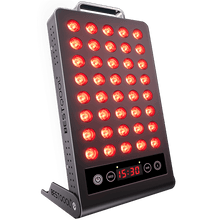
A panel's listed wavelengths only confirm that those wavelengths are present. They do not show that one wavelength can be assigned to the face while another is assigned to the neck, or that individual areas receive independently selectable output. Verify the exact device manual, coverage guidance, LED layout, and controls before assuming there are separate physical zones. For more context, see how to interpret a panel's wavelength mix and treatment areas.
How Device Format Changes Planning
| Device Format | Coverage and Positioning | Overlap Considerations | Practical Planning Point |
|---|---|---|---|
| Panel | Broad, non-contact field at a specified distance | Can reach adjacent areas beyond the intended target | Define a treatment zone with the device's stated distance and coverage guidance. |
| Mask | Fixed facial coverage, usually close to or in contact with the face | Likely to overlap with a panel aimed toward the face | Treat a mask-plus-face-panel setup as same-area exposure unless the panel is directed elsewhere. |
| Belt or Wrap | Contact or near-contact coverage around a localized area | Overlap may occur if a panel or handheld is also used on that area | Map the wrapped area before adding another source. |
| Handheld LED Device | Small, movable treatment field | Easy to place over an area already covered by a panel or wrap | Track each spot rather than relying on memory. |
| Laser Device | Often localized and directional | Beam edges and intensity can be difficult to define precisely | Follow the device instructions closely; do not assume a visually small beam has a simple, uniform boundary. |
Coverage is not always a clean rectangle or circle. Beam geometry and intensity distribution can make exact overlap difficult to calculate, particularly with laser-style beams. That uncertainty is a reason to avoid casual stacking.
Treat Same-Area Overlap as Potentially Additive

When two devices shine on the same skin area, the exposure may add. Different wavelengths do not cancel one another out, and using one red device plus one near-infrared device does not automatically make each session separate.
Exposure depends on more than wavelength, including:
- Irradiance at the actual treatment distance
- Session duration
- The device's illuminated area and intensity distribution
- Contact versus non-contact positioning
- Beam angle and edge spill
- Pulsing or duty cycle, where applicable
- Heat and comfort during use
Radiant exposure is often estimated by combining irradiance and time. In a multi-device setup, however, that estimate is only as reliable as the measurements behind it. Consumer specifications may be measured differently, may apply at a different distance, or may not show the output distribution across the full treatment area.
There is no direct, evidence-based consumer rule for calculating cumulative exposure or setting a maximum combined dose when fields from separate devices overlap in one session. That is why a device's individual instructions should not be treated as permission to add a second source over the same area.
A Simple Decision Path
-
Do the devices illuminate separate areas? If yes, they may be easier to coordinate, provided each is used as directed.
-
Do the fields overlap or might they overlap? Treat the setup as combined exposure rather than two independent sessions.
-
Do you have verified, compatible guidance for the exact setup? If not, avoid intentional same-area stacking or use only a modification expressly allowed in the device instructions.
-
Are you relying on wavelength names alone? Reassess. A label such as 630 nm, 660 nm, 810 nm, 830 nm, or 850 nm does not establish the delivered dose, coverage, or suitability of a combined routine.
Avoid trying to isolate individual wavelengths from a mixed-wavelength panel by covering LEDs, improvising masks or shields, or changing the device position unless the manufacturer specifically permits and explains that method.
Simultaneous and Sequential Use Solve Different Problems
Using devices simultaneously can shorten a routine when their treatment fields are clearly separate and easy to control. For instance, a facial mask may be used while a panel is positioned for a non-overlapping body region.
Sequential use can make tracking simpler. You can complete one clearly defined area, reposition, then treat the next area without having to judge where two light fields meet. It does not, however, make same-area exposure disappear. If both sessions cover the same location, the total exposure still needs consideration.
Choose timing based on control rather than assumptions about biological superiority:
- Simultaneous use can be practical for separate areas, but may increase the chance of accidental overlap, excess heat, or positioning errors.
- Sequential use may be easier for area-by-area tracking, especially with panels, handhelds, and wraps.
- One-device use may be the clearest option when coverage boundaries, output information, or instructions are uncertain.
If two manuals conflict on distance, session duration, eye protection, frequency, or contraindications, follow the more conservative applicable instruction.
Safety Considerations Before Combining Devices
Near-infrared light is not visible in the same way as red light, so you cannot rely on brightness to judge exposure. Follow each device's eye-safety instructions, including any directions about goggles, closed eyes, positioning, or avoiding direct viewing.
Stop and reassess if heat or discomfort becomes difficult to tolerate. Do not assume that a device feels mild simply because another device is also comfortable on its own.
Seek guidance from a qualified clinician before combining devices if you have personal factors that may affect use, including:
- Photosensitizing medication use
- Eye conditions or concerns about eye exposure
- Pregnancy
- Active cancer treatment or related medical concerns
- Wound-care needs
- Other medical conditions for which light exposure may need individualized advice
Pre-Combination Checklist
Before adding a second device to your routine:
- Identify the exact skin areas each device will cover.
- Read each device's verified instructions for distance, duration, frequency, eyewear, and contraindications.
- Confirm whether treatment fields are truly separate rather than merely aimed in different directions.
- Estimate exposure only when reliable output information applies at your intended distance and positioning.
- Avoid unplanned same-area overlap.
- Use eye protection and positioning precautions exactly as instructed.
- Monitor heat and comfort throughout the session.
- Consult a qualified clinician when medications, eye health, pregnancy, cancer-related care, wound care, or other medical factors are relevant.
A simpler, non-overlapping setup is often easier to plan and follow than adding more light to the same area.


 Small
Small

 Moderate

 Moderate

 Moderate

 Full
Full

