
Do not assume closed eyelids make direct red or near-infrared light exposure safe. Unless the exact device's instructions explicitly allow treatment over the eyelids and explain the required eye-protection protocol, avoid placing a mask, panel, wand, or laser directly over closed eyes.
That precaution matters because closed eyelids do not fully block light from entering the eye, particularly when a treatment includes near-infrared light. Red-light exposure that is overly intense or longer than recommended may harm the retina. AdventHealth's eye-safety guidance also notes that looking directly at red light can temporarily blur or dim vision.

There is a second reason to be cautious: red light is not an established solution for every kind of dark circle. Under-eye darkness can reflect pigment, visible blood vessels beneath thin skin, or shadows from tear-trough hollowing and skin laxity. A device that might be used for general facial skin goals is not necessarily a good match for the cause of your dark circles.
Closed eyelids are not the same as eye protection
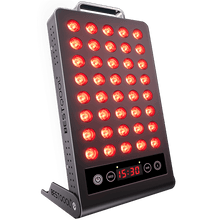
"Red light therapy" describes a broad category, not one uniform exposure. A facial LED mask, a panel positioned near the face, a handheld wand, and a laser can differ in output, distance, exposure time, beam pattern, and whether they emit red light alone or combine it with near-infrared or blue light.
Those differences matter more than the device category or the fact that your eyes are shut.
A sensible default is:
| Proposed use | Practical approach |
|---|---|
| Light used on facial areas away from the eyelids | Follow the device's intended-use instructions, distance guidance, session length, and eye-protection directions. |
| Light used near the orbital bone or under-eye skin | Use only if the instructions address that area. Keep the device out of direct eyelid placement unless the labeling specifically permits it. |
| Light placed directly over closed eyelids | Avoid unless the exact instructions explicitly authorize this use and specify how to protect the eyes. |
| Any attempt to look into LEDs or a beam | Do not do this. |
The concern is not that every cosmetic facial device will cause injury. Rather, there is no universal eyelid-use setting that can be safely applied across masks, panels, wands, and lasers.
A pediatric case report documented retinal structural and visual-function damage after repeated direct ocular exposure to a low-level red-light device used for myopia control. The patient improved after the exposure stopped and medical treatment was provided. This was not a cosmetic-mask study and cannot predict the risk from a consumer facial device used around closed eyelids. It does, however, show why repeated direct irradiation of the eye should not be treated casually. Read the case report.

Retinal photoinjury can depend on irradiation power, exposure duration, and photothermal, mechanical, and photochemical effects. That is why a setting used by someone else---or advice based only on "red light"---is not an adequate safety standard for eyelid treatment.
How to handle a facial device near your eyes
If you are considering red or near-infrared light around the upper cheeks, brow area, or outer eye area, start with the manual rather than an online routine.
Check these points before use
-
Intended treatment area Look for language about the face, eye area, eyelids, or periocular use. "For facial use" does not automatically mean "for use over the eyes."
-
Eye-protection instructions Follow the manufacturer's directions exactly. In professional high-powered treatments, protective goggles are described as essential. That does not establish which home devices require goggles or whether a mask's eye cutouts provide equivalent protection.
-
Distance and treatment time Use the listed distance and session duration. Do not move a panel closer, extend a session, or hold a wand over the eyelid in an attempt to target dark circles more aggressively.
-
Light modes Check whether the device combines red or near-infrared light with blue light. Blue light in the 400--500 nm range can injure eyes and impair retinal function through several injury mechanisms, making device-specific eye guidance especially important. A dermatology review of photobiomodulation and light exposure also notes that protocols are not standardized enough to create universal settings for wavelength, dose, frequency, or treatment duration.

- Your personal eye history If you have an eye condition, recent eye treatment or surgery, photosensitivity concerns, medication-related light sensitivity, or uncertainty about using light near your eyes, ask an ophthalmologist or qualified clinician before proceeding.
At-home masks and panels may be lower intensity than professional devices, but "lower intensity" is not the same as proven safe for direct eyelid exposure. Nor should you assume that closed eyes, eye cutouts, or a red-light-only label replace the precautions in the device instructions.
Will red light help your particular dark circles?
Dark circles are an appearance, not one diagnosis. The most useful first question is not "Which device should I use?" but "What is creating the darkness?"
| Likely contributor | How it may appear | Why red light may not address it |
|---|---|---|
| Pigment | Brown or gray-brown discoloration | Pigment-related darkness has a different mechanism from shadows or visible vessels. |
| Vascular visibility or thin lower-eyelid skin | Bluish, purplish, or translucent appearance | Light does not necessarily change the thin skin or vascular component creating the appearance. |
| Tear-trough hollowing or skin-laxity shadowing | Darkness that shifts with lighting, facial angle, or volume loss | A structural shadow is not simply surface discoloration. |
| Mixed causes | More than one pattern at once | A single cosmetic approach may not address every contributor. |
The evidence reviewed for periorbital hyperpigmentation does not establish red-light therapy as a standard treatment. One narrative review included 18 studies involving 619 participants and evaluated treatments such as chemical peels, platelet-rich plasma, lasers, carboxytherapy, microneedle fractional radiofrequency, and autologous fat; red-light or LED photobiomodulation was not identified among the treatment categories in that review. That absence does not prove that no red-light studies exist. It does mean the evidence base should not be presented as showing that red light reliably improves under-eye pigmentation, puffiness, visible vessels, thin skin, or hollowing. Review of periorbital-hyperpigmentation treatments.

Structural dark circles deserve particular caution before investing in eye-area light exposure. If the main issue is a tear trough or shadowing from volume loss, a treatment aimed only at surface appearance may not address what is producing the shadow.
When not to self-treat dark circles
Dark circles alone do not diagnose a medical condition. Still, persistent or unusual under-eye changes can have contributors beyond cosmetics, including chronic dermatitis-related post-inflammatory pigmentation, anemia, thyroid dysfunction, and nutritional deficiencies.
Arrange a clinical or eye-area assessment rather than continuing cosmetic self-treatment if you notice:
- marked difference between one eyelid and the other;
- a persistent, localized change that does not respond to usual care;
- focal eyelash loss; or
- loss or distortion of normal eyelid anatomy.
These findings do not diagnose cancer or another condition on their own. They are reasons to have the eyelid examined, because some non-cosmetic conditions can mimic ordinary periorbital changes.
A safer decision path
- Identify the likely cause of the dark circles. Consider whether the appearance is mostly pigment, vascular visibility, thin skin, or structural shadowing.
- Read the exact device documentation. Confirm its intended treatment area, contraindications, distance, session length, and eye-protection instructions.
- Avoid direct eyelid exposure when the labeling is absent or unclear. Closed eyes are not a substitute for explicit instructions.
- Seek eye or medical evaluation when risk factors or warning signs are present. That is the safer next step when the cause is uncertain or the eyelid appearance is atypical.


 Small
Small

 Moderate

 Moderate

 Moderate

 Full
Full

