
Not automatically. You may be able to fit facial red light therapy into a getting-ready routine, but a bathroom is not automatically a suitable place for a powered device. Steam, condensation, splashes, wet hands, and damp surfaces can still be concerns even when you are not standing beside the shower.
The practical rule is simple: use your device only in the environment and setup allowed by its instructions. If the room, device, hands, or power setup are damp, wait until everything is dry or move the session to a dry room. A battery-powered mask is not automatically safe around steam or water just because it is cordless.
Make the Bathroom a Go-or-No-Go Decision

Before starting a facial session, pause for a quick environment check. A bathroom may work only if your exact device is intended for that setting and the area is dry and stable.
Use the bathroom only when all of these are true:
- Your device documentation permits use in the current environment.
- Your hands are dry before touching controls, charging ports, plugs, or cords.
- The sink area, countertop, floor, and nearby surfaces are dry.
- There is no active shower steam, condensation, or splashing water nearby.
- Any cord, adapter, or power setup is dry and positioned away from water.
- A power strip is not sitting on the bathroom floor.
Being several feet from the shower does not automatically make a dry-location device appropriate for bathroom use. Steam and condensation can affect the space after the water is turned off, while wet hands and damp surfaces can complicate setup. For a fuller explanation of the environmental factors to check, see bathroom safety considerations for red light therapy devices.
If you cannot confidently answer "yes" to the checklist, treat that as a reason to postpone the session or relocate it---not as a reason to improvise.
Build Your Routine Around a Dry Window

For many people getting ready in the morning or evening, the easiest approach is to separate the light session from the wettest part of the routine.
A dry-window routine might look like this:
- Shower, wash up, or complete other water-based grooming.
- Let the room air out and dry yourself fully.
- Check that the counter, floor, device exterior, and power setup are dry.
- Use the device only if its instructions allow the setting and conditions.
- Continue with the rest of your routine.
That sequence is not a universal treatment protocol for cleansing, skincare, shaving, makeup, or sunscreen. Those details depend on the instructions for the device and any topical products you use. The key bathroom decision is environmental: do not make a damp, steamy room the default location simply because it is convenient.
For example, if you have just finished a hot shower and the mirror is fogged, there is moisture on the counter, or your hands are still damp, the better choice is to wait, ventilate and dry the area, or do the session elsewhere. If you want to plan the shower portion of your routine separately, review whether to use red light therapy before or after your morning shower.
Watch for Post-Shower Warning Signs

After a shower, the room may look usable before it is actually dry enough for an ordinary electrical device. Treat these as stop signs:
- A fogged mirror or lingering steam
- Wet or damp hands
- Water on the counter, floor, stand, or nearby surfaces
- A damp cord, plug, adapter, or charging area
- Moisture on the exterior controls or housing
- A setup that would place the device or its power components near splashes
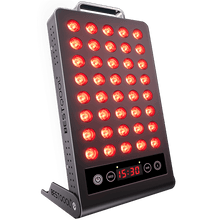
For panels, visible fogging, damp cords, or moisture on the panel exterior are reasons to move the device to a dry space rather than operate or store it in that bathroom. The panel-specific checklist in this bathroom storage safety guide advises against running or storing a panel in a fogged bathroom and recommends moving a damp cord to a dry room.
The same general principle applies to a facial mask: cordless operation does not, by itself, confirm that the mask, battery compartment, controls, or charging port can handle steam or water exposure. Check the manufacturer's instructions rather than assuming that the lack of a wall cord removes the moisture concern.
If a Panel Gets Damp, Do Not Try to Dry It by Using It
If a light panel or its setup becomes damp, stop rather than trying to keep the routine moving.
For a panel, do not:
- Run it "to dry it out."
- Open its housing to inspect the inside.
- Continue using it in a damp room.
- Leave it stored in a humid bathroom.
Instead, limit your response to what the device instructions permit: inspect the exterior, dry the exterior as directed, relocate the panel to a dry environment, and follow the manufacturer's care or service guidance if needed.
This point is specifically about panels. Do not extend panel-care steps to a mask or other device unless that model's documentation gives the same instructions.
Keep the Session Separate From Water-Based Multitasking
A getting-ready routine often invites multitasking: checking the mirror, handling toiletries, adjusting cords, reaching for products, or moving between the sink and shower. In a damp bathroom, those habits can undermine a careful setup.
Rather than trying to make the session fit every step of grooming, create a short, uninterrupted dry interval. Set up the device only after you have finished water-based tasks and have dried your hands and surrounding surfaces. Keep the device and its power components away from the sink, shower, and wet floor.
If you are unsure whether skincare, makeup, or other products belong before or after your session, do not rely on a generic bathroom routine. Check both your device instructions and your product directions. You can also review how skincare products may fit around facial red light therapy.
Choose the Time You Can Follow Instructions Fully
The best time for facial red light therapy is not necessarily the moment you are already in the bathroom. It is the point in your morning or evening when you can follow your device instructions fully: in a dry setting, with dry hands, an appropriate power arrangement, and no need to rush through a wet or distracted setup.
If that window is before the shower, after the bathroom has dried, or in another room entirely, that is the more practical routine. Check your exact device documentation for permitted environments, water-exposure limits, charging and power guidance, and care instructions rather than trying to squeeze a session into a wet, distracted, makeup-on bathroom moment.


 Small
Small

 Moderate

 Moderate

 Moderate

 Full
Full

