
For ordinary hamstring fatigue or delayed soreness after sprinting, jumps, or change-of-direction work, red or near-infrared light therapy can be an optional recovery add-on. It is not a proven hamstring-specific treatment, and it should not be used to self-manage symptoms that may indicate a strain.
The best practical approach is simple: choose a post-workout, later-evening, or recovery-day slot that fits your routine; use only the distance, coverage, and session guidance supplied for your device; and keep your expectations modest.
First, Separate Routine Soreness From a Possible Strain

Light therapy may be reasonable when your hamstrings feel generally tired, tight, or sore after a demanding training session and your normal movement is unchanged.
Do not treat light exposure as a solution for a possible pulled hamstring. Stop self-managing and seek clinical assessment if pain was sudden or sharp, you felt a pop, walking or running mechanics are impaired, bruising develops, weakness is substantial, you notice a palpable defect, or symptoms worsen rather than settle.
The evidence base is broader than the specific scenario of post-sprint hamstring recovery. A systematic review of photobiomodulation in healthy people included 39 randomized trials involving 861 participants. Its pooled analyses found some effects favoring treatment for outcomes such as time to exhaustion, repetitions, isometric peak torque, and blood lactate—but evidence quality ranged from very low to moderate, and the findings do not establish a protocol for hamstrings after sprinting or plyometrics. The systematic review and meta-analysis also included both laser and LED approaches, without showing that either is superior for hamstring recovery.
In short, consider light therapy for ordinary post-training fatigue, not as a way to diagnose, heal, or accelerate return from a hamstring injury.
Choose a Timing Slot You Can Use Consistently
There is no established “best” moment to use photobiomodulation around exercise. Available evidence has not determined whether application before, during, or after training is superior. That means there is no reason to delay food, rest, your usual cooldown, or other recovery habits in pursuit of a narrow post-workout window.
Immediately After Training
If your hamstrings simply feel worked after sprint repeats or plyometrics, a session after training can be a convenient option. Use it as part of winding down—not as justification to add more high-speed work or ignore unusual pain.
Later That Day
For an evening track, field-sport, or gym session, using the device later at home may be easier than doing so immediately afterward. This can suit athletes who prefer to finish their normal post-training routine first.
On a Recovery or Rest Day
A rest-day session is also a reasonable scheduling choice for routine residual soreness. Keep the same principle: follow the device-specific guidance rather than trying to compensate for a hard session with longer or more frequent exposure.
A randomized, placebo-controlled trial has examined low-level laser therapy before or after plyometric exercise, but the available record does not provide results, participant details, or light parameters that would support a practical protocol or timing recommendation. The indexed plyometric trial is therefore not a basis for treating pre-workout use as a performance strategy.
Set up the Device Without Guessing the Dose

Research protocols vary substantially. The exercise review included wavelengths from 655 to 950 nm and listed broad total-energy ranges, including 60–300 J for large muscle groups. Those figures are not a home-treatment prescription for the hamstrings.
Energy alone does not tell you the irradiance at your treatment distance, the area covered, the number of treatment sites, or the session duration. Do not build a routine from a wavelength number or joule figure alone.
Instead, use this setup check:
- Verify the device information. Use a device with clear instructions for output, intended treatment distance, coverage area, and session guidance.
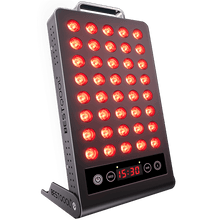
- Cover the relevant area. Position the panel or applicator so its intended coverage reaches the back-of-thigh hamstring area you want to address. Maintain the manufacturer-specified distance rather than moving closer to improvise a stronger dose. A guide to positioning a panel for muscle recovery can help with consistency.
- Follow the stated session instructions. Do not extend time, change distance, or stack sessions simply because the hamstrings feel especially sore.
Use the device in accordance with its safety guidance, including its instructions for eye exposure and any use limitations that apply to you.
Keep Light Therapy in Its Proper Place
A light session is optional. It does not replace sensible training adjustments, sleep, nutrition, or a progressive rehabilitation plan when an injury is suspected.
For athletes and coaches, the useful question is not, “Did the light make me ready to sprint tomorrow?” Instead, track whether normal movement, tolerance for training, and symptoms are moving in the right direction. If they are not, increasing light exposure is not the answer.
Recover, Reassess, Progress

If your symptoms fit normal post-training soreness, use a cautious, device-specific light session whenever it fits your post-workout or recovery-day schedule, alongside your usual sleep, nutrition, and training adjustments.
If pain was sudden, function is impaired, bruising or weakness develops, or progress stalls, shift from recovery self-care to clinical evaluation—not more light exposure or harder training.


 Small
Small

 Moderate

 Moderate

 Moderate

 Full
Full

