

For skin rejuvenation, home-use red light therapy is usually aimed at lower to moderate delivered doses, while pain relief protocols often use a somewhat broader range depending on the target tissue and depth. The key variable is the delivered dose in J/cm² at the skin, not the session length printed on the device page.
If your face is the target, the question is less “How long should I sit there?” and more “What dose actually reaches the tissue?” In practice, that difference can be large because distance, irradiance, and device area all change the delivered J/cm². This article breaks down the dose ranges, shows how to estimate home-use exposure, and gives practical setup rules for face, joints, and larger body areas.
What J/cm² Means And Why It Matters More Than Time

Dose Is Energy Per Area, Not Just Minutes
J/cm² means joules of light delivered to one square centimeter of tissue. It is the most useful way to compare protocols because two devices can both run for 10 minutes and still deliver very different skin-level exposure. In red light therapy, the device’s power, treatment distance, beam spread, and treatment area all affect the final dose.
A simple way to think about it is: higher irradiance at the skin means you reach a target dose faster, while lower irradiance means you need a longer session to deliver the same J/cm². That is why a product page’s timer setting is only part of the story; the actual exposure depends on the full setup.
Device-Page Claims Versus Skin-Level Exposure
Many home devices advertise session time, panel power, or “recommended use” without clearly stating the irradiance at the skin. That matters because skin-level exposure is what determines whether you are closer to a rejuvenation-style dose or a pain-relief style dose. A session can feel “long enough” and still underdose the skin if the panel is too far away or too weak.
A practical rule is to treat any home device claim as a starting point, then adjust for distance and coverage area. If the panel is farther away, the dose falls quickly; if the area is larger, total delivered energy may be spread over more tissue. That is why the same routine can be reasonable for the face but inadequate for a knee, shoulder, or lower back.
Typical J/cm² Ranges: Skin Rejuvenation Versus Pain Relief

Skin Rejuvenation: Lower To Moderate Doses
For skin-focused use, especially face and cosmetic rejuvenation, the practical target is usually a lower to moderate delivered dose rather than an aggressive one. Home routines commonly cluster around modest exposures because skin responds to photobiomodulation in a biphasic way: too little may do nothing, but too much can stop adding benefit.
A conservative home-use lens is to think in terms of lower-to-moderate J/cm² per session for facial skin, with enough exposure to be meaningful but not so much that you are chasing very high energy totals. For skin rejuvenation, consistency matters more than trying to “blast” the skin with long sessions.
Pain Relief: Often Different By Tissue And Depth
Pain protocols often use a different dose strategy because the goal is not cosmetic skin change but modulation of discomfort in superficial or deeper tissues. That means the practical range can shift depending on whether you are treating a superficial area like the jawline or a deeper, more loaded area like a knee or shoulder.
A published review on photobiomodulation for pain control highlights that protocol details, not just wavelength, drive outcomes. In other words, pain relief protocols are highly dose-dependent and should be matched to the condition being targeted.
Practical Comparison Table
Use Case |
Common Dose Strategy |
Main Goal |
Practical Note |
Skin rejuvenation |
Lower to moderate J/cm² |
Texture, tone, cosmetic support |
Usually favors shorter, repeatable sessions |
Pain relief |
Moderate and condition-specific J/cm² |
Symptom modulation |
Often depends on target tissue depth and area |
Larger body area |
Same dose may need more time |
Coverage and uniformity |
Distance and panel size matter more |
Small facial area |
Easier to dose precisely |
Local skin exposure |
Lower total session time is often enough |
How Distance, Power, And Time Change The Real Dose
The Dose You Get Depends On Irradiance
The core relationship is simple: dose = irradiance × time. If irradiance is measured at the skin in mW/cm², you can estimate delivered J/cm² by multiplying by session time in seconds and dividing by 1,000. For example, if a device delivers 50 mW/cm² at the skin, a 10-minute session gives about 30 J/cm². If the same device is moved farther away and irradiance drops to 25 mW/cm², the same 10 minutes gives only about 15 J/cm².
That is why “10 minutes” is not a universal protocol. The same session length can be a low-dose facial routine on one panel and a much higher exposure on another.
Device Features That Change Your Actual Exposure
The most important home-device variables are irradiance, treatment distance, beam coverage, and whether the panel output is measured at the skin or only at the device face. A published guide on light-based device selection emphasizes that measurable specs, settings, units, and operating conditions should be kept explicit because they change interpretation.
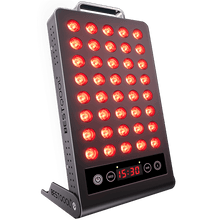
If you want a more reliable routine, look for: - stated irradiance at a known distance - clear treatment area coverage - timer or dose guidance tied to output, not just minutes - a setup that can be repeated at the same distance each session
Practical Home-Use Routines By Body Area
Face And Skin Rejuvenation
For facial use, the best home setup is usually a short, repeatable routine with a fixed distance and consistent frequency. Because the face is a smaller target, a panel can deliver a useful dose without long sessions. A conservative approach is to keep sessions on the shorter side, track the actual distance, and avoid moving the device around mid-session unless the instructions call for it.
If you are using a mask or panel for cosmetic skin goals, think in terms of steady repetition over weeks rather than chasing a high dose in one sitting. Skin-oriented protocols generally benefit from consistency and moderate exposure more than from very long sessions.
Joints And Pain-Prone Areas
For pain relief, the body area matters. A knee, shoulder, lower back, or jaw may need a different practical setup than the face because tissue depth and coverage are different. Pain-focused protocols are more likely to require a careful balance between dose, frequency, and location.
A useful approach is to start with the lowest reasonable session dose that still fits the target area, then adjust based on response over several sessions. If the area is larger, you may need either a longer session, a closer distance, or multiple placements to maintain coverage.
Larger Body Areas
Large areas are where people most often underestimate the challenge. A bigger treatment zone means more total light has to be delivered, and the dose can become uneven if the panel is too small or too far away. In those cases, the effective J/cm² at the edges may be much lower than what the center receives.
For larger body areas, session planning often works better when you divide the area into zones rather than trying to cover everything at once. That approach helps keep the delivered exposure more even and makes it easier to match your actual target dose.
What The Evidence Suggests About Ranges And Boundaries
The Dose Response Is Biphasic
Photobiomodulation does not behave like a simple “more is better” intervention. The literature consistently points to a biphasic response, meaning a dose that is too low may fail to do much, while a dose that is too high may stop adding benefit.
That is why a practical home plan should stay within a reasonable session range instead of assuming that longer treatment automatically means better results. For skin rejuvenation, moderate exposure is usually the safer starting point. For pain relief, the best range depends on the body area and symptom target.
Stop-Or-Adjust Triggers
If you do not know the skin-level irradiance, session length alone is not enough to judge dose. If the device must be moved unusually far away to fit the area, the delivered J/cm² may drop below a useful level. If the device is very close and the exposure feels excessive, it is reasonable to shorten the session or increase spacing, especially for sensitive skin.
A separate practical boundary is expectation management: red light therapy is a dose-sensitive home tool, not a guarantee. It may support cosmetic skin goals or symptom relief, but it should not be treated as a replacement for medical evaluation when pain is persistent, severe, or worsening.
How To Choose A Device For Your Goal
Skin Rejuvenation Priorities
For skin-focused use, look for: - clear irradiance at a stated distance - enough coverage for the face or targeted area - repeatable session timing - a dosing guide that fits moderate exposure rather than very long sessions
If the product only talks about “minutes per day” without output data, it is harder to judge whether you are actually in a useful J/cm² range.
Pain Relief Priorities
For pain relief, look for: - documented output at the skin - body-area-specific guidance - ability to target joints or sore regions consistently - flexible placement so you can keep the same distance and angle session to session
Pain protocols are more likely to vary by area than cosmetic routines, so device fit matters. A small face-focused panel may be fine for skin but inefficient for a knee or shoulder.
Quick Comparison Of Device Features
Feature |
Better For Skin Rejuvenation |
Better For Pain Relief |
Small target area |
Yes |
Sometimes |
Large coverage panel |
Helpful |
Often better |
Fixed short sessions |
Yes |
Can work |
Adjustable positioning |
Helpful |
Very helpful |
Output specs at skin |
Essential |
Essential |
Action Checklist For Conservative Home Use
- Identify your goal first: skin rejuvenation or pain relief.
- Find the device’s irradiance at the treatment distance you will actually use.
- Estimate the delivered J/cm² instead of relying on minutes alone.
- Keep distance, angle, and session length consistent from session to session.
- Use lower-to-moderate exposure for skin goals and area-specific planning for pain goals.
- Reassess if the dose is hard to standardize, the area is too large for the panel, or the skin feels irritated.
Key Takeaways
For skin rejuvenation, the practical target is usually a lower to moderate J/cm² routine with consistent repetition rather than long, aggressive sessions. For pain relief, the dose range is more variable and depends on the body area, tissue depth, and the symptom you are trying to address. The most important home-use variable is not session length by itself, but the delivered dose at the skin, which changes with distance, power, and coverage.
FAQ
Q: What J/cm² Range Is Commonly Used for Skin Rejuvenation Versus Pain Relief?
A: Skin rejuvenation usually sits in a lower-to-moderate delivered-dose range, while pain relief often uses a broader and more tissue-specific range. The exact target depends on the device output at the skin, the treatment area, and how deeply the target tissue sits.
Q: Why Does Distance Matter So Much?
A: Distance changes irradiance, and irradiance determines how much J/cm² you actually deliver in a session. Two routines that both last 10 minutes can produce very different exposures if one is done close to the panel and the other is done farther away.
Q: How Should Home Users Set up A Face or Joint Session?
A: Keep the target area, distance, and angle consistent, then choose a session length that fits a moderate, repeatable dose rather than the longest possible exposure. For face routines, shorter and more consistent sessions are often easier to standardize; for joints, make sure the panel coverage and distance still deliver a meaningful dose to the full area.


 Small
Small

 Moderate

 Moderate

 Moderate

 Full
Full

