
No. One fixed wavelength is not a reliable all-day setting for both morning alertness and a sleep-protective evening. The practical approach is to use two different light signals: brighter, more circadian-active light early in the day, followed by much dimmer, lower-melanopic light as bedtime approaches.
The trade-off is built into the biology. The circadian system is particularly sensitive to blue--cyan light in roughly the 460--495 nm range, near melanopsin's peak sensitivity around 480 nm. That can make this part of the spectrum useful in a morning-oriented lighting strategy---but the same blue-enriched light is more likely to suppress melatonin and delay the body clock when used in the evening. A consensus on light, circadian rhythms, and health supports changing both intensity and blue content across the day rather than relying on one constant setting.
Wavelength matters, but it is not the whole decision. What reaches your eyes, when it reaches them, how bright it is, how long exposure lasts, your prior light exposure, and individual sensitivity all affect the response.

Think in Two Light Goals
| Time of day | Primary goal | Practical light characteristics | What to limit |
|---|---|---|---|
| Morning and daytime | Support alertness and a daytime circadian signal | Brighter light at the eyes; daylight, broad-spectrum white light, or an appropriate light-therapy setup | Remaining in dim indoor light when a stronger daytime signal is the goal |
| Evening | Reduce circadian stimulation before sleep | Dim, blue-depleted, warm/amber/red-leaning ambient light when practical | Bright, blue-enriched lighting close to bedtime |
| Sleep environment | Keep light exposure very low | Minimal light reaching the eyes | Bright room lighting and unnecessary nighttime illumination |
The useful concept is melanopic exposure at the eye. Ordinary lux describes light for vision, but it does not fully describe the spectrum or its likely circadian effect. Two lamps can appear similarly bright---or have the same color temperature---while delivering meaningfully different melanopic stimulation.
Morning: Prioritize Timing and Light at the Eye
For a morning routine, the first question is not "Do I need blue light?" It is: Can I get sufficiently bright, appropriately timed light to my eyes after waking?
Outdoor daylight is often the simplest reference point for a strong daytime signal when weather, schedule, and eye comfort allow. If that is impractical, a purpose-designed light box or a brighter indoor setup may be worth considering.
Blue-enriched morning light may have a role, but it is not required for everyone. In one small study of 18 young participants, blue-enriched morning light produced acute wake-promoting effects and faster reaction times than control lighting. The study does not establish a universal wavelength, dose, or device recommendation. The study of blue-enriched morning light is best read as support for a possible alerting effect, not proof that narrow-band blue light is the superior choice for every person.

If you are evaluating a morning light box
Check the manufacturer's verified specifications for:
- Illuminance at the intended distance, not just the lamp's maximum output.
- Recommended session timing and duration.
- Where the light is meant to sit relative to your eyes. Therapeutic exposure depends on light reaching the eyes; simply having a lamp somewhere in the room is not equivalent.
- Whether the instructions call for normal, intermittent visual exposure rather than staring directly into the source.
One published administration protocol describes blue-enriched white light in the 460--490 nm range at 2,500--10,000 lux, from about 1 m away, for 30--60 minutes with eyes open and intermittent glances toward the source. Treat that as one protocol example, not a universal dose. Its stated morning timing may not fit someone trying to use light immediately upon waking.
Evening: Lower Melanopic Exposure Instead of Hunting for a "Sleep Wavelength"
The evening goal is simpler: reduce the light signal telling the circadian system that it is still daytime.
At the same intensity, blue-enriched evening light is more sleep-disruptive than blue-depleted light. In the hours before bed, dimming the room and reducing blue content are usually more useful decisions than selecting a supposedly perfect sleep color.

A practical evening setup
| Do | Avoid |
|---|---|
| Dim household lighting as bedtime approaches | Keeping daytime-bright room lighting on late |
| Use a lower-blue ambient scene for navigation or quiet activities | Using a bright blue-enriched task light close to bed |
| Keep the sleep environment as dark as practical | Treating a warm-looking bulb as automatically low-impact |
| Reserve brighter, more circadian-active lighting for earlier in the day | Assuming color alone cancels the effect of high intensity or long exposure |
Warm, amber, and red light can be reasonable visual-light options for an evening environment because they generally contain less blue light. But "warm" is an appearance, not a measurement of circadian impact. Correlated color temperature, measured in Kelvin, cannot by itself verify a lamp's melanopic output.
Red light also deserves a narrower claim than it often receives. Light in the 630--660 nm range has minimal blue-spectrum content, so it may fit a low-blue evening environment. However, the available evidence does not establish red light as a reliable melatonin intervention, a universal sleep treatment, or a meaningful source of morning energy. It also does not show that red light provides the acute alerting or phase-advance effects reported for blue-enriched morning light.
Can One Adjustable Lamp Cover Both Routines?
Possibly---but only if it can create genuinely different morning and evening conditions.
An adjustable-color lamp can be useful when its daytime scene provides adequate light at the eyes for the actual distance and location where it will be used, and its evening scene can be both dimmed and made blue-depleted. Changing a bulb from "daylight" to "amber" is not enough by itself.

Choose the device category by the job
Tunable household lamp or smart bulb Useful for creating distinct daytime and evening scenes. Check whether the system provides spectral or melanopic information, output at your use distance, dimming range, and scheduling controls. Do not assume a color-changing household bulb replaces a light-therapy device.
Dedicated bright-light or SAD-style lamp Designed for a more deliberate morning light-therapy setup. Verify the specified distance, illuminance at that distance, recommended use pattern, and safety instructions. Use it according to its directions rather than treating it as ordinary room lighting.
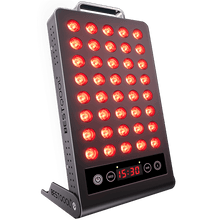
Red/NIR panel Do not treat a red or near-infrared photobiomodulation panel as interchangeable with a circadian light box, a blue-light-reduction strategy, or an amber night light. The available evidence does not provide a validated protocol for using these panels as evening circadian devices.
Safety Checks Before Bright or Blue-Enriched Light
Get individualized clinical or eye-care guidance before starting bright-light use if you have retinal disease or another eye condition. A published protocol also identifies photosensitizing medications and migraine susceptibility as considerations; light exposure may trigger migraines in susceptible people.
The available evidence does not provide bipolar-specific safety guidance or a validated evening circadian protocol for red-light panels. People with bipolar-spectrum conditions or other complex health concerns should seek clinician input rather than self-designing a high-intensity or blue-enriched light routine.
Choose Your Setup
Use this short checklist before buying or repurposing a device:
- Is the goal morning alertness, evening low-light ambience, or both through separate programmed scenes?
- Does the product provide useful specifications beyond Kelvin and marketing color labels?
- What illuminance reaches your eyes at the recommended distance?
- Can the device be scheduled for brighter daytime use and much dimmer evening use?
- Are medications, migraine history, and eye health accounted for?
- Is it a lighting product, a light-therapy device, or a red/NIR panel---and are you asking it to do the job it was designed for?
The decisive routine is not a magic wavelength: use brighter, more circadian-active light early, then dimmer, lower-melanopic light late. Persistent sleep problems, mood changes, or higher-risk health conditions warrant clinician guidance.


 Small
Small

 Moderate

 Moderate

 Moderate

 Full
Full

