

Reduce mirror glare by moving the red light device outside the mirror’s direct reflection path, softening other bathroom lighting, and maintaining the manufacturer’s prescribed treatment distance and angle. Always use the recommended eye protection rather than relying on mirror placement, closed eyes, or ordinary sunglasses.
Does a comfortable facial session suddenly feel harsh because the bathroom mirror makes one red light panel look like two? A few adjustments to placement and room lighting can reduce reflected brightness without changing the prescribed treatment distance. The goal is a calmer, more controlled setup that prioritizes safety and consistent exposure.
Why Bathroom Mirrors Make Red Light Feel Brighter

Mirror glare is uncomfortable brightness caused by light reflecting toward your eyes. Bathrooms can intensify this effect because they often combine a large mirror with glossy tile, polished counters, glass shower doors, chrome fixtures, and bright overhead lighting.
A mirror does not increase the device’s power output, but it can redirect some of that light into your field of view. The reflected panel may create a second visible hotspot, increasing discomfort and making it harder to sit naturally throughout the session. This effect is especially noticeable when a panel is placed directly behind you, beside your face, or opposite the mirror.
The geometry is straightforward: Light striking a flat mirror leaves at a corresponding angle. If you can see a bright image of the illuminated LEDs from your treatment position, reflected light is traveling toward your eyes. Moving your body or the device several inches sideways may be enough to interrupt that path.
Bathroom glare is also a contrast problem. Strong differences among the illuminated panel, its mirror image, and darker areas of the room can force your eyes to keep adapting. Practical home lighting recommendations encourage even background illumination, shielded light sources, diffusion, and adjustable brightness, particularly for people who are sensitive to glare or have reduced vision.
Start With the Device Instructions, Not the Mirror

Red light therapy, also called photobiomodulation, exposes tissue to low levels of red and, in some devices, near-infrared light. Facial devices commonly use visible red wavelengths for skin-focused applications, while some include invisible near-infrared wavelengths intended to reach deeper tissue.
The device’s specified treatment distance, session duration, and eye-protection requirements should determine your setup. Do not move significantly closer simply because angling the panel away from the mirror makes it appear dimmer. Visual brightness is not a reliable measure of exposure, especially when invisible near-infrared LEDs are operating.
Research protocols vary substantially in wavelength, irradiance, treatment distance, and total energy. Published research shows substantial variation in treatment protocols, with no universal approach for every device or skin goal. Excessive exposure may also reduce benefits or increase warmth, redness, and irritation. A panel intended for use at 12 inches should not automatically be used at 6 inches merely because the new angle feels comfortable.
For example, suppose the manufacturer specifies a 10-minute session at 12 inches. Moving the panel 8 inches to one side can remove its reflection while preserving the 12-inch face-to-panel distance. Moving the panel much farther away may reduce the delivered intensity, while moving it closer may increase exposure.
Position the Panel Outside the Mirror’s Reflection Path

The most effective arrangement is usually one in which you cannot see the illuminated LEDs or their bright mirror image from the treatment position. This does not mean hiding the panel from your face. Instead, adjust the relationship among the panel, your face, the mirror, and your eyes.
Begin by sitting or standing where you normally treat your face, with the device turned off. Position the panel at the recommended distance, then imagine a path running from the panel to the mirror and back toward your eyes. Shift the panel a few inches to the left or right, or rotate the entire treatment station slightly away from the mirror.
Turn the panel on briefly while wearing the required eye protection. If a bright rectangular reflection remains directly in front of you, adjust the device laterally before changing its distance. A slight angle often removes the direct reflection while keeping the treatment area evenly exposed.
Facing perpendicular to the mirror can work well with a tabletop panel. If the mirror is on the north wall, for example, sit facing east or west instead of directly north. The panel can remain in front of your face while its strongest reflection travels toward the side of the room rather than back toward you.
Avoid extreme angles that place one cheek noticeably closer to the panel than the other. If the exposure appears uneven, return the panel to a centered position and rotate the chair and device together relative to the mirror. Do not compensate by doubling the session or treating one side longer unless the device instructions specifically support that method.
Cover the Mirror When Repositioning Is Not Enough
Temporarily covering the mirror may be the simplest solution in a small bathroom. A clean, dry, opaque towel, removable fabric panel, or purpose-made mirror cover can stop the reflection completely.
Secure the cover so it cannot fall onto the device, block ventilation slots, or touch a warm surface. Red light devices generally produce less heat than high-energy light treatments, but some panels and power components become warm during use. Keep fabric away from the housing and follow all clearance requirements.
A removable matte cover is preferable to glossy plastic, which can create another reflection. The cover must also remain dry. Neither the material nor its fasteners should interfere with outlets, power cords, switches, or airflow.
Glare-Control Method |
Main Advantage |
Main Limitation |
Shift the panel sideways |
Preserves normal bathroom use |
Requires sufficient counter or floor space |
Rotate your chair or stool |
Keeps the treatment distance consistent |
May be awkward in a narrow bathroom |
Cover the mirror |
Removes the reflection immediately |
Requires safe clearance from the device |
Treat outside the bathroom |
Avoids mirrors, humidity, and glossy surfaces |
Requires another private space |
Reduce surrounding light |
Reduces competing hotspots |
Does not eliminate the panel’s reflection |
Adjust Bathroom Lighting Without Making the Room Completely Dark
Turning off harsh vanity and overhead lights can reduce competing reflections. Complete darkness, however, is not always more comfortable. A single intense red source in an otherwise dark room can create severe visual contrast.
If darkness makes the panel feel harsher, use low, evenly distributed background lighting. A dimmable, diffused fixture is generally more comfortable than an exposed bulb or narrow spotlight. Position the background light outside the mirror’s direct reflection path, and avoid ceiling fixtures that shine straight down onto your face.
Bathroom lighting used for grooming should ideally illuminate the face from the front or sides rather than depend entirely on one overhead fixture. During a red light session, however, side lights should be switched off or dimmed if they add glare.
Warm-to-neutral bathroom lighting may produce less stark contrast than cool, blue-white light reflected from glossy surfaces. This adjustment does not change the red light therapy dose; it only makes the surrounding visual environment more comfortable.
Prepare a Low-Reflection Treatment Area
Clean, bare, dry skin is a sensible starting point for facial treatment. Remove makeup, sunscreen, heavy creams, and reflective cosmetics unless the device manufacturer or your clinician advises otherwise. These products may create uneven shine or affect how light reaches the skin.
Do not scrub aggressively before treatment. Use a gentle cleanser, pat your face dry, and allow any remaining moisture to evaporate. Strong exfoliation, a recent chemical peel, severe sunburn, an active skin infection, or an unhealed procedure may require postponing treatment and seeking professional advice.
Reduce environmental reflections by placing a dark, matte towel over a glossy counter, moving chrome cosmetic mirrors out of view, and closing a reflective shower door or curtain. These changes are particularly helpful with larger panels because their wider light fields can strike several surfaces at once.
Once you find a comfortable arrangement, mark the device and chair positions with removable tape. A repeatable setup reduces the temptation to estimate the distance differently each day. Consistent distance, angle, and duration are more useful than adjusting the session according to how bright the room appears.
Eye Protection Still Matters
Reducing mirror glare improves comfort, but it does not replace device-specific eye precautions. Incorrect or excessive use may harm unprotected eyes, so follow the manufacturer’s protective-equipment instructions carefully.
Use the goggles or opaque eye shields supplied or approved for the device, especially when treating near the face or using near-infrared wavelengths. Do not assume that ordinary sunglasses block the relevant wavelengths. Closing your eyes may reduce visible discomfort, but eyelids are not equivalent to protective eyewear.
Avoid staring at the LEDs or their mirror image. Reflected light may be less intense than direct exposure, but visible brightness cannot determine whether the exposure is appropriate for your eyes. Near-infrared output further complicates visual judgment because a functioning emitter may appear dim or completely unlit.
Consult an eye-care professional or qualified healthcare provider before facial red light use if you have an eye disorder, recent eye surgery, pronounced light sensitivity, migraines triggered by bright light, or take medication that affects light sensitivity.
Know When the Bathroom Is the Wrong Treatment Space
A bathroom may be convenient, but it is not automatically suitable for an electrical wellness device. Move the session to a bedroom, office, or another dry, private area if the bathroom is cramped, highly reflective, poorly ventilated, or places the device too close to the sink, bathtub, or shower.
Confirm whether the device is approved for use in damp environments. Do not assume that a facial panel is moisture-resistant simply because it is intended for skin care. Keep electrical equipment and extension cords away from water, and never balance a panel on an unstable sink edge or pile of towels.
A dry room with a matte wall can simplify positioning. Place the panel in front of a stable chair, maintain the recommended distance, use a timer, and remove unnecessary mirrors from view. Although this setup may be less convenient than treating beside the sink, it is usually safer and easier to reproduce.
Avoid Fixes That Alter the Intended Dose
Do not attach tissue paper, fabric, plastic, frosting film, or another homemade diffuser directly to the therapy panel. Materials placed over the LEDs can block certain wavelengths, alter the delivered intensity, trap heat, or interfere with ventilation. Diffusion may be useful for ordinary bathroom fixtures, but a therapy device should not be modified without an approved accessory.
Do not shorten or lengthen sessions solely because the mirror makes the light appear more or less intense. Photobiomodulation can produce a dose-dependent response: Too little exposure may have little effect, while excessive exposure may increase temporary warmth, dryness, redness, or irritation. Longer sessions are not automatically better.
Evidence for facial red light applications is promising in some areas but remains uneven. Many studies are small, use different protocols, or require confirmation through larger controlled trials. Treat the device as a measured wellness tool, not as an ordinary red bathroom lamp or a guaranteed solution for every skin concern.
A Practical Setup Check
A well-arranged session keeps your face evenly positioned at the prescribed distance while the panel and its reflection remain outside your direct line of sight. The device should stand securely on a dry surface, its ventilation openings should remain clear, and its power cord should stay well away from water.
The room may have soft background illumination, but bright overhead bulbs, exposed vanity lights, and reflective cosmetic mirrors should not compete with the treatment panel. Your skin should be clean and dry, the timer should match the instructions, and your eye protection should be in place before the LEDs turn on.
Stop the session if you develop persistent eye discomfort, a severe headache, unexpected pain, pronounced redness, a rash, blistering, or excessive heat. Seek professional advice before resuming, particularly if you take photosensitizing medication or have a medical skin or eye condition.
Frequently Asked Questions
Does a Mirror Double My Red Light Therapy Dose?
No. A mirror does not duplicate the panel’s electrical output, and reflected light is not equivalent to placing a second identical device in front of you. It can redirect some light toward your face or eyes, making the session feel brighter and the actual exposure harder to judge. Do not count reflected light as part of a planned dose.
Can I Simply Close My Eyes?
Closed eyes may feel more comfortable, but they are not a substitute for the eye protection specified by the device manufacturer. This is especially important when the device includes near-infrared wavelengths, which cannot be evaluated reliably by visible brightness.
Can I Cover the Mirror With a Towel?
Yes, provided the towel is securely attached to the mirror, remains dry, and stays well away from the panel, electrical components, and ventilation openings. A matte, opaque cover works better than a shiny material.
Is It Better to Use Red Light Therapy Before or After a Shower?
Using the device after gentle cleansing may be practical because your skin is clean, but your face should be completely dry and free of heavy products before treatment. Keep the device away from steam, splashing water, and damp counters, and confirm that the manufacturer permits use in a bathroom.
Should I Move Closer if Angling the Panel Makes It Look Dimmer?
No. Maintain the prescribed treatment distance unless the manufacturer provides an approved adjustment. Changes in angle, room lighting, and mirror position can alter perceived brightness without reliably indicating how much light reaches your skin.
A comfortable facial red light routine depends on controlled placement, not on tolerating unnecessary brightness. Interrupt the mirror’s reflection path, preserve the prescribed distance and session duration, protect your eyes, and move to a dry, less reflective room whenever the bathroom cannot provide a stable setup.


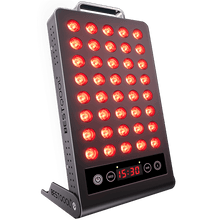
 Small
Small

 Moderate

 Moderate

 Moderate

 Full
Full

