

Red light therapy can complement either practice: use it during Yin for stillness and targeted exposure, or after Vinyasa when muscle recovery is the priority.
Do your hips feel guarded during a long Yin pose, or do your legs feel heavy after a faster flow? A consistent, well-timed routine can help you monitor stiffness, comfort, and next-day soreness without adding a complicated wellness ritual. The most practical setup depends on your goals, yoga style, and red light device.
The Short Answer: During Yin, After Vinyasa
During Yin yoga, using red light therapy while holding poses is often the more convenient option. Yin’s slow pace and relatively stationary positions make it easier to keep a body area facing the panel at the device’s recommended distance for several minutes.
For an active Vinyasa class, post-practice exposure is usually more practical. A flowing sequence continually changes your position, angle, distance, and skin exposure, making consistent light delivery difficult. After class, you can comfortably target the hips, thighs, calves, shoulders, or back without compromising alignment or interrupting your breathing.
This is a practical distinction, not a proven clinical rule. Research directly comparing red light exposure during Yin yoga with treatment after Vinyasa is lacking. Most recommendations are extrapolated from separate research on photobiomodulation, exercise recovery, musculoskeletal discomfort, and yoga.
Practice and timing |
Best suited to |
Main advantage |
Main limitation |
During Yin holds |
Relaxation, gentle mobility work, and localized stiffness |
Stillness supports stable positioning and uninterrupted exposure |
Long holds may encourage overstretching if warmth reduces your sense of resistance |
After Vinyasa |
Recovery, post-class soreness, and heavily worked muscles |
Treatment can focus on specific tissues while you rest |
Adds time after class and may be uncomfortable if you are already overheated |
Before either practice |
Stiff muscles or joints that need a gradual warm-up |
May make movement feel more comfortable |
Does not replace an active warm-up or careful progression |
Before and after |
Frequent training or a specific recovery goal |
Separates preparation from recovery |
More exposure is not necessarily better and must remain within device instructions |
What Red Light Therapy Is—and Is Not

Red light therapy, also called photobiomodulation, exposes tissue to selected red or near-infrared wavelengths. Many devices use red wavelengths of approximately 25–28 millionths of an inch, while some combine them with longer near-infrared wavelengths intended to penetrate more deeply.
The proposed effects involve cellular energy production, circulation, and inflammatory signaling. Evidence indicates that red light therapy stimulates cellular activity, but research on exercise performance and recovery remains limited. Many available studies are small or conducted outside yoga settings.
Therapeutic light is also different from ordinary red-colored room lighting. A studio may look red without delivering a defined therapeutic wavelength or meaningful dose. Red light therapy is not necessarily the same as infrared heat or hot yoga. Although some equipment produces noticeable warmth, light treatment should not replace muscular warm-up, movement preparation, or temperature management.
Red light cannot mechanically repair a torn ligament, correct unstable alignment, or reverse advanced joint damage. It is best viewed as a potential recovery or comfort tool, not as permission to push farther into a pose.
Why Red Light Therapy Works Well During Yin Holds

Stillness Makes Exposure Easier to Control
Yin yoga commonly uses supported floor positions held for several minutes. This stillness makes it easier to keep the target tissue oriented toward a panel without repeatedly moving in and out of its treatment area.
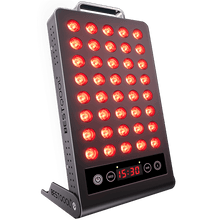
Consider using a panel for tight hips. In a supported butterfly or reclined hip-opening position, you may be able to remain comfortably exposed throughout a short light session. During a flowing class, the same panel might illuminate the front of your hips in one pose, your side in the next, and the mat during a transition.
Light may also complement the relaxing quality of restful stretching. However, this practical pairing is not evidence that red light allows tissues to stretch farther or makes deeper poses safer.
Yin Makes the Routine More Efficient
Using red light during Yin combines two activities that would otherwise require separate time blocks. A 15-minute light session completed while you hold several comfortable, supported positions takes 15 minutes in total; performing the activities separately could require 30 minutes.
Combining the practices may improve consistency, which is often more useful than following an ambitious routine only occasionally. It also reduces the temptation to extend treatment simply because each wellness practice seems to require its own session.
A restorative setup might include a supported reclined pose, slow breathing, and a timer set according to the device manual. Position the panel securely, keep cords outside your movement area, and provide enough ventilation to prevent the room from becoming uncomfortably warm.
Warmth Can Be Mistaken for Flexibility
Warm or relaxed tissue may feel less resistant, but that sensation does not prove that a joint is safer at its end range. Yin already places prolonged, relatively passive stress on connective tissues. If the light or equipment warmth makes a pose feel easier, you may unintentionally deepen it beyond your usual boundary.
Use the same range you would choose without the light, especially during your first few combined sessions. A gentle pulling sensation may be appropriate, but sharp pain, pinching, numbness, tingling, or joint pressure is a reason to leave the pose.
For example, if you normally support a seated forward fold with a folded blanket and bent knees, keep those supports during the red light session. Do not remove them merely because your hamstrings feel temporarily warmer.
Why Post-Vinyasa Treatment Is Usually the Better Match
Active Flow Makes Consistent Exposure Difficult
Vinyasa links poses through continuous movement. Your distance from a panel changes as you move through standing sequences, lunges, planks, backbends, and floor poses. Clothing and body orientation also affect how much skin receives direct light.
Practicing in a red light room may still create a calming atmosphere, and some gentle formats combine fluid movement with panel exposure. For example, one studio offers a 45-minute gentle Vinyasa class centered on breathing, warmth, and noncompetitive movement. That approach may be enjoyable, but it does not ensure that every body area receives the same controlled exposure throughout class.
If your goal is a measurable home routine, post-practice treatment is easier to standardize. You can select a target area, maintain the recommended distance, set a timer, and repeat the same protocol from session to session.
Recovery Is More Relevant After a Demanding Flow
A stronger Vinyasa class can load the quadriceps, glutes, calves, shoulders, wrists, and trunk through repeated transitions and weight-bearing poses. Post-practice red light therapy is commonly used to support recovery from this exercise-related stress.
The evidence is promising but not definitive. Small studies suggest possible effects on strength, endurance, or recovery, but the findings do not establish an ideal yoga-specific protocol.
A practical post-Vinyasa setup is straightforward. Cool down normally, drink water, and allow your breathing and body temperature to settle. Then expose the most heavily worked area while resting in a comfortable position. After a lunge-heavy class, for example, you might treat the front and sides of your thighs rather than automatically completing a full-body session.
Savasana Can Bridge Movement and Recovery
If your studio or home setup permits safe panel placement, light exposure during an extended savasana can serve as post-exercise treatment without requiring a separate recovery block. The light is still applied after the active work, even though it remains part of the yoga session.
However, a five-minute savasana should not automatically become a 20-minute treatment. Follow the exposure time specified for your device rather than adjusting the session around a generic recommendation. Panel intensity, treatment distance, beam coverage, and intended use vary too widely for a universal timer.
Should You Use Red Light Before Yoga?
Pre-practice treatment may be worth considering when stiffness is the main barrier to comfortable movement. Some exercise research examines pre-exercise photobiomodulation as a form of muscle preparation intended to support circulation and cellular activity before exercise.
For yoga, this might mean a short session directed at the hips before a morning practice or at the shoulders before a sequence containing repeated planks. Yoga-focused sources commonly suggest approximately five to 10 minutes before practice, while other protocols recommend longer exposure. These differences likely reflect variations in device intensity, distance, treatment area, and whether the session targets one area or the entire body.
Pre-practice light should supplement movement rather than replace it. Even if your hamstrings feel comfortable after exposure, begin with easy joint circles, gentle folds, and progressively larger ranges. Light treatment does not prepare balance, coordination, tendon loading, or movement technique.
A Practical Decision Framework
Choose exposure during Yin when your session is quiet, supported, and stationary; you want to combine relaxation with light treatment; and you can maintain the device’s required distance without twisting toward the panel. This approach is particularly practical when the desired treatment area naturally faces the panel in a comfortable resting pose.
Choose post-Vinyasa exposure when the class is sweaty, strength-focused, fast, or technically demanding. This timing is also preferable when you want to select a target area based on how the practice actually felt rather than guessing beforehand.
If you remain unsure, test one timing instead of changing several variables at once. Use the same device settings and a similar yoga class for two to four weeks. Track next-morning soreness, perceived stiffness, sleep comfort, and whether the routine is easy enough to maintain. Personal tracking cannot prove a medical effect, but it can reveal whether the routine provides a repeatable practical benefit.
Consistency matters more than finding a perfect schedule. Many home-use recommendations suggest several sessions per week, but treatment schedules vary by purpose. Always prioritize the device manual over broad online timing recommendations.
Safety and Setup Considerations
Follow the manufacturer’s instructions for distance, duration, frequency, skin exposure, and eye protection. Longer treatment or closer positioning can increase exposure beyond the device’s intended limits. Excessive use may cause temporary redness or swelling and, in more serious cases, blistering.
Because intense light can affect the eyes, eye protection may be necessary, especially when your face is close to a panel or the manufacturer requires goggles. Do not stare directly into high-intensity LEDs.
Keep panels, stands, blankets, and electrical cords away from transitions and walking paths. If the equipment produces warmth, ventilate the room and avoid combining it carelessly with an already hot or humid practice. After hot yoga or an unusually intense flow, cool down and rehydrate before adding another potentially warming recovery method.
Consult a healthcare professional before use if you have a photosensitive condition, take light-sensitizing medication, have a history of eye or skin cancer, are pregnant, cannot reliably sense heat, or are managing a significant cardiovascular, neurological, orthopedic, or skin condition. Persistent pain, loss of function, severe swelling, numbness, or an inability to bear weight requires clinical evaluation rather than a longer light session.
The Bottom Line
Use red light therapy during Yin when stillness, relaxation, and efficient targeted exposure are your priorities. Use it after Vinyasa when recovery from muscular effort is the main objective. Whichever timing you choose, maintain an honest range of motion, follow the device protocol, and judge the routine by its consistency, comfort, and practicality—not by the intensity of the light or stretch.


 Small
Small

 Moderate

 Moderate

 Moderate

 Full
Full

