
Not automatically. Wavelength affects how light travels through tissue, and more exposure is not necessarily better. Do not assign each family member a separate home-use wavelength or dose plan simply because they are older, younger, active, or focused on a different routine.
Use the wavelengths and modes your exact device provides, follow its instructions, and keep each person’s routine within those limits. A shared device does not require identical habits, but it does not justify guessing at personalized settings.
Treat Wavelength Configuration and Personal Routine as Separate Decisions
Wavelength is a technical property of the device, not a personality setting. Light scattering in tissue varies by wavelength; shorter wavelengths undergo more Mie scattering than longer wavelengths. Dose response can also vary across tissues, which is one reason a family should not assume that more light, more time, or a different mode will automatically be better for a particular person. A review of photobiomodulation light parameters and efficacy describes both this wavelength-dependent behavior and the biphasic dose-response principle: increasing delivered light does not necessarily increase the biological response.
That does not translate into an at-home chart assigning one wavelength to a teenager, another to an older relative, and another to a person who exercises.
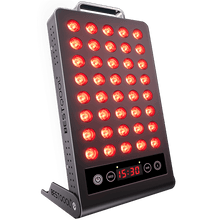
For example, the BestQool BQ150 manual lists 630 nm and 660 nm red light, plus 850 nm and 940 nm near-infrared light. These wavelengths are device features, not instructions to select a different wavelength based on a household member’s age, fitness level, or general goal.
If a shared device offers multiple modes, use the manual to understand those modes. Do not assume that one person’s preferred mode should become everyone else’s default or that changing modes creates a personalized result.
Let Individual Routines Differ Only Within Device Guidance
A household can vary when and how people use a shared device without creating a separate protocol for each person.
The variables that may appear in a device’s controls or instructions include:
- Wavelength or mode
- Intensity
- Session duration
- Distance or positioning
- Frequency of use
Those controls do not establish a customized plan by age, body size, skin type, or activity level. On the BQ150, for instance, wavelength, intensity, and session duration can be adjusted, but the manual does not provide separate settings for different family members or goals.
A better household rule is: start with a conservative, manual-compliant routine and do not increase exposure simply because another person uses more.
A simple shared log can keep the process organized without turning it into self-prescribing:
| Record | Why It Helps |
|---|---|
| User | Prevents copying another person’s routine by default |
| Positioning | Helps each person repeat the same manual-compliant setup |
| Mode | Keeps each person’s setup organized |
| Date and time | Prevents scheduling conflicts |
| Comfort during use | Provides a reason to pause rather than escalate exposure |
If a session is uncomfortable, stop rather than moving closer, extending the time, or increasing intensity.
Use Timing for Household Convenience, Not Promised Effects
Morning, after-activity, and evening slots can work as scheduling choices. The useful question is not which time of day is “best” in general; it is whether each person can use the device according to its instructions.
For example, a household might reserve:
- A morning slot for one adult’s regular routine
- An after-activity slot for another adult
- An evening slot for a third user
These time blocks help avoid overlap and make it easier to track each person’s routine. They should not be treated as proof that a particular time of day produces a particular effect.
Follow the positioning directions for the exact model. The BQ150 manual gives a general range of approximately 3 to 6 inches from the skin, but that is not a reason to create different distance rules for different ages or goals. Heating thresholds can vary by wavelength, so do not treat a closer position or higher intensity as automatically preferable.
Do Not Turn an Adult Routine Into a Child’s Protocol

Children should not inherit an adult household member’s settings, wavelength choice, session pattern, or treatment area.
Clinical research involving children is not the same as a general home-use guide. For example, a randomized sham-controlled trial of transcranial photobiomodulation in children aged 2–6 years examined a specific clinical population and intervention. It does not provide a shared-device protocol or a basis for adapting an adult routine for a child. Follow the exact device manual’s eye-protection instructions.
Do not create an age-based setting chart for children, teens, or older relatives. Children, health concerns, and uncertain suitability belong with a qualified clinician, not trial-and-error changes to a shared device.
A Simple Household Use Checklist
Before anyone changes a wavelength, intensity, position, or session duration, use this checklist:
- One goal per person: Write down each person’s non-medical reason for using the device.
- One manual check: Confirm the exact model’s available modes and positioning directions.
- One conservative routine: Stay within those directions without increasing exposure for faster results.
- One personal record: Track mode, timing, positioning, and comfort for each user.
- One clear escalation rule: Children, health concerns, and uncertain suitability should be discussed with a qualified clinician before self-adjusting use.
For current BestQool owners, review the exact device manual and safety information before changing a setting.


 Small
Small

 Moderate

 Moderate

 Moderate

 Full
Full

