

A garage-gym red light station does not need much wall space to work well. The simplest approach is to choose a floor-standing or portable LED device, keep your treatment distance consistent, and build the station around the recovery positions you already use after training.
Does your garage gym already feel crowded with a rack, plates, storage hooks, and one patch of open floor that has to do everything? The good news is that a compact red light station can still work well if it is easy to roll into place, aimed at the right body area, and used consistently. With the right layout, you can fit a practical station into a real training space and keep device choice, placement, distance, and safety straightforward.
Start With the Goal, Not the Device
The first decision is not where to hang a panel. It is matching the device to the treatment goal. If your main reason for adding red light therapy is post-lift muscle recovery, joint comfort, or broader lower-body coverage, a small face mask or handheld wand is usually the wrong fit for a garage gym. A panel, flexible pad, or wearable wrap makes more sense because those formats better suit quads, calves, shoulders, the low back, and other training-heavy areas.
That matters because red light and near-infrared light serve different purposes. The most commonly discussed red range, roughly 630 to 660 nm, is generally used for more superficial targets such as skin and hair, while near-infrared in the roughly 810 to 850 nm range reaches deeper tissues such as muscles and joints. In a gym setting, that usually makes a combo device more practical than a skin-only device. If you want one station that can handle sore knees after squats, tight shoulders after pressing, and occasional skin use, a compact panel with both red and near-infrared wavelengths is usually the most flexible choice.
Why Limited Wall Space Usually Favors a Stand
A dedicated red light room can be customized in many ways, but a one-size-fits-all setup does not really exist. In a garage gym, limited wall space makes that even more obvious. Wall mounting sounds tidy, but it competes with shelves, mirrors, resistance band anchors, pegboards, and folding benches. It also locks your panel into one height and one treatment angle unless the mount is adjustable.
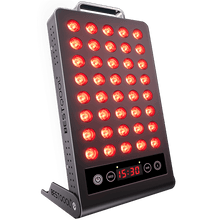
In practice, the setup that tends to hold up best in a real garage gym is a stand-based station. A tabletop unit can live on a sturdy utility cart or storage cabinet. A mid-size or larger panel can sit on a vertical stand with wheels, so you can roll it beside a bench for chest and shoulder work, in front of a chair for knee sessions, or near open floor space for a quick full-front exposure after training. Notes from home-setup testing show many vertical or horizontal stands need about 32 x 29 in of floor space, plus some extra height for the support hardware. That footprint is often easier to find than a clear stretch of wall.
Pick a Garage-Gym Location You Will Actually Use
Placement affects both convenience and results, and easy access helps people stay consistent. In a garage gym, the best spot is usually not the emptiest wall. It is the area you naturally pass through after training, where you can sit, stand, or lean without moving barbells and plates every session.
A practical example is the recovery-lane approach. If your rack and platform dominate the center, use one side wall or rear corner for recovery rather than trying to hang a panel over your main lifting zone. A rolling panel can park beside a storage shelf when not in use, then move into a 3 ft by 3 ft open space after training. If your goal is mostly lower-body recovery, place a stool or flat bench there so you can sit with your knees and quads facing the panel. If upper-body recovery matters more, place the station where you can stand comfortably at the correct distance without clipping dumbbells or stepping around a bike.
This is where small-space logic helps. A garage gym does not need to look like a spa. It needs one repeatable station with a nearby outlet, decent airflow, and enough clearance to hold the recommended distance every time.
Distance, Dose, and Session Length Matter More Than Decor
What matters most is irradiance and distance. Irradiance is the device’s output at a stated distance, and it is one of the easiest specs to misread because companies often advertise power loosely. For setup purposes, that means you should not guess where to stand just because the panel feels bright.
Several home-use notes point to a useful range: many panels are used about 6 to 12 in away, while broader or lower-intensity setups may stretch farther. One home-setup guide warns that distances beyond about 12 in can reduce how much light actually reaches the body, while another space-planning source gives roughly 6 to 12 in as a common working range. For a garage gym station, the easiest solution is to mark your usual position. A small piece of tape on the floor or a fixed chair location removes the guesswork.
Session length also needs restraint. Red light therapy is often described as hormetic or biphasic, meaning too little may do very little, but too much is not automatically better. Starting with shorter sessions, often around 5 to 10 minutes per treatment area, then building toward roughly 10 to 20 minutes if the device manual supports it, is the safer and more practical path. That approach also fits better after training, when you want recovery support without turning the session into another time burden.
The Best Layouts for Tight Spaces

When wall space is scarce, three layouts usually make the most sense. The first is a compact rolling panel next to a bench or stool. This works well for most lifters because it gives you seated access for knees, shins, ankles, and quads, then standing access for the torso and shoulders.
The second is a tabletop or mid-size panel on a utility cart. This is useful when the garage doubles as storage and the station needs to move. It also makes cable management easier because the timer, eye protection, and cleaning cloth can stay on the same cart.
The third is a flexible pad or wearable device stored in a drawer or cabinet. For extremely crowded gyms, this can be the smartest fallback. It uses almost no wall space, stores easily, and works well for targeted areas such as elbows, the low back, or knees. The tradeoff is speed and coverage: a wearable is compact and convenient, but a panel usually treats larger areas faster and with more consistent positioning.
Here is a simple comparison for limited-wall garage gyms:
Setup style |
Best for |
Main advantage |
Main tradeoff |
Rolling panel |
Broad recovery use |
Easy to reposition, larger coverage |
Needs open floor footprint |
Cart-mounted panel |
Small multi-use garages |
Portable and organized |
Less stable than a dedicated stand |
Flexible pad or wearable |
Very tight spaces |
Minimal storage and no mounting |
More targeted, slower for full-body use |
Safety and Realistic Expectations
Home LED devices are generally considered low-risk when used as directed, and short-term use appears generally safe, but a garage gym adds a few practical hazards that wellness rooms do not. Extension cords across walkways, sweaty floors, unstable stands, and poor ventilation are common and avoidable problems. Keep the device on a stable surface, do not create a tripping path around barbells, and clean dust off the panel regularly so the lenses and vents stay clear.
Eye comfort matters too. If you are treating near the face or using a bright panel, goggles or the eye protection provided with the device can improve comfort. Closed eyes may be enough for some body-only sessions, but staring directly into LEDs is still a poor habit. If you are pregnant, taking photosensitizing medication, have eye disease, or plan to use light around a diagnosed medical condition, get guidance from a clinician first.
It is also worth keeping claims grounded. Hair regrowth and wrinkle reduction have the strongest evidence, while broader claims around athletic performance and many full-body optimization promises remain less certain. In a garage gym, that means treating red light therapy as a recovery support tool, not a fix for poor sleep, overtraining, or an unresolved injury.
Build the Station Around Habit
The most effective garage-gym station is the one that keeps recovery friction low. Put it where your cooldown already happens, keep the distance repeatable, and choose a device that matches the body areas you actually want to treat. If wall space is limited, that is not a deal-breaker. It is often a reason to choose a smarter format.
A compact stand, a measured spot on the floor, and a realistic routine will usually beat an impressive wall-mounted setup that is awkward to reach and easy to skip.


 Small
Small

 Moderate

 Moderate

 Moderate

 Full
Full

