

For most home panels, “too close” is the point where irradiance rises faster than your skin and eyes can comfortably tolerate, or where the device’s own labeling says you are outside the tested distance. A practical starting range is often 6 to 12 inches for consumer panels, but the safest distance is the manufacturer’s minimum distance, eye-protection requirement, and session-time limit for your exact device. If you cannot verify those details, do not guess—check the manual, the irradiance-at-distance chart, and any FDA clearance or safety labeling first.
Why Distance Matters First: Dose, Heat, Beam Spread, And Eye Safety

Distance controls how much light reaches the skin, how evenly it lands, and how quickly exposure builds. Moving farther away usually lowers irradiance sharply, while moving closer can increase dose quickly but also increase heat, discomfort, and the chance of uneven exposure. For red and near-infrared therapy, outcomes depend on wavelength, irradiance, treatment time, repetition, and other device settings rather than on distance alone.
The eye issue is the main reason to treat distance as a safety variable, not just a comfort choice. In lab testing of red light devices for myopia, some laser-based devices reached ANSI group 1 safety limits in 2.8 seconds and 1.4 seconds for a 7-mm pupil, far below a 180-second treatment exposure. That does not automatically apply to every home panel, but it does show why users should not assume that a marketed treatment time is eye-safe without device-specific documentation.
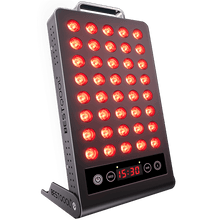
Close-up of a red light therapy panel showing beam spread and intensity zones
What Counts As “Too Close” Depends On The Device And Goal

If your panel has a cleared labeling distance, use that first. One FDA-cleared home light therapy system specified a minimum distance of 20 cm, or about 8 inches, to avoid exceeding an ocular safety limit, with a per-session dose range of 10 to 60 J/cm² and stop conditions for painful warmth or visual discomfort. Another cleared OTC device specified 6 inches for decolletage use with supplied protective eyewear, 10-minute sessions, and no changes to power settings or treatment time.
For some devices, being too close is defined directly in the labeling. One FDA-cleared home-use system warned that 2 inches or less without a diffuser creates a high-irradiance zone above the FDA-recommended limit for repeated daily use, increasing the risk of thermal burn and temporary vision impairment. Another cleared device required at least 6 inches from the skin to stay below a moderate exposure limit, with a mandatory timer limit and stop instructions if warmth becomes painful or the skin reddens.
Measuring tape showing 6 to 12 inch distance markings with a therapy panel in background
Practical comparison of common distance patterns
Use case or device pattern |
Distance pattern in the evidence |
Practical takeaway |
General consumer panel use |
6 to 12 inches is a common starting range |
Start conservatively, then adjust only if your device manual supports it |
Cleared home light therapy system |
Minimum 20 cm, about 8 inches |
Do not go closer unless the labeling specifically allows it |
Cleared OTC decolletage panel |
6 inches, 10-minute sessions |
Stay at the labeled distance and do not alter time or power |
High-irradiance zone on a cleared panel |
2 inches or less without diffuser |
Treat this as too close for repeated daily use |
Direct-contact LED mask |
Contact is required by design |
Distance is not the setting to manage; follow the mask’s own timing and eye-safety rules |
Best-Practice Setup For Home Panels: Start Farther, Then Verify

The safest practical approach is to start at the manufacturer’s tested distance, then verify comfort, heat, and eye safety before tightening anything. For one cleared device, first-time users were instructed to start at 6 inches and reduce only if no heat sensation was felt; the same labeling required eye protection, a session limit, and a day 1 test at 8 inches for 5 minutes before any closer sessions. That is a good model for any panel where the exact safe distance is not obvious.
A useful rule for high-power panels is that the closer you get, the more important it becomes to confirm these items before each session:
- Minimum distance in the manual
- Irradiance at that distance
- Session time limit
- Eye protection instructions
- Stop conditions for heat, redness, or visual discomfort
- Any contraindications such as photosensitivity or recent skin injury
If any of those are missing, the device is not giving you enough information to safely judge “too close.” A MAUDE report of a consumer LED facial massager described eye discomfort, skin redness, and irritation, but the report also lacked technical parameters, clearance, and distance guidance, which made safe-use verification impossible.
Person wearing protective eyewear during red light therapy session at proper distance
Match Distance To The Treatment Area, Not Just The Panel
For facial or other superficial skin goals, closer placement can raise surface dose quickly, but it can also make the treatment more intense than needed. For larger body areas or deeper tissue targets, published guidance commonly places consumer panels farther away, because coverage increases while power per square inch falls. That means distance and session time work together: farther away may require longer sessions, but too close may push you into discomfort or the biphasic dose range where more light is not better.
A reasonable working pattern from the evidence is:
- Skin-focused use: usually closer than deeper-tissue use, but still within the device’s safe window
- Recovery or larger-area use: often farther back to cover more area evenly
- Sensitive areas: more distance, shorter sessions, or both
- Panels with unknown output: do not rely on “close feels stronger” as a proxy for effectiveness
The evidence also suggests that dose can build too quickly when you are close, and that too much exposure can reduce benefit rather than improve it. That is especially relevant for high-power panels, where small changes in distance can create large changes in delivered irradiance.
Action Checklist: Safer Distance Routine For A High-Power Panel
- Check the manual first for minimum distance, max session time, eye protection, and stop conditions.
- Confirm the device is cleared or otherwise documented and that the labeling includes irradiance at the stated distance.
- Start at the labeled distance or the manual’s conservative starting distance rather than moving in by feel.
- Use eye protection whenever the device instructions require it, especially for face use.
- Stop immediately if you get painful warmth, redness that persists, or any visual discomfort.
- Do not shorten the distance just to “get more power” unless the device’s tested protocol explicitly allows it.
- Record distance, time, and any reaction so you can spot overexposure patterns session to session.
FAQ
Q: How Far Should I Sit or Stand From A High-Power Red Light Therapy Panel?
A: If the device has a labeled minimum distance, use that exact distance first. In the evidence, common panel distances were 6 to 12 inches, with some cleared devices requiring 6 inches or about 8 inches, and some laser-based devices using much more restrictive safety handling because ocular limits can be reached quickly.
Q: What Happens If I Use A Panel Too Close to My Skin or Eyes?
A: Being too close can raise irradiance fast enough to cause overheating, redness, discomfort, uneven exposure, and eye risk. The evidence includes device labeling that treats 2 inches or less without a diffuser as a high-irradiance zone and a myopia-device safety study showing some laser-based systems can approach safety limits in seconds, which is why eye protection and distance rules matter.
Q: Does the Right Distance Change for Skin Care Versus Recovery?
A: Yes, usually. Superficial skin goals often use a closer but still safe setup, while larger body areas and deeper tissue targets generally use a bit more distance to balance coverage and intensity. The exact setting still depends on the panel’s irradiance, beam spread, and labeling, so the device manual should override generic distance advice.
Bottom Line
The safest answer to “how close is too close” is: closer than the device’s tested and labeled minimum distance, or closer than the point where heat, redness, or visual discomfort appears. Start with the manufacturer’s distance, use eye protection when required, and do not trade distance for intensity unless the panel’s documentation explicitly supports it. If the device does not provide irradiance, distance limits, and stop rules, you do not have enough information to treat it as safe.


 Small
Small

 Moderate

 Moderate

 Moderate

 Full
Full

