
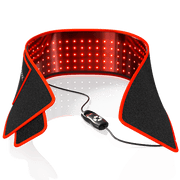
A red light therapy belt usually stays in place by fastening around a body area and holding its light panel flat against the target. A wrap may secure with adjustable straps or hook-and-loop closures and conform across a broader surface. Neither format is automatically more stable: retention depends on the panel's shape and flexibility, the closure path and adjustment range, the body area, and how much the wearer moves.
The most useful comparison is not "belt versus wrap" as fixed categories. Those labels are not standardized. A belt can be broad and flexible, while a wrap can be relatively narrow or difficult to fasten for a particular placement. Compare the actual construction and documented fitting instructions rather than relying on the product name alone. BestQool's fit comparison makes the same distinction: size, flexibility, fastening range, and intended placement matter more than the label.
What Physically Holds Each Format in Position?

A belt-style device generally uses a circumferential fastening path: it goes around the waist, torso, thigh, knee, or another target area, then closes so the light panel remains against that area. Its stability comes from the tension and overlap created around the body, along with how well the panel follows the local contour.
A wrap-style device is often a flexible light unit that drapes over or around a treatment area, then stays in place through straps, hook-and-loop closures, or another adjustable attachment system. But those features vary by model; a wrap should not be assumed to have straps or hook-and-loop closure simply because it is called a wrap. A description of wrap-style devices notes that adjustable straps or hook-and-loop closures may be used to secure flexible units.
In practical terms:
| Format Tendency | How It Is Retained | Potential Advantage | Possible Limitation |
|---|---|---|---|
| Belt-style format | Fastens around a body segment | Circumferential closure can hold the panel in place around the body | Can ride up, rotate, or loosen when the area tapers or changes shape with posture |
| Wrap-style format | Conforms over a larger area and secures with adjustable attachment | May adapt to broad, curved, or uneven surfaces | Excess material can fold, bridge, or bunch and make the device less stable |
The closure itself is only part of the system. The panel must also lie evenly. A device can be tightly fastened and still be poorly positioned if it arches away from the body, leaves gaps, rolls at the edges, or shifts off the intended area.
Why Body Shape and Posture Matter

Movement changes the body surface under the device. That is why a belt or wrap that feels secure while standing may behave differently while seated, reclined, bending gently, or taking a few slow steps.
Cylindrical Areas Often Favor Circumferential Fastening
A belt-style closure uses a circumferential fastening path that can be effective on areas with a relatively even circumference, such as part of the waist or thigh. The panel is held in place by the device's wraparound path rather than by a single point of attachment.
That does not mean the belt will remain stable through every posture. At the waist, sitting can change the relationship between the abdomen, lower back, and hip line. A belt that sits comfortably while upright may ride upward, crease, or shift when seated or reclined.
The exact fastening line matters. Measure the circumference where the device will actually close, not a general clothing size or a usual waist measurement. A listed maximum circumference also does not confirm that the panel will be centered, that the closure will overlap comfortably, or that the device will provide the intended coverage.
Taper Creates a Migration Path
A waist-to-hip transition, tapered thigh, rounded abdomen, and curved lower back can all make retention more difficult. If the body is narrower above or below the fastening line, a device may drift toward the smaller circumference during movement.
For a tapered waist-to-hip area, small closure adjustments may matter more than having a very long strap. The useful question is whether the closure can be fine-tuned while keeping the panel centered and flat---not merely whether the device can reach around the body.
Broad or Uneven Areas May Need More Conformity
Wrap-style formats may be easier to lay across a broader lower-back, hip, upper-thigh, or similarly uneven area when the material can conform without pinching, slipping, or leaving visible gaps.
However, more material is not always more secure. A wrap that is too large for the placement can fold at the sides, bridge across a curve, or collect into bulky sections under its straps. Those folds can change where the panel sits and may make the device harder to fasten comfortably.
Retention and Coverage are Separate Questions

A device that closes securely around the torso does not necessarily cover the full lower-back, hip, or abdominal area a user intends to treat. Likewise, a wider wrap may span more surface area but be less stable if its edges roll or its center bridges over a curve.
When comparing formats, consider both questions:
-
Will it stay centered? Look at the fastening path, closure type, adjustment points, and whether the device remains stable in the posture planned for the session.
-
Will the light panel lie flat across the intended area? Check the panel dimensions, flexibility, edge behavior, and whether excess material creates folds or gaps.
-
Can it close comfortably at the exact placement? Usable fastening range, required overlap, extension availability, and clothing thickness can all affect real-world fit.
-
Does the intended area change shape when you move? A knee, shoulder, waist, and lower back all change contour differently during ordinary posture changes.
For example, a narrower belt may remain neatly centered around a limited waist or thigh area, yet not extend across a broad lower-back section. A larger wrap may cover that broader surface more easily, but only if it remains flat rather than bunching at the sides.
What to Test Before a Session
Treat ordinary movement as a fit check, not proof that a device is suitable for exercise. Before relying on either format, secure it according to the manufacturer's instructions and test the position in the posture you expect to use.
A Practical Stability Check
-
Fasten the device snugly, not compressively. It should remain in place without digging in, restricting movement, or requiring excessive tension.
-
Check the panel before moving. Look for raised sections, folds, rolled edges, bridging over a curve, or visible gaps between the panel and target area.
-
Test the intended posture. If you plan to sit, sit. If you plan to recline, recline. A standing-only check can miss posture-related shifting.
-
Add gentle movement. Try a comfortable bend, a normal change from sitting to standing, or a few slow steps if those movements are consistent with the device instructions.
-
Watch for migration. Stop and readjust if the device rides up or down, rotates, loosens, slides off-center, pinches, or forms new folds.
-
Reconsider repeated tightening. If the device repeatedly needs to be pulled tighter, the placement, panel size, closure arrangement, or format may not suit that body area and routine.
Some belt-specific instructions allow low-movement activities such as resting, gentle stretching, or light walking, while cautioning against vigorous movement that shifts the device. That is not a general approval for exercise. Follow the instructions for the exact device, particularly for permitted activity, skin-contact guidance, temperature precautions, session duration, and cable or power-management requirements.
Choose for the Planned Position, Not the Product Label
A belt may be a practical format when its wraparound closure matches the circumference and contour of the target area. A wrap may be more practical when a broader, flexible panel can lie smoothly over a curved or uneven surface. Neither is a universal winner during movement.
Choose the format whose documented fastening system and panel shape match the body area and the low-movement routine planned for the session. A stable, comfortable fit test---and the specific manufacturer's instructions---matter more than whether the device is marketed as a belt or a wrap.


