
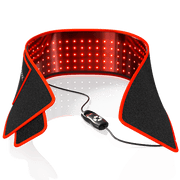
No body shape is inherently better for red light therapy. The practical question is whether a device can stay comfortably positioned and cover the area you intend to treat.
A wider, flexible wrap is often more practical for a broad, curved, tapered, or uneven area---such as the lower back, hips, or upper thigh---provided it can lie flat without pinching, slipping, bunching, or leaving visible gaps.
The decision is less about clothing size, height, or a body-shape label than it is about five fit factors:

- The circumference where the device will fasten
- The width and length of the light-emitting area
- How much the target area curves or tapers
- Whether the fastening system stays stable in your treatment position
- Whether the device can be worn according to its instructions without pressure, discomfort, or overheating
Start With the Treatment Area, Not Your Body Type
"Belt" and "wrap" are useful shorthand, but they are not standardized product categories. A device marketed as a belt may be broad and flexible; a wrap may still be too narrow, short, or difficult to secure for your intended placement. Compare the actual specifications rather than relying on the name.
Wearable belts and wraps are generally used for localized or medium-size areas, including the abdomen or back. They are not automatically the right format for treating the whole body or several large areas in one session; broader formats may be more appropriate for that goal. Guidance on matching device size to the treatment area
A wrap's flexibility can be particularly useful on contoured areas and joints. However, "larger" does not automatically mean "better." Excess material can fold at the sides, bridge across a curve, or become difficult to fasten. In that case, a smaller device that stays centered may offer more predictable surface coverage.
Measure the Exact Placement
Do not use your usual clothing size or general waist measurement as a fit check. Measure the precise location where the device will sit.
For example, the natural waist is not necessarily the measurement that matters for a device intended to fasten around the lower abdomen, widest hip area, upper thigh, or lower back.
Take these measurements before comparing products
- Circumference at the fastening point Use a flexible tape measure around the body at the exact line where the belt or wrap will close. Keep the tape level and comfortably snug, not pulled tight.

-
Target width Measure how far the intended area extends from side to side. This helps determine whether the light-emitting section is wide enough.
-
Target length Measure the up-and-down span you want to cover. A device can fasten around the body yet still be too short to cover the desired area.
-
Contour and taper Notice whether the area changes substantially in circumference over a short distance. A waist-to-hip transition, a rounded abdomen, a tapered thigh, or the curve of the lower back may affect whether a device stays flat.
-
Your treatment position Consider whether you will use the device standing, sitting, reclining, or lying down. A fit that seems stable while standing may shift when seated or reclined.
Compare the specifications that actually control fit
When reviewing a product page or manual, look for:
- Usable fastening or strap range
- Whether an extension or additional strap is available
- Light-panel width and length
- Overall device dimensions
- Closure type and adjustment points
- Intended treatment locations
- Instructions on use against bare skin, over clothing, or at a specified distance
- Guidance on session length, heat, cleaning, and safety
A stated maximum circumference is only one part of the decision. It may not explain how much overlap is required, whether an extension is included, whether the measurement assumes bare skin, or how much room is needed for a comfortable closure. A device that technically closes may still feel restrictive or fail to cover a broad target area.
Likewise, a narrow belt can fit around the torso without providing broad lower-back coverage. Fit around the body and coverage across the body are separate questions.
Let Curves, Taper, and Movement Guide the Choice
Curved areas do not make someone a poor candidate for a belt or wrap. They simply make positioning more important.
The lower back illustrates the difference. The lumbar region is curved rather than flat, so a flexible wrap may be easier to position across a broader section of the area than a rigid device. For lower-back use, the wrap should be wide enough to cover the intended lumbar area rather than only the spinal midline, and it should lie flat without arching away at the center or sides. Lower-back wrap positioning guidance

The same practical test can help with other contoured placements:
Check for flat, stable coverage
Before relying on a device for regular sessions, assess whether it:
- Lies evenly: There are no obvious raised sections, folds, or bridges over the target area.
- Stays centered: It does not slide upward, ride down, rotate, or drift onto an unintended area.
- Fastens comfortably: It is secure without digging in, compressing the body, interfering with normal movement, or requiring repeated tightening.
For a tapered waist-to-hip area, adjustability can matter more than raw strap length. A closure that permits small positioning changes may help keep the device stable. For a rounded lower abdomen or thigh, a wider flexible wrap may work well if it conforms smoothly; if it rolls at the edges or collects excess material, it may not.
For the lower back, position matters as much as size. The intended area is generally centered across the lumbar curve just above the pelvis, rather than slipping down onto the hips. If a device shifts, rides up, or arches away, the surface area actually covered changes during the session.
A Secure Fit Should Not Be a Tight Fit
Do not tighten a belt or wrap in an attempt to force better contact. For lower-back positioning, the practical guidance is a snug, non-compressive fit: stable enough to remain in place, but not painful, restrictive, or uncomfortably hot.

Comfort is not a minor detail. If a device is too tight, awkward to sit with, or difficult to keep positioned, it may be less practical to use consistently. A fit that requires constant readjustment is also a sign to reconsider the placement or format.
Wearable wraps are often designed for direct skin contact, while panels are commonly used at a distance. That is a format-level distinction, not a universal instruction. Always follow the specific device manual for skin contact, clothing, distance, treatment duration, and temperature guidance. Comparison of panels and wraps
Surface fit also should not be mistaken for proof of treatment adequacy. Light penetration is limited in deeper tissue, and a close, stable fit does not by itself establish that a device is appropriate for a deep structure, diagnosed condition, or particular therapeutic outcome. Individual responses can also vary with tissue characteristics, skin type, condition, and treatment parameters.
Seek clinical guidance for a diagnosed condition or for persistent, severe, worsening lower-back pain---especially if it is accompanied by numbness, weakness, or radiating symptoms.
A Practical Pre-Purchase Fit Checklist
Before choosing between a belt and a wrap, confirm all of the following:
- [ ] I measured the exact circumference where the device will fasten.
- [ ] I know the width and length of the area I want to cover.
- [ ] The device's usable strap range accommodates that measurement without forcing the closure.
- [ ] The light-emitting area is large enough for my target, not merely long enough to fasten around it.
- [ ] I considered taper, curvature, and how the device will behave while sitting, standing, or reclining.
- [ ] The device can lie flat without obvious gaps, folds, or pressure points.
- [ ] I reviewed the current product instructions for placement, skin distance, use, and safety.
- [ ] I understand that stable fit supports positioning and coverage, but does not guarantee a medical result.
Measure the target area first, then compare those measurements with the current BestQool product specifications and instructions. Choose the format that offers stable positioning and sufficient coverage without forcing the fit; if the listed details do not clearly answer a placement or sizing question, contact BestQool support with your measurements before deciding.


