
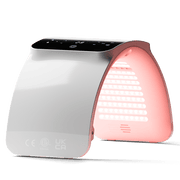
Do not rely on a universal "safe" distance for facial red-light sessions. Use the facial treatment distance and session length documented for your exact panel, but do not treat extra distance as eye protection. Avoid looking directly at the LEDs, and use protective eyewear whenever the device instructions require it.
If your panel does not provide a facial distance, session-duration guidance, eye-protection instructions, and stop-use conditions, do not build a protocol from generic online distance ranges.
Set Distance and Session Time From Your Panel's Documented Protocol

Distance is part of the treatment setup, not a stand-alone eye-safety rule. Moving farther from an LED panel generally lowers irradiance---the intensity reaching your face. That changes the skin dose, heat exposure, and total light exposure. Moving closer generally raises all of them.
But panels do not all behave the same way at the same distance. Beam pattern, panel size, LED layout, output, and measured irradiance all affect the exposure at your face. A distance that is appropriate for one device cannot automatically be transferred to another.
Session length matters just as much. A lower-intensity position used for longer can still deliver a meaningful dose, while a closer position can increase exposure and warmth quickly. Treat the manufacturer's distance and duration as a matched pair rather than adjusting one without considering the other.
Before a facial session, check three items in your model's manual:
- Facial treatment distance: Use the stated position for facial use rather than a generic inches-or-centimeters range.
- Session duration: Follow the listed time for that distance and mode.
- Eye-protection instructions: Confirm whether the manufacturer requires supplied or specified eyewear for facial sessions.
Some device protocols use distances such as 6 inches or a minimum of 20 cm, but those are examples of device-specific instructions---not universal eye-safe clearances. This point is supported by Read why panel distance and labeling matter.
Why Distance and Closed Eyes Do Not Replace Eye Protection

The key practical rule is simple: do not stare at the LEDs at any distance.
There is no universal distance in the available guidance at which every red or red/near-infrared LED panel can be viewed directly without protective measures. A treatment distance may be designed to help control skin dose, eye exposure, or both---but you need the device-specific labeling to know its intended purpose.
"I'm Farther Away, so I Don't Need Goggles"
Not necessarily. More distance generally reduces intensity, but it does not establish that direct viewing is safe. Some documented device protocols pair a specified treatment distance with supplied protective eyewear. Follow the instructions for your exact panel rather than deciding that a farther position makes eyewear optional.
"I Can Just Keep My Eyes Closed"
Closed eyelids should not be presented as equivalent to opaque, device-appropriate protective eyewear. The available evidence does not establish that closing your eyes reliably replaces eyewear when a manufacturer requires it.
If the manual calls for blackout goggles or other protective eyewear, put it on before switching the panel on. If the manual does not clearly address eye protection for facial use, seek clarification from the manufacturer's support resources rather than assuming that closed eyes are sufficient.
"It's Only Red Light"
A facial panel may use visible red wavelengths, near-infrared wavelengths, or both. That wavelength mix is relevant to the device's safety assessment, along with output, distance, and duration. It does not support treating all red and near-infrared devices as having identical eye-safety considerations.
Also, do not apply assumptions about laser-based red-light devices directly to home LED panels, or vice versa. Device type and protocol matter.
Use a Conservative Facial Setup

A cautious setup reduces avoidable mistakes without trying to calculate a personal eye-exposure limit.
- Read the model-specific instructions first. Confirm distance, duration, mode, eye-protection requirements, and stop conditions.
- Position the panel before turning it on. Set it at the documented facial distance; do not begin extremely close simply to shorten the session.
- Wear required eyewear before activation. Do not use direct LED viewing as a way to "test" brightness or comfort.
- Keep your gaze away from the LEDs. Protective eyewear does not make staring into the panel a useful part of a facial session.
- Use only the documented session duration. Do not compensate for a changed distance by guessing at a longer or shorter time.
Very close use can increase heat and skin discomfort. One device-labeling example treated 2 inches or less without a diffuser as a high-irradiance zone for repeated daily use. That does not make 2 inches a universal cutoff for all panels; it illustrates why close-range experimentation is a poor substitute for a documented protocol.
Stop the session if you experience painful warmth, persistent skin redness, or visual discomfort. Do not assume that the absence of immediate discomfort proves a setup is safe.
For concerning symptoms during or after use---such as visual discomfort or other unexpected changes---pause use and contact an eye-care professional.
When Generic Guidance is Not Enough
Do not try to self-design a facial protocol if your panel lacks key technical and safety information. A generic distance rule cannot adequately assess a device that does not provide:
- Irradiance or output information at stated distances
- Facial distance limits
- Session-duration guidance
- Eye-protection instructions
- Clear stop-use conditions
Missing documentation does not prove a device will cause harm. It does mean there is not enough information to responsibly turn a broad online recommendation into a personal safety protocol.
Use Extra Caution with Relevant Health Factors
The available information does not support condition-specific clearance rules for people with retinal disease, glaucoma, cataracts, light-triggered migraines, photosensitivity, or recent eye surgery. That absence of a universal rule should not be interpreted as reassurance that no added precautions are needed.
Seek individualized guidance from an eye-care or medical professional before continuing if you have an eye condition, recent eye procedure, a history of light-triggered symptoms, or a medication or health factor that may affect photosensitivity.
Interpret FDA Language Narrowly
If a product label mentions FDA clearance, interpret that statement as device-specific and protocol-specific. It does not mean that every home red-light panel is cleared, that every facial-use setup has been evaluated, or that unprotected direct viewing is appropriate.
The relevant question is not simply whether a device uses regulatory language. It is whether the instructions for that exact model clearly state how to position it, how long to use it, and what eye protection is required.
The right facial distance is the one documented for your specific panel and intended treatment protocol. Eye safety still depends on avoiding direct LED viewing and following the model's protective-eyewear guidance. Check your manual or official support resources before your next session, and seek eye-care guidance before use if you have relevant risks or symptoms.


