

You usually can. Overhead room light or daylight near your desk does not automatically cancel red light therapy, but it can make sessions less controlled, less comfortable, and less consistent.
Do your shoulders tighten up by midafternoon while your face, scalp, or hands barely see daylight during the workweek? Desk-side red light can still be worthwhile in a bright room, especially for skin support and localized recovery, if you use it as a short, deliberate session instead of as background decor. The key is knowing when ambient light is fine, when it gets in the way, and how to set up the session so it has a real effect.
What changes when you use red light therapy at a desk?
Specific red and near-infrared wavelengths matter more than “any bright light,” so the main question is not whether your office is lit, but whether your device is still delivering a meaningful dose to bare skin at the right distance for long enough. In real desk setups, that usually means the treatment light needs to be close enough and strong enough that its therapeutic signal is not trivial compared with the rest of the environment.
In practice, overhead lighting is usually the smaller issue. Standard office lights may add visual brightness, but they do not replace the device’s targeted wavelengths and measured output. What they do change is the experience: the red glow looks less obvious, it is easier to lose track of timing, and facial sessions can feel more irritating if screen glare is already bothering your eyes.
Natural sunlight is different because it is far more intense and broad-spectrum. That does not neutralize red light therapy, but it does make the session harder to standardize. If direct sun is hitting the same area you are treating, you no longer have a clean, repeatable setup. That matters because dose response is biphasic: too little may do very little, but too much is not automatically better.
Does ambient light reduce the benefits?
Evidence for skin, hair, and clinical use is stronger than vague claims about dramatic productivity or mood enhancement. That makes desk use easier to judge. If your goal is smoother skin, support for thinning hair, or a short session for a stiff neck or wrist, ambient light is usually manageable. If your goal is something more speculative, like all-day focus, then a sloppy setup matters more because the expected benefit is already less certain.
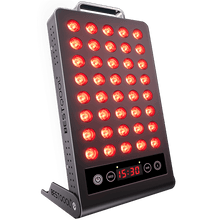
A useful way to think about it is this: room light affects precision more than possibility. A good red light panel aimed at your jawline from 8 inches away for 10 minutes is still doing its job in a normally lit office. But if the device is weak, far away, partly blocked by clothing, and competing with direct afternoon sun while you keep shifting in your chair, the session becomes more like exposure theater than a repeatable routine.
That is why intentional treatment blocks tend to work better. A short session before your first meeting or right after lunch is more practical than leaving a lamp glowing beside your monitor for three hours and assuming more time equals more benefit. At-home guidance commonly lands around 5 to 20 minutes, depending on the device and its irradiance.
Overhead lighting vs. sunlight: which matters more?

The practical difference is control.
Lighting condition |
What it usually means for desk use |
Best move |
Normal overhead room light |
Usually acceptable for most desk sessions |
Keep your device distance and timing consistent |
Bright window light nearby |
Often still acceptable if sun is indirect |
Turn slightly away from the window and expose bare skin |
Direct sunlight on treatment area |
Harder to control dose and comfort |
Move out of the sun or do the session later |
Strong screen glare plus facial treatment |
More eye strain risk and less comfort |
Angle the device away from the eyes and shorten the session |
Home devices vary widely in wavelength and power, so one person’s desk setup may involve a serious tabletop panel while another is using a small cosmetic lamp with unclear specs. That difference matters more than whether the ceiling light is on.
How to make desk sessions work
Peak wavelength and irradiance at a real distance matter because desk use is all about geometry. For surface goals such as skin tone, visible red in the 630 to 660 nm range is commonly used. For deeper targets such as joints, muscle, and some recovery use, near-infrared around 810 to 850 nm is often chosen. If a device does not clearly state its peak wavelengths and output at a stated distance, it is hard to know whether your desk routine is meaningfully dosed.
A simple desk example helps. If your panel’s instructions suggest 10 minutes at 8 inches for your face or wrist, treat that as the session. Do not double the time just because the room is bright. Do not place it 2 ft away because you want it out of the way. Those mistakes matter more than the overhead lighting itself.
Bare skin, measured distance, and regular weekly use matter more than trying to create a perfectly dark room. If you wear long sleeves, keep the treated wrist or forearm exposed. If you are treating your neck after hours at a laptop, angle the panel directly at the sore area instead of letting the light spill across the room.
Safety at a desk matters more than people think
Red light therapy is generally considered low risk when used as directed, but desk sessions create one predictable problem: eye exposure. When the device sits at monitor height, users tend to glance at it repeatedly. That is unnecessary and avoidable. You do not need to stare into the LEDs for the session to work.
This is where many preventable problems show up in everyday use. People place a panel too high and too close to their line of sight, then decide the therapy gives them headaches. Often the fix is simple: lower the panel, angle it toward the treatment area instead of the eyes, and separate work time from treatment time. If you are treating the face, especially at close range, protective eyewear is a sensible choice.
Lower power than clinic systems also means marathon sessions are not a smart workaround. More exposure is not automatically better, and overuse can increase irritation.
When should you avoid mixing red light with desk daylight?
If direct sun is hitting the treatment area, skip the multitasking instinct and move. Sunlight adds heat, glare, and variability, and it can make it harder to judge whether the device feels comfortable. This matters even more if you are treating sensitive skin, recent irritation, or a facial area that already feels warm.
If you are using photosensitizing medication, have a history of significant eye issues, get migraines triggered by light, or want to treat an area with a known medical condition, take the conservative route first. Medical sources consistently recommend realistic expectations and clinician guidance, especially because evidence quality still varies widely by condition.
So, can you do it?
Yes, with one caveat: treat red light therapy at your desk as a session, not as office ambiance. Overhead lighting is usually fine, indirect daylight is often workable, and direct sunlight is where the setup starts to lose control.
If you keep the treatment area exposed, follow the device’s actual distance and timing, and protect your eyes from unnecessary glare, desk use can be practical and consistent. The cleaner the setup, the easier it is to tell whether the light is helping your skin, scalp, or recovery instead of just making your workspace look red.


 Small
Small

 Moderate

 Moderate

 Moderate

 Full
Full

