

Use red light therapy on clean, dry skin before the rest of your morning skincare. A bathroom setup can work well if the area stays dry, ventilated, and easy to use consistently.
Ever look in the mirror at 7:15 AM and see puffiness, uneven tone, or that tired, creased look that no cleanser seems to fix? With consistent use over several weeks, red light can support smoother texture, calmer-looking skin, and softer fine lines, but the benefit usually comes from routine rather than a single session. The easiest approach is to fit it into a real morning without turning your sink counter into a science experiment.
Why the bathroom routine can work
Red light therapy for skin care has enough credible medical research behind it to justify a practical home routine, especially for visible signs of aging, mild redness, and general skin support. In everyday life, the bathroom is often the one place where you already cleanse, check your skin in good light, and apply moisturizer and sunscreen, so it makes sense to put the session there instead of adding a separate ritual elsewhere in the house.
Photobiomodulation is the technical term for this process. In simple terms, specific red and near-infrared wavelengths are absorbed by the skin and may affect cellular energy, inflammation signaling, circulation, and collagen-related activity. That does not make red light a cure-all, but it helps explain why it is often used for skin rejuvenation, acne support, wound healing, and scar care.
The best order in your morning skincare routine
Clean, bare skin is the most evidence-aligned starting point for an at-home facial session because makeup, sunscreen, sweat, and thicker products can interfere with how evenly light reaches the skin. In practice, the simplest sequence is to wash your face, pat it fully dry, use the device, and then apply a hydrating serum, moisturizer, and sunscreen.
Using red light before skincare is also the lower-irritation option for most people. If you apply strong actives first, especially retinoids, benzoyl peroxide, or exfoliating acids, you may increase irritation on already reactive skin. Morning sessions are especially easy to organize because sunscreen naturally comes last.
A bathroom-friendly sequence that actually fits a weekday
At-home devices are usually less powerful than in-office systems, so consistency matters more than trying to do a long session. A workable example looks like this: cleanse for about 30 seconds, dry your face completely, sit or stand at the mirror with the device at the recommended distance, complete the treatment cycle, then apply a simple hydrating layer and finish with broad-spectrum sunscreen before leaving the bathroom.
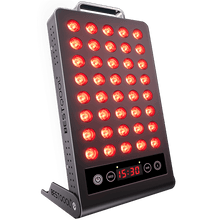
If your device is a mask, the session may be as short as 3 to 10 minutes. If it is a panel or wand, common home-use timing is often about 5 to 20 minutes per treatment area, usually from roughly 6 to 24 inches away depending on output and design. The only correct setting is the one your device manufacturer specifies, because dose changes with both distance and duration.
How long, how often, and what results to expect
Repeated use over time matters more than a single perfect morning. For facial skin goals, a realistic home routine is several sessions per week, with many expert and patient-facing clinical sources pointing to gradual improvement over roughly 2 to 12 weeks, and often longer for fuller cosmetic results.
A controlled skin-rejuvenation trial helps explain why patience matters. Clinical research has shown improvements in skin feel, complexion, roughness, wrinkles, and collagen-related measures after repeated sessions, not after one-off exposure. That matches what most home users notice first: the skin may look a little calmer or fresher early on, while changes in fine lines and firmness usually take longer.
Why dose matters
Dose matters because red light appears to follow a biphasic response: too little may do very little, and too much is not automatically better. That is why standing twice as close to a panel for twice as long is not a smart shortcut. It is also why a short daily mask protocol can be more useful than occasional long sessions that irritate the skin or make the routine too hard to maintain.
Making the bathroom setup safe and effective

Eye protection still matters, especially if you are facing a bright panel or using a device that instructs you to shield your eyes. Red light is generally considered non-ionizing and non-heating when used correctly, but shining intense light directly into the eyes or ignoring device instructions creates unnecessary risk.
Home-use safety matters even more in a bathroom because sinks, splashing water, and rushed mornings create avoidable mistakes. Keep cords away from wet countertops, dry your hands before touching the controls, and do not store the device where steam from a hot shower collects every day unless the manufacturer says that environment is acceptable. A dry drawer or shelf outside the main splash zone is the better choice.
When to skip your session
LED light precautions are especially relevant if you are taking photosensitizing medications, have a history of skin cancer, inherited eye disease, or very reactive skin. It is also sensible to postpone a session if your face is sunburned, freshly over-exfoliated, or visibly irritated from shaving, peels, or strong acne treatment. Calm skin tends to tolerate light better than already stressed skin.
What red light can help with, and what it probably will not
The strongest research support in dermatology is for improving some signs of skin aging and for hair growth, not for every wellness claim attached to social media devices. For a morning face routine, the most reasonable goals are softer fine lines, less visible redness, modest texture improvement, and support for a healthier-looking overall complexion.
Evidence remains limited for many claims, so it is better to think of red light as a helpful adjunct rather than a replacement for proven basics. It does not replace sunscreen, sleep, moisturizer, prescription acne care, or a dermatologist’s evaluation for rosacea, melasma, suspicious lesions, or persistent breakouts.
Pros and cons of doing it in the bathroom
Bathroom routine advantage |
Real-world limitation |
It pairs naturally with cleansing and sunscreen. |
Humidity, cords, and splashing water need attention. |
Morning use makes consistency easier. |
Rushed mornings can lead to skipped or shortened sessions. |
Mirror lighting helps with even placement. |
Counter space is often tight for panels and chargers. |
Clean-skin sequencing is straightforward. |
Some devices are better used while seated outside the bathroom. |
At-home red light devices can be a practical addition to skincare when expectations stay realistic. The upside is convenience, low downtime, and easy pairing with a sensible routine. The downside is that results are usually gradual, device quality varies, and a poor setup can make you inconsistent enough that the treatment never gets a fair trial.
A simple way to judge whether your routine is working
Gradual improvement rather than overnight change is the right mindset. Take a makeup-free photo in the same bathroom lighting on day one, then again every two weeks. If, after 6 to 8 weeks, you notice no change in redness, texture, or fine lines, review the basics first: clean skin, correct distance, correct timing, regular use, and a device suited to facial treatment.
Steady, clean-skin use in the morning is usually the sweet spot: wash, dry, treat, moisturize, protect. If your skin looks calmer, more even, and a little less tired over time, that is the kind of result red light therapy is best suited to deliver.


 Small
Small

 Moderate

 Moderate

 Moderate

 Full
Full

