

Yes, but it usually works better as a short recovery add-on than as a meaningful in-workout performance tool. Whether it helps depends more on dose, device strength, and consistency than on squeezing in a few random seconds during rest.
Do your muscles feel tight before the next set even when your timer says go? Research on photobiomodulation shows real biological effects on muscle tissue and recovery markers, but the biggest benefits depend on dose, device strength, and consistency rather than a few random seconds under a panel. Here is when bench-side use makes sense, when it wastes time, and how to do it without turning your workout into a gadget ritual.
What “using it between sets” really means
Red light therapy uses red and near-infrared light rather than heating tissue the way a heating pad or sauna does. For gym use, near-infrared matters most because it reaches deeper tissues than visible red light, making it more relevant for quads, glutes, chest, shoulders, and other training muscles.
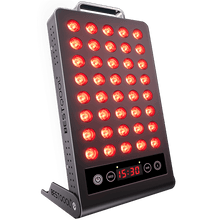
In practical gym terms, using it between sets means exposing a muscle group during your rest period while seated on a bench, usually with a panel, wrap, or targeted device aimed at the area you just trained or are about to train. That can work if the setup is already in place and the light can reach bare skin or very thin clothing, but it becomes awkward fast if you have to keep repositioning a handheld device, changing clothes, or cutting your rest short.
The short answer for lifters: possible, but not ideal for every set
Human muscle research suggests photobiomodulation can help with muscle recovery, but the results depend heavily on the protocol. That matters because a normal hypertrophy rest period might be 60 to 90 seconds, while many home-use recommendations are closer to 5 to 20 minutes per treatment area. In practice, that makes bench-side use most realistic during longer rest blocks, circuit transitions, or while training one body part and treating another.
A good example is lower-body day with long breaks after heavy squats. If you already have a panel set at bench height and your quads are exposed, a planned 3- to 5-minute exposure spread across several rest periods may be workable. If you are doing fast-paced dumbbell presses with 45-second rests, adding light therapy in the middle will usually disrupt your training more than it helps.
Where the evidence is strongest, and where it is still shaky
The more evidence-aware view is that red light therapy has limits. Stanford’s overview is notably cautious about broad claims for sports performance, while muscle-focused reviews and rehab summaries are more positive about soreness, fatigue, and post-exercise recovery. The most reasonable takeaway is that recovery support is easier to defend than dramatic mid-workout strength gains.
Technical reviews of photobiomodulation describe deeper-tissue effects from, along with a Goldilocks dosing problem: too little may do very little, and too much may reduce the benefit. That nuance matters more than many gym conversations admit. Sitting under a panel for a few seconds between curls is probably underdosed; staying there too long between every set may reduce training density without adding much payoff.
Clinical-style summaries for home users reinforce the same point. If you only use red light on random bench breaks when you remember, you should not expect a reliable effect. A repeatable plan usually matters more than whether the light happens before, during, or after one specific set.
When it makes the most sense between sets
Pre-exercise and immediate post-exercise use both appear in the research, which gives bench-side use a narrow but reasonable role. It makes the most sense when you are targeting a large muscle group, resting long enough to keep training quality intact, and using a device that covers the area without constant repositioning.
A panel next to a bench is more practical than a tiny wand. A long rest period on heavy bench press, hip thrusts, or split squats is more practical than a metabolite-heavy superset. A target like quads, pecs, hamstrings, or delts is also more practical than trying to hit deep hip tissue through clothing on a busy gym floor.
General home-use guidance often suggests 5 to 10 minutes per area. That means one useful strategy is to treat bench-side exposure as part of a larger session rather than the whole session. For example, you might do 3 minutes on your quads during warm-up, add a few more minutes during longer rests, and finish the remainder after training instead of forcing a complete dose into every rest interval.
When it is a poor idea
Red light therapy should not replace the fundamentals of recovery. If your rest times, sleep, protein intake, hydration, or program design are poor, sitting under a panel between sets will not fix that. It is an adjunct, not a substitute for the basics that actually drive adaptation.
It is also a poor idea when it changes your lifting mechanics or focus. If you are twisting to face a panel, rushing your set because the device timer is running, or losing the mental reset you need for heavy work, the tradeoff is wrong. The session still has to serve the workout.
Safety guidance is generally favorable when devices are used properly, but eye protection and correct device use still matter, especially in a gym where bright panels can face your eyes at close range. It also makes sense to avoid improvised use if you are photosensitive, taking medications that increase light sensitivity, or trying to treat a medical injury that needs diagnosis rather than self-experimentation.
How to make bench-side use practical

The simplest rule is to match the device and the rest interval to the muscle you care about. A larger panel placed about 6 to 24 inches away, depending on device instructions, is generally easier for areas like the chest, quads, or back than a small handheld unit. Near-infrared, or a combination of red and near-infrared, is usually the more practical choice for exercise recovery than red alone because muscle is not a surface-only target.
Here is the common-sense comparison:
Situation |
Bench-side use quality |
Why |
Heavy sets with 2 to 4 minutes of rest |
Good |
Enough time to get meaningful exposure without rushing |
Short 45- to 90-second rests |
Poor |
Usually too short to matter and may disrupt training |
Large panel already set up |
Good |
Better coverage and less fiddling |
Poor |
Too much setup for too little exposure |
|
Targeting quads, chest, shoulders |
Better |
Easier access and coverage |
Targeting deep or covered areas |
Worse |
Harder to expose tissue effectively |
Better device selection comes down to disclosed wavelength and output, not just marketing language. If a device does not list its basic specs, it is hard to know whether your between-set experiment has any chance of reaching a useful therapeutic range.
So, should you do it?
If you enjoy it, already have the setup, and can keep workout quality high, bench-side red light therapy is a reasonable recovery experiment. The best expectation is modest help with soreness and tissue recovery over time, not a dramatic strength boost from one glowing rest break.
Used well, it can fit into training. Used casually and inconsistently, it is mostly just another thing between you and the next set.


 Small
Small

 Moderate

 Moderate

 Moderate

 Full
Full

