

Possibly—but 20 minutes is not a universal safety or effectiveness limit. A larger back does not automatically need a higher light dose on each square centimeter of skin.
The important distinction is between:
- More total time to cover separate areas of the back, and
- More exposure time on the same area of skin.
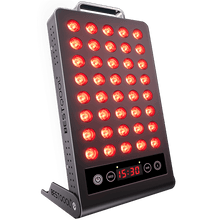
If your panel does not cover your whole back evenly, the practical approach is usually to treat the upper and lower back in separate positions, using the intended dose for each section. Do not simply leave the device on one position longer because your back is large.

Twenty Minutes Is a Guideline, Not a Universal Cutoff
A 20-minute timer can be a useful device-use guideline, but it does not by itself tell you whether a session is too short, appropriate, or excessive. Session time depends on the device’s irradiance at your treatment distance, the area it covers, and its instructions for use.
For example, guidance for a red/near-infrared back belt describes about 10–20 minutes at a time for a sore lower or mid-back. That is practical guidance for that belt and use case—not proof that every panel, distance, or whole-back setup must stop at 20 minutes. Read the belt-use guidance
Published photobiomodulation protocols also vary substantially. That variation is one reason not to treat "20 minutes" as a universal safety ceiling or an automatic target.
Think in Dose per Section, Not Minutes per Body Part
Light dose, often called fluence, is measured in joules per square centimeter (J/cm²). The basic relationship is:
Fluence (J/cm²) = irradiance (W/cm²) × time (seconds)
Irradiance is the light power reaching the treatment surface. It must be stated or measured at the distance you actually use—not inferred from LED count, electrical wattage, a maximum timer, or a marketing power figure.
A simple illustration: if you know your device's irradiance at the skin (in W/cm²) and your session time in seconds, you can calculate fluence as irradiance × time. That calculation is only useful if the irradiance value is documented at your chosen distance. Distance, beam spread, edge coverage, and movement all affect the dose that reaches the skin. See the technical dosing reference

A whole back needs more coverage, not automatically more dose per section. If each area receives the intended J/cm², treating additional sections changes your total appointment time—not necessarily the dose delivered to any one part of your back.
Before changing your timer, check these details
- Your model’s recommended treatment distance
- Its irradiance at that distance
- Its stated session-duration or fluence guidance
- Its effective coverage area, including whether output is intended to be even near the panel’s edges
- Whether the manual permits repositioning or longer total use
If the documentation does not give usable irradiance, distance, or session guidance, avoid trying to create a longer protocol from the timer alone.
When a Panel Does Not Cover Your Whole Back
Use the device’s verified coverage guidance to decide whether one position is enough.
If your whole back fits within the intended coverage area
Stay at the recommended distance and use the planned exposure for that single position. Do not extend the time solely because the treated area is broad.
If your whole back does not fit
Divide it into sections. For example:
- Treat the upper back for the planned per-section exposure.
- Reposition for the lower back.
- Apply the same planned exposure to that second section.
This can make your total session longer than 20 minutes while avoiding extra exposure to the first section.
Moving farther away may make the illuminated field look larger, but it also changes irradiance and can make the actual dose less certain. Use a greater distance only when your device instructions support it—not as an improvised way to cover more of your back.

Keep your eyes out of the direct beam. Do not stare into bright LEDs, and follow device instructions on eye protection, particularly when using a powerful panel at close range or if your eyes are light-sensitive. Review the eye-safety guidance
Why a Research Dose Is Not a Home-Panel Prescription
It is tempting to find a study dose and convert it into more minutes at home. That is rarely reliable.
A systematic review of fibromyalgia trials summarized protocols using 4–60 J per site, 2–3 sessions per week, for 4–12 weeks. Those figures describe varied clinical-study protocols in a specific population; they are not a whole-back prescription for nonspecific back discomfort, skin-focused use, muscle recovery, or your particular panel. Read the fibromyalgia protocol review
There is also reason not to assume that more light is always better. A cell-culture study found a biphasic response to 660 nm laser exposure: some lower doses were associated with greater cell proliferation and viability, while higher tested doses were associated with reduced cell growth and mitochondrial activity. Its numerical thresholds cannot be applied directly to a person’s back or to a different device, but the broader lesson is useful: longer exposure is not automatically more beneficial. See the cell-culture dose-response study

Use Heat and Skin Response as a Stop Signal
A mild sense of warmth can occur. It should not become uncomfortable.
Stop the session rather than extending it if you notice:
- Uncomfortable heat or burning
- Stinging
- Pronounced redness
- Lingering irritation
- Dryness or flaking
- Increased skin sensitivity
- Headache, eye strain, nausea, or unusual fatigue
If symptoms appear, pause use until they settle. For future sessions, reduce exposure time or use a different distance only if the manufacturer permits that setup. Persistent or concerning symptoms warrant medical advice. See practical warning signs during home-panel use
A non-thermal treatment goal is not a guarantee that every setup will remain comfortable. Heat can build differently depending on the device, distance, room conditions, skin response, and duration.
Get Individual Advice Before Extending Sessions If Any of These Apply
Ask a clinician or pharmacist before self-directed use—especially before increasing session length—if you:
- Have a photosensitive condition
- Take a medicine that may increase light sensitivity
- Have an active, undiagnosed lesion in the treatment area
- Have a history of skin cancer in the intended treatment area
- Are pregnant
- Are considering use for a child
These are precautionary situations, not a diagnosis or a blanket statement that light therapy is unsafe for every person in these groups. They do mean that a generic home-use timer is not enough to make an individualized decision.
A Whole-Back Plan That Does Not Overexpose One Area
Before going beyond 20 minutes, work through this sequence:
- Confirm your exact device’s recommended distance, irradiance, and session guidance.
- Check whether your full back fits within its verified effective coverage area.
- If it does not, split the back into sections rather than adding time to the same section.
- Apply the intended dose to each section, keeping positioning and distance consistent.
- Stop if heat, irritation, eye discomfort, or other symptoms develop.
- Seek professional advice if symptoms persist or if medication-related photosensitivity, relevant skin history, pregnancy, or other medical uncertainty applies.


 Small
Small

 Moderate

 Moderate

 Moderate

 Full
Full

