
Red or near-infrared light may modestly support lower-face skin quality for some people, but it is not a proven way to contour the jawline, tone facial muscles, reduce a double chin, or change jaw structure. Treat it, at most, as a cautious skin-quality adjunct---not as a replacement for treatment or evaluation matched to fat, skin laxity, dental structure, or a neck concern.
Start with What is Making the Jawline Look Less Defined

A softer jawline can have more than one cause. Submental fullness may involve both under-chin fat and skin laxity, and factors such as weight changes, posture, genetics, and age-related changes in skin can all affect the visible transition between the chin and neck.
A simple mirror check can help frame the question, but it cannot diagnose the cause.
| What You Notice | What May Be Contributing | Is Red Light a Logical Primary Solution? |
|---|---|---|
| A thick, persistent, pinchable roll beneath the chin | A substantial submental-fat component may be involved | No. Red light is not a direct fat-removal treatment. |
| Crepey skin, fine folds, or a neck that looks looser when looking down | Skin laxity may be contributing | Possibly as a modest skin-quality trial, with restrained expectations. |
| A jawline that has always appeared recessed or uneven | Dental, bite, skeletal, or facial-anatomy factors may be involved | No. Light therapy does not change bone structure or correct a bite. |
| New or changing swelling beneath the jaw or in the neck | Causes can include swollen lymph nodes, thyroid issues, or fluid retention | No. Seek clinical assessment rather than treating it as a cosmetic issue. |
Fat and laxity commonly coexist. A persistent under-chin fullness plus loose skin does not point to one simple fix, and it does not establish that light treatment is appropriate.
Do not self-treat a new, one-sided, painful, persistent, or otherwise symptomatic enlargement around the jaw or neck. Swallowing or breathing symptoms, a lump, enlarged glands, dental pain, or a bite change warrant evaluation by a medical or dental professional.
What Red Light May Support---and What It Does Not Contour
The most reasonable expectation for red light on the lower face is gradual support for skin appearance, not structural reshaping. If a person notices a change, it would be more plausibly described as a subtle improvement in skin quality, elasticity, or the look of fine creasing than as a newly sculpted jawline.
Red light used in dermatology is commonly discussed in the visible red range, and one dermatology consensus describes penetration of approximately 5 mm into the dermis and skin appendages. That depth does not demonstrate treatment of deeper submental fat or facial muscles.
Plausible Expectations
- Modest support for lower-face skin quality or a firmer-looking skin surface
- Gradual rather than dramatic visual changes
- A result that may be difficult to separate from normal changes in lighting, posture, skin hydration, or swelling
Expectations to Avoid
Red light therapy has not been established as a way to:
- Dissolve submental fat or remove a double chin
- Tighten substantial skin laxity to a facelift-like degree
- Sharpen the jawbone or alter facial structure
- Correct a bite, recessed chin, or dental issue
- Reliably increase cosmetic facial-muscle tone
The evidence often cited for photobiomodulation and muscle performance does not answer the facial-tone question. A systematic review of photobiomodulation for muscle performance and recovery examined exercised skeletal muscles, such as quadriceps, biceps, hamstrings, and calf muscles---not facial muscles or jawline contour.
Likewise, a clinical photoaging protocol should not be repurposed as a jawline prescription. A dermatology consensus lists red light at 630±10 nm, 40--80 mW/cm², and 40--100 J/cm², two to three sessions weekly for photoaging. Those parameters are not validated for under-chin fat reduction, facial-muscle toning, jawline contouring, or unsupervised use around the upper neck.
Use a Device-Manual-Led Lower-Face Routine

There is no source-supported universal placement method for a panel, mask, or handheld device on the jawline, under-chin area, or upper neck. That means there is no evidence-based universal angle, distance, session length, contact method, or thyroid-avoidance rule to copy from a generic online routine.
Before treating the lower face, verify the following for your exact device model:
- Whether facial and neck use are included in its intended instructions
- The current manual, rather than a retailer listing or a routine written for another device
- The stated treatment distance and exposure time
- Eye-related instructions and warnings
- Contraindications and medication-related cautions
- Whether the manual addresses upper-neck use at all
A device-safety buying guide emphasizes checking the exact model's manual, treatment distance, exposure time, warnings, and contraindications. Having those materials does not prove a device can contour the jawline; it simply gives you the minimum information needed to use it as instructed.
Do Not Proceed Until You Have Clarified These Points
Pause and seek clinical advice before use near the jawline or upper neck if you have eye concerns, photosensitivity, relevant medication use, suspicious skin changes, or a medical condition that could affect safe use.
The available information does not provide specific clearance guidance for the thyroid, salivary glands, teeth, jaw implants, or dental hardware. Do not infer that a device is appropriate over those areas simply because it emits red or near-infrared light. The exact device manual and a clinician's advice should guide that decision.
For a panel, follow only the manufacturer's stated distance and orientation. For a mask or handheld device, use only the placement and exposure instructions supplied for that model. Do not lengthen sessions or combine multiple devices in an attempt to force a contouring result.
Run a Limited Trial and Judge It Honestly

A cautious trial is more useful than indefinite treatment based on day-to-day mirror impressions. Commercial lower-face routines sometimes describe visible skin changes over roughly 8--12 weeks, with earlier changes in tone or radiance suggested sooner. That is not a controlled jawline-contouring timeline, and it is not a promise that a result will occur.
Use a simple three-step approach.
-
Create a baseline. Take photos before starting, then repeat them at planned intervals using the same camera distance, lighting, head angle, posture, facial expression, and time of day. Note recent weight changes or unusual swelling that could affect appearance.
-
Follow the manual consistently. Use only the treatment distance, session duration, frequency, and eye instructions verified for your device. Do not treat a photoaging protocol as a home routine for the jawline or neck.
-
Assess the right outcome. Look for modest skin-quality changes rather than a smaller double chin or a sharper bone structure. If there is no meaningful, repeatable difference under standardized conditions, do not respond by escalating exposure.
More light is not necessarily better. Photobiomodulation has a biphasic dose response: lower light levels may stimulate biological activity, while excessive levels may inhibit it. That principle does not provide a validated home dose for the jawline, but it is a reason not to exceed the device's instructions.
If you experience persistent irritation, redness, or discomfort, discontinue treatment and consult a healthcare professional.
Choose the Next Step That Matches Your Goal
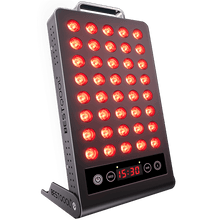
If your goal is modest support for lower-face skin appearance, a consistent, conservative routine may be reasonable when your exact device---including a BestQool device, if applicable---has verified instructions for facial or neck use and you can track results under standardized conditions.
If your goal is a visibly sharper jawline, double-chin reduction, major tightening, or correction of a bite or structural issue, red light therapy is unlikely to be the answer. A dermatologist, qualified aesthetic clinician, dentist, or medical professional can help identify whether fat, laxity, anatomy, dental factors, or a health concern is driving the change.


 Small
Small

 Moderate

 Moderate

 Moderate

 Full
Full

