
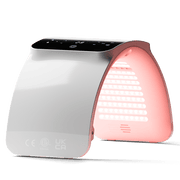
Yes---provided the light, clamp arm, and attachment surface are compatible and remain stable at the instructed position, a clamp-mounted setup can keep your hands free during a facial session.
But hands-free is not the same as effortless, full-face, even, or repeatable exposure. The ease of use depends on the mounting surface, arm stability, available clearance, and your treatment position.
Clarify What the Clamp is Supporting

"Clamp device" can describe two different arrangements:
- A light with an integrated clamp that attaches directly to a surface.
- A separate clamp-on arm that holds a compatible light or small tabletop panel.
The available format evidence specifically documents the second arrangement: a desk-mounted clamp arm supporting a smaller panel. In that configuration, the arm can hold the panel without the user supporting it and may allow positioning above the user, behind the user, or at different angles.
That can be genuinely hands-free---but only after setup. You still need to attach the clamp, position the arm, aim the light, and confirm that it stays in place. A clamp arm's flexibility can be useful when a fixed stand cannot reach the desired position.
A Practical Hands-Free Test
A clamp setup is hands-free only when the clamp fits securely on a stable surface and the arm can hold the panel at the desired position without drifting, as described in the evidence for the desk-mounted arm stand. Additionally, follow the electrical precautions from the device manual: keep cords and chargers intact, avoid use around water unless explicitly permitted, and do not use a device with damaged housing, exposed wiring, a swollen battery, unusual heat, or an unusual odor.
Do not assume that a desk, shelf, counter, or bed frame is appropriate simply because it has an edge. Compatibility, grip condition, reach, clearance, and load limits are specific to the mount and should be verified in its instructions.
Hands-Free Does Not Guarantee Full-Face Coverage

A clamp arm can hold a small light in place, but the mount itself says nothing about the illuminated area. Small tabletop panels are commonly described for targeted treatment, including the face, yet that does not establish that one position covers an entire face evenly.
A panel's size, treatment-area guidance, placement, and distance all matter. So do the contours of the face: the forehead, cheeks, chin, and areas near the eyes do not sit on one flat plane. A light that appears centered may still place some areas outside the documented treatment area or at a different angle than intended.
Likewise, LED count is not a measure of facial coverage, irradiance, or exposure evenness. A smaller panel may be suitable for a facial area, but its specifications---not its clamp or LED count---determine what the manufacturer instructs for use.
Test Repeatability, Not Just Reach
Before relying on a clamp-supported position, ask whether you can recreate it every time:
- Can you center your face in the device's stated treatment area?
- Can you maintain the instructed distance without leaning forward or backward?
- Can you keep the same angle without the arm shifting?
- Can you use the setup without repeatedly moving it between facial areas?
- Can you mark or remember the chair, clamp, and arm position for the next session?
Useful device documentation should include treatment-area guidance, session instructions, irradiance measurement distance and conditions, and eye-safety directions. A device-documentation checklist can help identify the details needed to compare formats. Those specifications still do not, by themselves, prove uniform exposure across the whole face---but they give you a basis for setting up the device as instructed.
Match the Format to Your Treatment Position
The most convenient format depends on where and how you plan to use it. A clamp can be highly practical in one setting and awkward in another.
| Treatment Position | Clamp-Supported Light | Panel on a Stand or Fixed Mount |
|---|---|---|
| Seated at a desk | Can work if the desk has a suitable clamp surface and the arm can reach the desired position. | A tabletop or floor stand may offer a simpler fixed position if it can be placed at the documented distance. |
| Reclined in a chair | No evidence available for this position with a clamp arm. | A mobile or fixed stand can be easier if it places the panel directly in front of the seated position. |
| Lying down | No evidence available for overhead use of a desk-mounted clamp arm. | Purpose-built horizontal panel supports are designed for lying-down arrangements, though adjustment convenience varies by design. |
| Dedicated treatment space | Offers flexibility and can be removed when not needed. | A wall-mounted panel can be stable and space-saving once installed, but it is not readily movable. |
For a seated desk routine, a clamp may be convenient when there is a solid attachment point at the right height and enough room to position the light without the arm obstructing your face or posture.
For lying-down use, the question is more demanding. A clamp arm that can angle a light upward or outward is not automatically suitable for holding it over you. If the intended routine requires overhead positioning, use only a support arrangement specifically documented for that purpose.
Wall-mounted and fixed panel setups reduce movement once installed, which can make the placement easier to reproduce. Their trade-off is less flexibility: a wall mount needs an appropriate wall and dedicated space, and moving it later may require a new installation location.
Check Stability, Clearance, and Electrical Conditions

The convenience of hands-free treatment should not override basic setup checks. Before use, inspect the full arrangement---not just the light.
Ensure the mount is designed for the panel size and that the clamp is securely attached according to the mount's instructions. Then follow the electrical precautions from the device manual: keep cords and chargers intact, avoid use around water unless the manufacturer explicitly permits that use, and do not use a device with damaged housing, exposed wiring, a swollen battery, unusual heat, or an unusual odor.
A fixed panel may reduce the chance of day-to-day arm movement, while a clamp can make a compact setup easier to relocate. Neither format is automatically safer; the safe choice is the one you can install, position, and inspect correctly.
Follow Device-Specific Facial and Eye Guidance
Do not improvise treatment distance, session time, or frequency to make one format behave more like another. A clamp-mounted light and a larger panel can both be hands-free while having different instructions for facial positioning and use.
Follow the exact manual for the device being used, especially for:
- Intended facial-use guidance
- Treatment distance and treatment area
- Session duration and frequency
- Eye-protection or eye-positioning instructions
- Ventilation and heat precautions
Do not stare directly into active LEDs or place a light close to the eyes unless the device instructions specifically address that use. Stop use if you experience burning, significant warmth, pain, rash, blistering, or persistent irritation. People using photosensitizing medicines or managing photosensitivity should seek advice from their prescribing clinician or pharmacist before use.
A clamp can make facial treatment hands-free when the mount and setup are stable, compatible, and repeatable. A panel may be easier to repeat when its stand or fixed placement supports broader, more centered illumination at the documented position. Choose based on verified mounting feasibility and the device's exposure guidance---not on the "hands-free" label alone.


