

Red light therapy and near-infrared light therapy may help some people reduce pain and stiffness related to lower-back and sciatic-type symptoms, but they are best treated as a supportive tool rather than a guaranteed fix. The most useful home routines usually center on the lower back, glutes, and the path of the radiating pain, with device distance, session time, and consistency mattering more than intensity alone.
If your pain shoots from the low back into the buttock, thigh, calf, or foot, you are probably trying to calm an irritated pain pattern rather than “heal a nerve” in one session. In a small controlled sciatic-nerve model, PMC reports that red LED photobiomodulation reduced pain hypersensitivity and improved sensorimotor function, which is encouraging—but that is not the same as proving the treatment cures human sciatica. This guide shows where to place the device, what ranges are commonly used, and when to stop and get medical care. A wearable option like Redot M can fit lower-back-focused sessions when targeted coverage is more useful than a panel setup.
What Sciatica And Radiating Leg Pain Usually Mean

Sciatica is a symptom pattern, not a single diagnosis. It usually describes pain that starts in the lower back or deep buttock and travels along the nerve path into the leg, sometimes with tingling, numbness, or weakness. The source can be a disc issue, spinal narrowing, muscle-related irritation, or another problem, so the label alone does not tell you the cause.
Radiating leg pain from the lower back is important because the location guides placement. For home light therapy, that usually means the lower back and deep glute region are the first targets, with the leg used as a secondary target if pain extends farther down the chain. If symptoms include progressive weakness, numbness in the groin area, bowel or bladder changes, fever, major trauma, or rapidly worsening pain, you should seek prompt medical evaluation rather than relying on self-care.
How Red Light And Near-Infrared Light Are Thought To Help
What The Therapy Is
Red light therapy and near-infrared light therapy are forms of photobiomodulation, meaning light is used to influence biological activity in tissue rather than to heat the body in the way a sauna or heating pad does. Visible red light is typically used for more superficial tissue, while near-infrared light is generally favored when the target is deeper tissue such as the low back, glutes, or hamstring region.
Why Wavelength And Dose Matter
The practical idea is simple: wavelength, power, distance, and session duration determine how much energy reaches the target area. Reviews of low-intensity laser and LED photobiomodulation for musculoskeletal pain suggest that response depends heavily on the dose and protocol, not just on “using a red light device” in general. In plain language, a weak device held too far away may do little, while an overpowered setting held too close may be uncomfortable or poorly tolerated.
A useful home rule is to think in terms of coverage and consistency first. You want enough light on the lower-back and buttock region to treat the painful segment, enough distance to follow the manufacturer’s safety instructions, and enough session time to keep the exposure repeatable. That is especially relevant when pain is more deep or radiating, because the practical target is usually the tissue closest to the suspected source of irritation, not just the spot where symptoms are felt.
Where To Place The Device For Lower-Back-Related Leg Pain
Best Starting Area: Lower Back And Deep Glute
For most people with radiating pain that starts in the low back, the first placement is centered over the lower lumbar area and upper glute region on the painful side or across both sides if symptoms are bilateral. If the pain travels into the buttock, that area is often a strong second target because the gluteal region sits between the spine and the leg path.
If your device has a panel or wrap, the goal is to cover the painful zone with steady, close-but-safe exposure rather than moving the light constantly around. For a panel, that usually means positioning it toward the lower back with the beam angled so it reaches the paraspinal and upper-glute area. For a wrap, it means keeping the wrap flat against the low back or upper buttock area without bunching or pressing into irritated tissue.
When To Shift Toward The Leg
If the pain is mostly down the thigh or calf rather than in the low back, the lower-back source still often remains the first target because the symptom is referred along the nerve path. The leg itself can be treated as a secondary area, especially if there is a clear muscle-tension component in the hamstring or calf. That said, if the problem is coming from the spine, treating only the calf is usually too far downstream to be the most efficient starting point.
A practical sequence is: low back first, then buttock, then the most symptomatic part of the leg if you have enough coverage or time. This keeps the session anchored to the likely source while still addressing the part that hurts most.
What Session Variables Matter Most At Home
Distance, Time, And Frequency
For home use, the three variables that matter most are distance from the skin, session length, and weekly consistency. Manufacturer instructions differ widely, which is why a home setup should follow the device’s own safety and dosing guidance instead of assuming all red light products are interchangeable. Reviews of photobiomodulation for pain control emphasize that protocol details drive outcomes.
A practical starting pattern for many home users is 5 to 15 minutes per target area, 3 to 5 times per week, adjusting for device strength, coverage, and skin tolerance. Stronger devices may need less time at a greater distance; weaker devices may require more time or closer placement within the safe range. If a wrap or panel makes the skin hot, causes irritation, or leaves lingering discomfort, the session is too aggressive for that user and should be scaled back.
Red Light Versus Near-Infrared For Sciatica
Red light is better suited to more superficial tissue, while near-infrared is generally more relevant when the target is deeper lower-back or glute tissue. For a sciatica-like pain pattern, that usually makes near-infrared the more practical choice for the main session, with red light serving as a complement if the device combines both wavelengths.
That does not mean near-infrared is automatically “better” in every case. It means the anatomy of radiating lower-back pain often favors deeper penetration, especially when the most likely target is the low back, deep glute, or proximal hamstring area rather than only the skin surface.
What The Evidence Suggests And What It Does Not
Encouraging But Not Definitive
A controlled animal study found that red LED photobiomodulation reduced pain hypersensitivity and improved sensorimotor function after spinal cord injury, which supports the broader idea that light therapy can influence pain-related pathways. Separate clinical reviews of low-intensity laser and LED therapy describe it as a potentially useful option for musculoskeletal pain control, but they also show that results depend on the condition, dose, and treatment setup.
In other words, the evidence is supportive but not absolute. It suggests that some people may feel less pain or stiffness, but it does not justify promising nerve regeneration, disc repair, or guaranteed relief from sciatica. If symptoms are severe, progressive, or not changing after a reasonable trial, a clinician should reassess the cause.
Reasonable Expectations
A home device is most likely to help when the pain is part of a broader musculoskeletal pattern: irritated lower back, tight glutes, protective muscle guarding, or chronic soreness that flares with sitting or bending. It is less likely to be enough by itself when there is significant neurologic loss, major structural compression, or a condition that needs another treatment plan.
That is why the best expectation is modest and practical: less pain, better tolerance for movement, and easier recovery around the irritated area. Think “supportive symptom management,” not “replacement for diagnosis or rehab.”
How To Build A Safe Home Routine
A Simple Routine To Start
- Place the device over the lower back and upper glute region, not just the leg.
- Use the manufacturer’s recommended distance and stay within the safe output range.
- Start with shorter sessions and watch for skin irritation, heat, or symptom flare.
- Repeat consistently for 2 to 4 weeks before judging whether it is helping.
- If symptoms worsen, spread down the leg more aggressively, or include weakness or numbness, stop self-treatment and seek medical advice.
How To Adjust For Sensitivity
If the area is very sensitive, begin with the device farther away, shorter sessions, and less direct exposure over the most irritated tissue. If you are using a wrap on the low back, make sure it is not compressing a sore spot or increasing discomfort when you sit or lie down afterward. The safest approach is the least aggressive setting that still lets you complete the session comfortably and repeatedly.
When To Stop
Stop the session if you get burning, marked irritation, headache from the light exposure, eye discomfort, or a clear worsening of radiating pain. Also stop if symptoms begin to look less like a simple pain flare and more like nerve compromise, such as increasing numbness, weakness, or loss of function.
How To Choose A Home Device
What To Look For
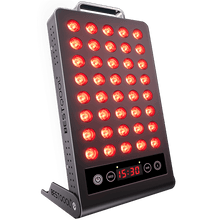
For lower-back and sciatica-style pain, the most relevant device features are wavelength range, output power, treatment area size, safety features, and whether the device is easy to position over the low back and glutes. A larger panel is often easier for back pain because it covers more of the painful zone at once, while a wrap can be more convenient for seated use.
If you are comparing products, prioritize near-infrared capability for deeper tissues, clear dosing instructions, and a design that lets you place the light where the pain actually starts. A device that is hard to position on the low back is less useful than a simpler one that you can use consistently.
Comparison Table: Common Home Setup Choices
Option |
Best Use Case |
Main Advantage |
Main Limitation |
Small panel |
Spot treatment on the low back or buttock |
Easy to aim |
Limited coverage |
Large panel |
Lower back plus glute area |
Better coverage |
Less portable |
Wrap |
Seated or hands-free use |
Convenience |
Less control over exact beam angle |
Red + near-infrared combo |
Mixed superficial and deeper discomfort |
Broader targeting |
More settings to manage |
Safety And When To Get Medical Advice
Red and near-infrared light therapy is generally used as a wellness or supportive recovery tool, not as a stand-alone treatment for serious nerve symptoms. Standard consumer devices are sold as fitness or wellness products, and they are not medical devices for diagnosing or treating sciatica. Keep manufacturer safety instructions, eye protection guidance, and session limits in view every time you use one.
Get medical advice sooner if pain is severe, persistent, or paired with weakness, numbness, fever, trauma, or bowel or bladder changes. Also get checked if the pain pattern changes rather than gradually improving, since radiating leg pain can come from several different causes and not all of them are appropriate for self-care.
Practical Action Checklist
- Confirm the pain pattern starts in the lower back or deep buttock and radiates down the leg.
- Place the device over the low back and upper glute first, then move to the most symptomatic leg area if needed.
- Use the manufacturer’s recommended distance, output, and session time.
- Start with short, comfortable sessions and increase only if the area tolerates it.
- Use the device consistently for 2 to 4 weeks before deciding whether it helps.
- Stop and seek medical evaluation if symptoms worsen, spread, or include weakness or numbness.
- Choose a device with enough coverage and near-infrared output for deeper tissue use.
Key Takeaways
Red light therapy and near-infrared therapy can be a reasonable home-support option for sciatica-like pain, especially when the pain pattern starts in the lower back and refers into the leg. The most practical setup is usually aimed at the low back and upper glute region, with near-infrared favored for deeper tissue exposure and session consistency favored over improvisation.
Use it as a bounded support tool, not a cure. If symptoms are stable and mild to moderate, a careful home routine may help with pain and stiffness; if symptoms are progressive or neurologic, stop self-treatment and get evaluated.
Q: Can Red Light Therapy Help Sciatica And Radiating Leg Pain?
A: It may help some people reduce pain and stiffness, especially when the pain seems tied to lower-back irritation or muscle guarding, but it is not a guaranteed fix and it should not replace medical evaluation when symptoms are severe or changing.
Q: Where Should I Put The Device For Radiating Leg Pain?
A: Start with the lower back and upper glute area, because that is often the source zone for leg radiation; treat the thigh or calf only as a secondary area if the device coverage allows and the symptoms extend that far.
Q: What Is The Safest Home Routine To Start With?
A: Use the manufacturer’s distance and session guidance, begin with short sessions, keep the device on the lower back or glute area, and stop if you get irritation, heat discomfort, or worsening radiating pain. If symptoms include weakness, numbness, or bowel or bladder changes, seek medical care promptly.


 Small
Small

 Moderate

 Moderate

 Moderate

 Full
Full

