

The simplest fix is to keep red light out of your partner’s direct line of sight: move sessions earlier, angle the panel away from the bed, use eye protection, and add a physical light barrier when needed.
Is your partner rolling over, covering their eyes, or waking up when your red light panel turns the room crimson? Most at-home routines only need a focused 10 to 20 minutes, so a few setup changes can protect your consistency without turning the bedroom into a light show. Here is how to keep your routine while making the room sleep-friendly for someone else.
Why Red Light Therapy Glare Is a Real Bedroom Problem

Red light therapy is a noninvasive light exposure method that uses red or near-infrared wavelengths, often through masks, handheld wands, caps, or panels; red light therapy is commonly used for skin appearance, recovery, and wellness routines. The issue in a shared bedroom is not just brightness. It is direction, timing, reflection, and whether the light hits your partner’s eyes while they are trying to wind down.
Glare happens when bright light enters the eyes directly or bounces off reflective surfaces such as mirrors, glossy dressers, white bedding, framed glass, or a cell phone screen. Even if red light feels warmer and calmer than blue-white light, a full panel aimed across the room can still be visually intense. Short-term use appears generally safe when devices are used as directed, but misuse may harm the skin or eyes, which is why eye protection matters in any home routine.
In practice, the bedroom problem usually shows up in three ways: the panel faces the bed, the session happens too close to sleep, or the user treats “more light” as better. Those are fixable.
Start With Timing Before Buying Accessories

The easiest anti-glare solution is often scheduling. Many at-home protocols use sessions around 5 to 20 minutes per body area, and several wellness and dermatology sources describe regular use over weeks as more important than marathon sessions. One overview recommends starting with shorter sessions and using red light therapy consistently over several weeks, with typical treatment windows of 5 to 20 minutes.
If your partner goes to bed at 10:30 PM, a 10-minute session at 9:00 PM in another room is usually less disruptive than a 20-minute session at 10:25 PM beside the bed. If the bedroom is the only practical space, try finishing before your partner begins their sleep routine. This also makes it easier to remove lotions, expose the intended treatment area, clean the device, and avoid rushing.
Red light is not the same as blue light, but a bright panel near the face can still feel alerting simply because it is bright. Some home-use guidance recommends avoiding bright panel exposure close to bedtime, especially direct facial exposure. That does not mean everyone must avoid evening use, but if your partner is sensitive to light, the shared-bedroom rule should be simple: finish the session before lights-out, not during lights-out.
Control the Beam, Not Just the Brightness
A red light panel should be aimed at the treatment area, not across the room. Red light therapy usually applies continuous red light to a targeted skin area, often in the 630 to 700 nanometer range. That targeted approach matters in a bedroom because the most partner-friendly setup treats your body as the endpoint, not the room.
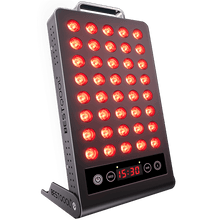
For a panel, place it so your body blocks the beam from reaching your partner. If you are treating your back, face the wall and let the panel shine toward your back from behind the bed area, not toward the mattress. If you are treating your legs, sit beside the panel with the light aimed downward or toward a wall corner. If you use a face mask, choose one with built-in eye shielding and avoid sitting where the mask glows directly toward your partner’s pillow.
Distance also changes glare. Many home routines place devices roughly 6 to 24 inches from the body, depending on manufacturer instructions and power. Moving a panel farther away may reduce visual intensity, but it also changes dose, so do not guess wildly. The more reliable fix is changing the angle, adding a barrier, or using a smaller device for targeted areas.
Use Eye Protection for You and Darkness Protection for Them

Eye protection is not just a comfort accessory. Safety guidance cautions users to avoid shining red light directly into the eyes and emphasizes that device effectiveness varies by wavelength, duration, frequency, and strength. If you are facing a panel, wear the goggles supplied by the manufacturer or red-light-specific protective eyewear.
Your partner does not need therapy goggles if they are not participating, but they do need darkness. A contoured sleep mask can help, but it should not be the first or only fix if the panel is blasting across the bed. Better options are a folding room divider, a blackout curtain hung from a tension rod, or simply moving the device so a closet door, open wardrobe door, or tall chair blocks the light path.
Here is a practical bedroom test: lie where your partner lies, turn the device on for a few seconds, and look for direct LEDs or bright reflections. If you can see the bulbs, your partner can too. If the wall is glowing but the bulbs are hidden, the setup is usually much more tolerable.
Choose the Right Device for a Shared Room

Bigger panels are efficient, but they are not always the best shared-bedroom choice. At-home options include masks, panels, wands, caps, combs, and helmets, while in-office devices are generally stronger than home products; at-home devices vary by purpose and design. For a partner-sensitive room, the best device is often the one that treats the smallest area well.
Setup |
Best For |
Bedroom Glare Risk |
Main Tradeoff |
Facial skin routine |
Low to medium |
Less useful for body recovery |
|
Handheld wand |
Small joints, scars, spot treatment |
Low |
Slower for large areas |
Small tabletop panel |
Face, neck, knees, hands |
Medium |
Needs careful aiming |
Recovery, broad coverage |
High |
Most likely to light the room |
A large panel can still work if you can place it in a closet opening, bathroom doorway, or corner where your body blocks the beam. If your routine is mainly facial, a mask or small panel may be a better bedroom compromise than a full-height unit.
Reduce Reflections in the Room

Reflective glare is easy to miss. A panel aimed away from your partner can still bounce off a mirror, glossy closet door, window, framed print, or pale wall. The fix is low-tech: close curtains, cover mirrors temporarily, turn framed glass away, and avoid placing the device near shiny furniture.
For example, if your panel sits on a dresser across from a mirror, the mirror may send a bright red reflection straight to the bed. Move the device 2 ft to the side, angle it toward a darker wall, or drape a dark towel over the mirror during the session. This is not about making the room look better; it is about removing secondary light paths.
Do Not Solve Glare by Overusing the Device

It can be tempting to shorten the distance, increase the intensity, or “get it done faster,” but that is not how photobiomodulation should be treated. A recent product-focused review explains that red light therapy can follow a biphasic dose response, where low doses may help but excessive exposure may reduce benefit or increase unwanted effects; biphasic dose response is one reason to follow device instructions instead of improvising.
The partner-friendly version is simple. Keep the recommended time, distance, and frequency, then improve the environment around the session. If your device says 10 minutes at a specified distance, do that in a better position rather than standing much closer for 5 minutes with the panel lighting up the bed.
A Shared-Bedroom Setup That Usually Works

A practical evening setup looks like this: finish the session 30 to 60 minutes before your partner plans to sleep, place the panel in a corner or against a wall, aim it only at the body area being treated, wear protective eyewear if your face is exposed, and block any direct line of sight with a divider, closet door, or curtain. Keep mirrors and glossy surfaces out of the beam.
If you use red light mainly for recovery after workouts, consider moving the routine to a bathroom, spare room, garage gym, or home office. If you use it for facial skin care, sit at a vanity or desk with a small device instead of turning on a body panel beside the bed. Consistency matters, but so does making the habit easy for the person sharing the room.
When to Be Extra Cautious
People with eye conditions, light sensitivity, a history of skin or eye cancers, pregnancy, photosensitizing medications, or unusual symptoms should get professional guidance before using red light therapy near the face or eyes. Personal discussions about red light and eye health can be useful for context, but they are anecdotal rather than controlled safety standards, which is why eye conditions deserve medical input instead of bedroom experimentation.
For skin-focused use, dermatology guidance also recommends choosing devices designed for the specific concern, following directions exactly, and using recommended eye protection. That advice is especially relevant in a shared bedroom because the person not receiving therapy did not choose the exposure.
FAQ
Can my partner just close their eyes?
Closed eyes are better than staring toward a panel, but they are not a complete comfort solution. If the device is bright enough to glow through eyelids or wake someone, reposition the device or add a barrier instead of asking your partner to tolerate it.
Is red light safer for sleep than blue light?
Red light is generally less associated with circadian disruption than blue light, but a bright panel can still disturb sleep through glare and alertness. The safest shared-room approach is to keep bright therapy sessions away from your partner’s bedtime routine.
Should I use a dimmer setting?
A lower intensity can reduce glare if your device offers manufacturer-approved settings, but do not change settings blindly if the protocol depends on a specific distance and output. Use the manual first, then solve glare with angle, timing, and barriers.
A Partner-Friendly Routine Is Still an Effective Routine

Red light therapy does not need to dominate the bedroom to be consistent. Keep the light targeted, protect eyes, reduce reflections, and schedule sessions before your partner is trying to sleep. The best setup respects both goals: your recovery routine and their dark, quiet room.


 Small
Small

 Moderate

 Moderate

 Moderate

 Full
Full

