

Red light therapy works best as a consistent recovery tool alongside exercise, mobility, and sleep. For sore or stiff joints at home, short targeted sessions before or after workouts are usually more useful than occasional use.
Red light therapy fits best as a short, consistent recovery block around your workouts, not as a replacement for strength work, mobility, sleep, or medical care. For sore, stiff joints at home, the most useful approach is usually targeted sessions before or after training, repeated over weeks rather than used once in a while.
Does your knee feel rusty when you step onto the treadmill, or do your shoulders stay tight long after a lifting session ends? The most reliable practical benefit is not an overnight cure, but a smoother warm-up, less post-workout soreness, and a routine you can actually stick to at home. You’ll leave with a simple way to fit red light therapy into your gym schedule, choose realistic timing, and avoid common setup mistakes that waste time and money.
Where Red Light Therapy Fits in a Joint-Friendly Home Gym
Red light therapy as photobiomodulation is a noninvasive approach that uses red and near-infrared light to influence cellular activity without relying on heat. In plain terms, it is usually used as a recovery tool: you expose a painful or stiff area to a light panel, pad, or wrap for a short session, with the goal of making movement feel easier and recovery more manageable. In a home gym, that means it belongs next to your mobility band, foam roller, and incline bench, not in place of them.
The best current evidence on symptom relief suggests it may help, especially for inflammatory issues and some musculoskeletal pain. That matters if your main problem is morning stiffness, achy knees after squats, or cranky elbows after pressing. It matters less if you are dealing with a clearly mechanical problem such as an unstable joint, a major ligament tear, or advanced joint damage, because red light is not proven to fix those issues.
In real home use, the people who get the most value from this tend to be the ones already doing the boring but effective basics. If you are strength training twice a week, walking daily, and doing five to 10 minutes of joint-specific mobility, adding a 10- to 20-minute light session can be a sensible next step. If you are skipping sleep, rushing warm-ups, and training through sharp pain, the light is unlikely to rescue the routine.
What It May Help, and What It Will Not
Research on arthritis and joint symptoms is promising but still mixed, largely because studies use different wavelengths, doses, treatment times, and target areas. That is the main reason one study can show meaningful symptom relief while another shows little change. The practical takeaway is simple: if you try it, judge it by function over time. Pay attention to whether you can get through your warm-up faster, whether stairs feel easier, and whether stiffness fades sooner after training.
Short home sessions for joint comfort are often in the 15- to 20-minute range several times per week. That makes red light therapy appealing for a home gym because it is easy to attach to a habit you already have. For example, if your lower back and hips stiffen after deadlifts, a post-workout light session while you do slow breathing and easy stretching is realistic. A protocol you repeat four times a week usually beats the perfect protocol you do twice a month.
There are tradeoffs. Limits of lower-powered home devices mean results may come more slowly. Cost is another real downside, especially since many devices are not covered by insurance. The upside is control: you can use a device exactly when your joints usually act up, whether that is before your first set of lunges or after an evening bike ride.
The Easiest Way to Add It to Your Workout Timing

Red and near-infrared light have both been used around exercise, with two practical strategies: brief pre-exercise exposure to help prepare tissue, and post-exercise exposure to support recovery. If stiffness is your main limiter, pre-workout use makes sense. If soreness and lingering irritation are the bigger problem, post-workout use is usually easier to notice.
Before Training for Stiff Joints
A short pre-exercise session may help with muscle readiness. For a home gym user with stiff knees, that can look like five minutes of light on each knee, followed by five minutes of easy cycling, then bodyweight squats before loading the bar. The goal is not to treat the entire workout with light. The goal is to arrive at your first working set feeling less restricted.
If your shoulder feels sticky before upper-body days, use the light first, then move immediately into shoulder circles, band pull-aparts, and two lighter ramp-up sets. That sequence is practical because it stacks one gentle input after another rather than expecting a device to do all the work.
After Training for Soreness and Irritation
Post-workout sessions are commonly used to support recovery. This is the easier option for most people because you are already in the gym space and your schedule pressure is lower. A simple example is 15 minutes on the knees, low back, or elbows after training while you hydrate and let your heart rate come down.
For many home users, this is the most sustainable pattern: train, cool down, use the light, then leave the gym area. Over a month, that gives you roughly 12 sessions if you train three times per week, which is enough time to judge whether your joints are becoming easier to live with.
How to Build a Routine You’ll Actually Keep
Consistency matters more than occasional use, and that is where most home routines either work or fall apart. A good starting rhythm is three sessions per week for the first month, tied to your existing workouts. If your joints are especially stiff in the morning, you can instead use it before a mobility session on non-lifting days.
A practical way to test usefulness is to choose one joint and one benchmark. If your right knee is the problem, track how it feels during the first 10 bodyweight squats, during stairs later that day, and when you get up after sitting for 30 minutes. That is more useful than asking a vague question like whether you feel better.
Light routines that fit daily habits tend to work better, which is a principle borrowed from broader light therapy use. In practice, that means putting the device where you already stretch or lift, plugging it in ahead of time, and deciding in advance whether it belongs before or after your workout. Friction kills consistency faster than imperfect settings do.
Choosing a Device Without Falling for Marketing
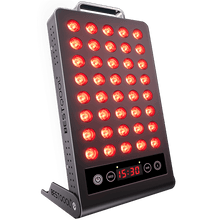
Measured output over glossy claims matters more, even though Yale’s guidance is about bright light therapy rather than red light therapy. The consumer lesson still applies: many light devices sound impressive but deliver less useful light than buyers expect. For joint pain in a home gym, the most practical setup is usually a device large enough to cover the target area without awkward repositioning every two minutes.
Wavelengths commonly studied for recovery and pain include red and near-infrared light, and near-infrared is generally the more relevant option for deeper tissues. If your issue is a superficial area like a tender tendon near the surface, red light may still be useful. If the problem feels deeper, such as a hip joint or thicker muscle around a knee, combined red and near-infrared coverage is usually the safer bet.
This is also where expectations need to stay grounded. Ongoing uncertainty in patient experiences is exactly why device shopping gets messy. A more expensive panel is not automatically better, and a cheap wearable wrap is not automatically useless. The better question is whether the device makes it easy to treat the same area consistently for several weeks.
Safety, Limits, and When to Pause
Red light therapy is generally considered low risk when used as directed, but low risk is not the same as right for everyone in every situation. Protect your eyes if the device is very bright, avoid staring into the LEDs, and follow the manufacturer’s timing instructions rather than assuming longer sessions are always better. If you take medications that increase light sensitivity or have an eye condition, it is sensible to check with a clinician first.
Cautions for photosensitive groups are worth noting, and while that source focuses on bright light rather than red light, the broader warning about photosensitivity still applies. It also makes sense to stop and reassess if a joint becomes more swollen, hotter, or more painful, because that can signal a problem that needs medical evaluation rather than more recovery tools.
If your joint pain is constant, wakes you at night, or comes with locking, giving way, fever, or obvious weakness, that is a medical issue first and a home-gym optimization question second. Red light therapy can be a useful support, but it is not a shortcut around diagnosis.
A well-placed red light session can make a home gym feel more recovery-friendly, especially when stiffness and low-grade joint pain keep interrupting training. Use it consistently, pair it with smart strength and mobility work, and judge it by better movement over time rather than hype.


 Small
Small

 Moderate

 Moderate

 Moderate

 Full
Full

