

The simplest fix is usually to move your treatment position closer to power instead of stretching the setup across the room. Red light therapy works best when distance, angle, and timing stay consistent.
Does your setup fall apart the moment you realize the panel cord will not reach the sofa without stretching across the room? In real home routines, the biggest improvement usually comes from making the setup easier to repeat, because many home protocols center on short sessions several times per week rather than one perfect session once in a while. A practical setup helps you place the device correctly, choose the right seating, and keep the treatment distance realistic.
Why the outlet problem matters more than it seems
A common home-panel distance of about 6 to 12 inches makes an outlet on the far wall more than a minor inconvenience. If your body ends up 3 or 4 ft away because the sofa cannot move, the problem is not just comfort. The light reaching the target area may drop enough to make the session less useful. That is one reason some home users feel a device does nothing when the real issue is placement.
A 10- to 20-minute session done consistently over weeks is a more sensible starting point than trying to compensate with very long sessions from across the room. In practice, if you cannot hold the recommended distance comfortably and repeatably, the room layout is working against the therapy.
The best fix is usually to bring your body to the outlet

A dedicated treatment space usually works better than an improvised corner of the couch. In most living rooms, that means placing the panel near the outlet and bringing over a stable chair, bench, or small ottoman instead of insisting that the sofa remain the treatment spot. This solves three problems at once: power becomes simple, distance becomes repeatable, and the panel angle becomes easier to line up with your knees, back, face, or shoulders.
Consider a common example. If your panel is designed for use around 8 to 12 inches away and your sofa sits 5 ft from the nearest outlet, the most efficient solution is usually to place the panel beside the outlet and set a chair 10 inches away facing it. That preserves the intended dose far better than leaning sideways off the sofa or placing the panel on a coffee table several feet away.
A sofa-friendly room can still have a treatment station
A close, consistent setup on clean, exposed skin matters more than making the therapy look elegant in the room. A small chair near a side wall, a timer on a side table, and a marked floor position for the panel often create a smoother routine than trying to keep everything centered around the couch. If the panel treats your lower back or quads, the chair can face sideways. If the goal is facial skin support, a straight-on seated angle is usually easier.
This approach works because it matches how red light therapy is typically used at home. Sessions are short, but they repeat. If setup takes five frustrating minutes every time, consistency usually slips before you have time to see results.
If you want to stay on the sofa, change the device, not the distance
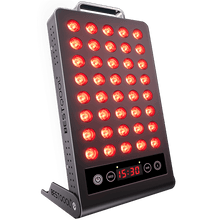
A device matched to the treatment goal and body area matters even more when the outlet is awkward. If the sofa is nonnegotiable because of mobility, comfort, or family logistics, a small panel on a rolling stand, a flexible therapy pad, or a handheld device may fit better than a floor panel that expects you to sit or stand close to it. For a shoulder, knee, or lower back, a pad or compact targeted device is often more realistic in a living room than a large panel balanced on furniture.
Setup choice |
Best when |
Main advantage |
Main tradeoff |
Small panel near chair |
You can move your seat |
Better repeatable distance |
Less lounging comfort |
Flexible pad on sofa |
You want localized treatment |
Easy positioning on curved areas |
Less coverage |
Handheld device |
Very small treatment area |
Precise spot use |
Slower for larger areas |
Large panel across room |
Rarely ideal |
Broad coverage if positioned correctly |
Distance usually becomes the weak point |
The practical rule is simple: if the room forces you to use a broad-coverage device like a spot tool, switch to a spot tool. If the room lets you hold the right distance easily, the larger panel keeps its advantage.
Do not try to make up for distance with extra time
The dose-response pattern is not simply more is better. Red light therapy is often described as hormetic, meaning too little may do very little, an appropriate dose may help, and too much may reduce benefit or irritate skin. That is why stretching a 10-minute close session into a 30-minute far-away session is not a smart workaround.
A general starting rhythm of about 2 to 5 sessions per week fits many at-home routines, with some wellness-focused sources suggesting 3 to 5 sessions weekly and 10 to 20 minutes per area. If your outlet problem makes every session a production, simplify before you intensify. A basic setup you actually use four times a week is better than a perfect layout you skip.
Safety and buying judgment matter here
An FDA-cleared home device and careful use by the directions matter more than trying to engineer around a poor room fit. Home devices are generally less powerful than clinic systems, and that is not automatically a problem, but it does mean the tested distance and timing matter. If the only way your panel works in the living room involves an awkward cable path, unstable furniture placement, or guesswork about distance, that is a sign to rethink the room or the device format.
A medical check-in before home use may be worth considering if you have photosensitivity, eye concerns, a history of skin or eye cancer, are pregnant, or are using the device for a skin or hair issue rather than general wellness. That matters because the strongest human evidence is still more convincing for some skin-rejuvenation and hair-growth uses than for the broader wellness claims often seen in marketing.
What realistic expectations look like
The better-supported uses for skin and hair deserve the most confidence. If your goal is recovery comfort, mild muscle soreness, or a consistent self-care routine, a clean and repeatable setup is still worthwhile. Just keep expectations grounded: the living room layout should help you deliver the intended session, not turn the device into a whole-body cure because it glows red.
If the outlet is too far from the sofa, the cleanest answer is usually to create a small treatment station near power or switch to a device meant for close, localized use on the couch. When the setup becomes easy, the routine usually becomes consistent, and consistency is where home red light therapy has the best chance to be useful.


 Small
Small

 Moderate

 Moderate

 Moderate

 Full
Full

