

Short work breaks can be enough for red light therapy when sessions are brief, targeted, and consistent. The key is to use the 5 to 15 minutes you already have instead of trying to build a new routine around longer sessions.
Do you hit that familiar wall in the middle of the workday, when your shoulders feel stiff, your eyes feel tired, and your focus starts drifting between tabs? You do not need a spa-style routine to make red light therapy workable. Most home guidance centers on short 10- to 20-minute sessions repeated over weeks, not long one-off treatments. Here is a practical way to fit it into real breaks without turning your calendar into another wellness project.
Why short breaks can work
Red light therapy is a noninvasive light-based treatment that usually uses visible red wavelengths for surface-level targets and near-infrared light for deeper tissue. In practical terms, that means a face mask or small panel may make sense for skin-focused goals, while a panel, pad, or wrap with near-infrared is often a better fit for neck tension, low back tightness, or post-workout soreness.
A useful starting principle is the biphasic dose response: too little may do very little, while too much may blunt the benefit. That matters on busy workdays because you do not need extra-long sessions just in case. In practice, a moderate dose you can repeat consistently is usually better than a longer session that disrupts meetings, lunch, or your commute.
Most consumer guidance and clinician-facing summaries point to short sessions done several times per week, with results building over weeks or months rather than after one treatment. That pattern is exactly why work breaks can be enough: the advantage comes from repetition, not from a single long session.
The easiest way to fit it into a workday
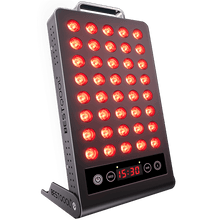
In practice, the least disruptive setup is the one that removes decisions. Leave the device where you already pause, such as near your desk, beside a stretching area, or next to the chair where you take a midmorning break. A small panel or flexible pad is usually easier to use during work hours than a larger setup, especially if your goal is one stubborn area like the neck, shoulders, jaw, or lower back.
Home-use guidance often places devices about 6 to 24 inches from the body, with many protocols starting at 5 to 10 minutes and building toward 10 to 20 minutes. A similar beginner pattern often starts with three to five sessions per week during the first month. If your break is short, that usually means treating one area well instead of trying to cover your whole body poorly.
Break window |
Best use case |
Practical setup |
5 minutes |
Beginner test session or one small area |
Sit still, expose bare skin, and target the face or one sore spot |
10 minutes |
Most realistic work-break session |
Treat the neck, shoulders, low back, or face at the device’s recommended distance |
15 minutes |
Deeper recovery day or lunch break |
Use it for one larger area, or one side and then the other on alternating days |
The schedule becomes easier when you match the session to the break instead of forcing the break to fit the device. A 10-minute coffee break can become a 10-minute shoulder session. A lunch break can become a 12-minute panel session followed by a short walk. If you only have 5 minutes before your next call, use that as a starter dose instead of skipping the day entirely.
A realistic work-break routine

If your goal is desk-related tension
Near-infrared light is commonly used for deeper tissue targets such as muscles and connective tissue, so this is where a panel or wrap often makes more sense than a cosmetic face mask. If you get tight across the upper traps by 2:30 PM, a realistic routine is 10 minutes on the neck and shoulders three to five times per week, with the device positioned close enough to deliver a useful dose without pressing into the skin unless the product is designed for contact use.
This is also where expectations need to stay honest. Red light is not a cure-all, and the evidence is stronger for some skin and hair uses than for broad performance or general wellness claims. If your shoulders hurt because your monitor is too low and you have not moved in four hours, the light may be a helpful support, but it is not a substitute for ergonomics, walking, hydration, and strength work.
If your goal is skin support during the day
Red light has better support for wrinkle reduction than for many broader claims. A practical midday skin routine is often 10 minutes with a face mask or compact panel on clean, bare skin, done consistently enough that it becomes part of your work rhythm rather than a separate event.
The main benefit of a daytime slot is adherence. If evenings are crowded or unpredictable, putting the session between tasks often means you actually do it. Typical home sessions in the 10- to 20-minute range fit a break far better than a long evening ritual that keeps getting postponed.
How to avoid disrupting your schedule
The first rule is to pick a fixed trigger, not a vague intention. Tie the session to the same part of your day, such as right after your first long meeting, at the start of lunch, or immediately after you shut your laptop for the afternoon. Consistency is easier when the cue is already built into your schedule.
The second rule is to avoid overextending a session. Longer-than-recommended exposure is unlikely to improve results, and misuse has been linked to burns, blisters, and eye injury. If your break is 10 minutes, do a 10-minute session and stop. Falling asleep under a device or stretching a session to 30 minutes because you missed yesterday is not a smart trade.
The third rule is to choose timing that fits the device. Devices that include blue light are often better earlier in the day, since blue light may be more disruptive later on. For plain red or red plus near-infrared, many people tolerate midday use well, which makes it a cleaner fit for short work breaks.
What benefits are realistic, and what are not
A fair evidence-based view is that home red light therapy has better support for certain skin and hair uses, while broader claims remain less settled. That means it is reasonable to use a short break session for facial skin maintenance, mild stiffness, or workout recovery support. It is less reasonable to expect a 10-minute desk break to transform sleep, mood, metabolism, and chronic pain all at once.
That difference matters because it shapes the plan. The review of the science is more skeptical about sweeping claims for athletic performance, sleep, chronic pain, and several other popular uses than many wellness sellers are. A practical reading of that gap is simple: use short work-break sessions for focused goals with clear feedback, and judge success by something observable, such as less neck stiffness at 4:00 PM, steadier skin texture after several weeks, or reduced post-lift soreness the next day.
Pros, Limits, and Safety During the Workday
A major upside of at-home use is convenience and repeatability. When a device is nearby, you are more likely to use it often enough to learn whether it helps. Short break sessions also lower the friction that usually kills habits because they do not require travel, changing clothes, or a full recovery routine.
The tradeoff is that home devices are often less powerful than clinic devices, so benefits may be slower or more modest. There is also a learning curve around distance, timing, and coverage. If you stand too far away, keep clothing over the area, or keep changing devices and protocols, you may never deliver a consistent enough dose to tell whether it works for you.
Eye protection and device quality matter. Use a device designed for the goal you have in mind, follow the manufacturer’s distance chart, and protect your eyes when treating near the face. It is also wise to talk with a clinician before starting if you are pregnant, photosensitive, taking light-sensitizing medication, managing an active skin condition, or considering use over an area affected by cancer or cancer treatment.
A short break is long enough to do red light therapy well if you keep the dose modest, the setup simple, and the goal specific. When it fits naturally into your day, consistency stops feeling like discipline and starts feeling like routine.


 Small
Small

 Moderate

 Moderate

 Moderate

 Full
Full

