
A much weaker wavelength does not automatically make the whole panel ineffective. It may reduce the dose---and therefore the potential contribution---of that particular wavelength, while the stronger channel can still deliver its own dose. The practical question is whether the weak channel matters for your goal and whether its output at your actual treatment distance is intentional, within specification, or genuinely out of specification.
There is no universal "acceptable" red-to-near-infrared output ratio. Light-therapy protocols vary by wavelength, dose, frequency, duration, and intended application. The right comparison is not whether every LED looks equally bright or carries the same electrical rating; it is whether each relevant wavelength delivers the documented optical output under comparable conditions.
First, decide whether the weaker channel is important to your goal

Multi-wavelength panels are not necessarily designed for equal output at every wavelength. Red light is generally described in the 620--700 nm range, while near-infrared spans roughly 700--1440 nm. Research and clinical discussions use wavelengths such as 630 nm, 660 nm, 808 nm, and 830 nm in different contexts, rather than treating them as interchangeable across dermatologic photobiomodulation applications.
That does not mean a particular wavelength guarantees a particular outcome. It does mean that an imbalance matters most when the weaker wavelength is central to the reason you chose the panel.
Before assuming the panel is ineffective, ask:
- Which wavelength appears weak? Identify the claimed peak wavelength or channel, not just the LED color you can see.
- Is that wavelength important to your intended use? A channel that is supplementary for one goal may be more important for another.
- Can the panel still be used in a documented mode that fits your goal? A stronger channel may still provide meaningful exposure, but it does not replace the missing contribution of the weaker one.
A panel can therefore be usable without being perfectly balanced. Conversely, a weak channel can be a meaningful problem if it was a main reason you selected that configuration.
"Weaker" should mean lower optical output at the skin
Several common comparisons are misleading.
| Comparison | Why it is not enough |
|---|---|
| Visible brightness | Near-infrared light may be difficult or impossible to judge visually. Visible red brightness also does not quantify output. |
| LED count | The number of packages, lenses, chips, or channel positions does not establish optical output from each wavelength. |
| Electrical wattage | An LED's stated electrical rating does not reveal how much optical power each wavelength channel emits. |
| A single total irradiance number | Total panel output does not show how much of that output comes from each wavelength. |
| One meter reading | A reading at one point, distance, or operating condition may not represent the treatment field or a specific channel. |
The more useful measurement is wavelength-resolved irradiance at the treatment surface. Irradiance is power density, usually expressed in mW/cm², at a stated distance. It determines how quickly energy dose accumulates:
$$\text{Dose (J/cm²)} = \frac{\text{Irradiance (mW/cm²)} \times \text{time (seconds)}}{1000}$$
For a multi-wavelength panel, that comparison needs to be resolved by channel. A total irradiance reading can tell you that the panel emits light, but not whether 660 nm, 850 nm, or another wavelength is contributing the amount claimed.
Verify the measurement before diagnosing a problem

An apparently weak channel is often a measurement question before it is a product-failure question. To compare readings meaningfully, keep the test conditions consistent.
Record the conditions that affect output
A useful measurement log includes:
- Panel model and selected mode
- Which wavelengths or channels are enabled
- Distance from panel to sensor
- Warm-up state and elapsed operating time
- Meter model and its calibration or wavelength suitability
- Sensor position: center, edges, and representative points across the intended treatment area
- Whether measurements were taken directly under LEDs or at the actual treatment distance
Distance matters. Irradiance can fall substantially as the sensor moves away from the panel, and a close-range reading may not represent what reaches your skin during normal use.
Location matters too. A strong center reading with weaker edge readings can reflect beam pattern, lens design, or incomplete beam overlap at that distance. A weak result at one corner does not necessarily mean the entire wavelength channel is weak. Repeat readings across the usable treatment area rather than relying on a single center or edge measurement.
Confirming a wavelength is present is not the same as measuring its strength
A spectral peak can help confirm that a panel emits near its claimed wavelength. It does not, by itself, show the irradiance, dose, or output ratio of that channel.
Likewise, a consumer meter may not respond equally to red and near-infrared wavelengths. Some general-purpose solar power meters can overstate narrow-band red/NIR panel irradiance because they detect wavelengths outside the intended bands. Phone-camera wavelength apps may help identify visible colored light, but they should not be treated as calibrated near-infrared irradiance instruments.
For a meaningful comparison, request or use a method that can distinguish the relevant wavelengths and document the test conditions. At minimum, an output claim should state:
- Measurement distance
- Enabled wavelengths or mode
- Meter type
- Measurement location
Without those details, two irradiance figures may not be comparable.
Why unequal output can occur

A difference between channels is not automatically evidence of failed LEDs or a faulty driver. Several explanations are possible, and the correct next step depends on what the documentation and repeated measurements show.
| Possible explanation | What to check next |
|---|---|
| Intentional channel design | Ask whether the manufacturer specifies unequal channel output, drive levels, or a wavelength-specific design rationale. |
| Heat or operating behavior | Compare output after warm-up and later in a normal session. Lower output over time can be related to thermal behavior. |
| Distance or beam-pattern effects | Repeat at the actual treatment distance and at several locations, not only directly in front of a single LED. |
| Meter mismatch or test artifact | Confirm that the meter is suitable for the wavelengths being compared and that it can resolve channel-specific output. |
| Potential out-of-spec condition | Compare repeatable, wavelength-specific readings with the published specification and stated tolerance. |
Manufacturers may operate LEDs below maximum ratings to manage heat and efficiency. That can be an intentional design choice, but it cannot be assumed from a wattage label or visual inspection. The same is true in the other direction: normal thermal behavior or an uneven beam pattern does not rule out a failed LED group, driver problem, optical issue, or inaccurate specification.
The evidence needed is documentation plus repeatable measurements under matched conditions.
Safety does not disappear because one channel is weak
An imbalance can mean more than "less light" from one wavelength. At a fixed session time, a stronger channel may deliver a higher dose than expected, because dose rises with irradiance and exposure time. That does not establish that a particular imbalance is hazardous, but it is a reason not to extend sessions casually in an attempt to compensate for the weak channel.
Continue to follow the panel's documented use guidance. A weak wavelength does not make stronger wavelengths harmless, especially for close facial exposure. Repeated direct exposure near the eyes remains a separate concern; closed eyelids do not reliably block close-range LED-mask light. Use the applicable eye precautions for the device and treatment position.
If the panel includes blue or violet-blue emission, evaluate that channel separately rather than applying red/NIR assumptions to it. Blue wavelengths have different reported tissue interactions and require controlled parameters.
A practical keep, support, or return decision
Keep using and monitor when all of the following are true:
- The suspected weak wavelength is not central to your goal, or the difference is documented as intentional.
- The panel performs within its stated operating guidance.
- Your reading was not wavelength-specific, was taken under incomplete conditions, or has not been repeated across the treatment area.
Request documentation or contact support when:
- The imbalance remains repeatable at your real treatment distance.
- You cannot determine whether the published irradiance figure includes all channels or only a combined total.
- The manufacturer has not disclosed wavelength-specific output, test distance, mode, meter type, or tolerance.
- The channel difference appears after warm-up or only in a certain mode and you need help interpreting it.
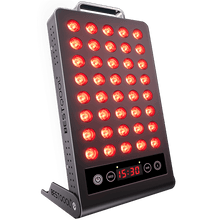
For a BestQool panel, provide support with the model, serial number or order information, selected mode, treatment distance, photos or video, meter details, warm-up time, and readings from several positions. Ask for wavelength-specific output information, the relevant test conditions, and any applicable tolerance or warranty pathway. The relationship between irradiance, time, and delivered dose is also important when discussing a stronger-than-expected channel in BestQool's dose explanation.
Use a return, repair, or replacement route when repeatable, appropriately measured results materially conflict with documented wavelength-specific specifications or stated tolerances---and the manufacturer cannot explain or resolve the discrepancy.
The calmest decision path is simple:
- Confirm which wavelength appears weak and whether it matters for your goal.
- Verify the measurement method, operating mode, warm-up state, distance, and sensor position.
- Compare wavelength-specific results with documented specifications and tolerances.
- Contact BestQool support if a meaningful discrepancy remains.


 Small
Small

 Moderate

 Moderate

 Moderate

 Full
Full

