


In this article7 sections
Red light therapy can be a useful tool in the toolbox for most muscle problems, so it is natural to wonder whether it can stop cramps. The short answer is that there haven’t been any research studies to answer this question directly; however, it may help tired muscles recover, and tiredness is one reason cramps happen. But a physical therapist would first ask why your cramps are happening, because the cause decides what will actually help.

What Does the Evidence Say About Red Light Therapy for Muscle Cramps?
Researchers have not properly tested red light therapy as a way to prevent cramps. The closest study looked at people with tight, crampy calf muscles. They were given a laser treatment alongside massage-style therapy and cupping. Their pain improved, but because the light was mixed in with other treatments, we cannot tell how much the light itself did. [1] [2]
Most research on red light looks at tired muscles instead. When people had red light on their muscles before exercise, they managed about five extra repetitions and lasted about four seconds longer before exhaustion. That sounds promising, but keep it in perspective: The benefits are small. Four extra seconds is noticeable in a lab, though it might not be on a weekend run. The amount of light matters, and the studies themselves are often small and of mixed quality and lastly fatigue is one trigger for cramps, not the whole story. Less tiredness does not guarantee fewer cramps. [3] [4]
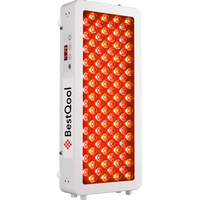
Is the Cramp Related to Fatigue, Hydration, Medication, or Nerve Function?
A cramp is not just a muscle problem. It starts with the nerves. Normally, your nervous system tells a muscle to tighten and then to let go. In a cramp, the "let go" signal fails and the muscle stays locked. This is most likely when a muscle is tired, especially if it is working in a shortened position, like a calf when you point your toes. [5]
Some people are simply more cramp-prone. Lab studies show their nerves behave slightly differently in the muscles that cramp. In a study of Ironman triathletes, the people who cramped were those who raced faster and had cramped before. Being dehydrated or low on salt made no difference. [6] [7]
A physical therapist would sort out the likely cause, because each one needs a different fix:
| Possible cause | What it looks like | What a physical therapist would check |
|---|---|---|
| Tired muscles | Late in hard or unfamiliar exercise; calves, thighs, feet | How much you train, how fast you start, any recent increase |
| Sweat and salt loss | Heavy sweating, hot weather, long events | How much you sweat, drink and eat salt |
| Medicines | Cramps that start or worsen after a new medicine | Your prescriptions; may refer you to a Physician or pharmacist |
| Nerve problems | Cramps with numbness, tingling, weakness or back pain | Reflexes, feeling and strength in the limb |
| Night cramps | At rest or in bed; common in older adults | Activity levels, general health, medicines |
Swipe to see the full table →
Medicines are easy to overlook. Water tablets (diuretics), cholesterol-lowering statins and some asthma inhalers have all been linked to leg cramps. [8]

When Are Recurring Muscle Cramps a Medical Warning Sign?
Most cramps are harmless. Occasionally they point to a problem with the nerves, blood circulation or general health. [9] See your doctor rather than treating yourself if you notice:
- Cramps that are frequent, severe or getting worse for no obvious reason.
- Weakness, shrinking muscles or twitching under the skin.
- Numbness, tingling or pain running down an arm or leg.
- A painful calf that is also swollen, warm or red. This could be a blood clot.
- Leg pain when walking that eases when you stop.
- Dark urine or severe muscle pain after exercise.
- Cramps that began after starting a new medicine, or that come alongside diabetes, or kidney, liver or thyroid problems.
How Can Red Light Therapy Be Used Around Cramps Related to Exercise?
If your cramps clearly come from hard training, red light is a reasonable thing to try for recovery. Just do not expect a full cure:
- Use it before exercise. Most of the benefit in studies came from using red light shortly beforehand. [4]
- Follow the instructions. More light is not necessarily better
- Stretch first during a cramp. RedLight will not stop a cramp that has already started.
- Keep track. Try it for a few weeks and note how often you cramp.
What Else Helps Reduce Recurrent Muscle Cramps?
These approaches have more going for them than red light, although the research is still limited:
- Stretch to stop a cramp. Gently stretching the cramping muscle, or tightening the muscle on the opposite side, is the quickest way to end a cramp. [10]
- Stretch to prevent night cramps. In older adults, stretching both the calves and the backs of the thighs before bed made night cramps less painful. Calf stretches alone did not reduce how often they happened. [11]
- Pace yourself. Starting too fast is a common trigger. Build up training gradually. [7]
- Drink sensibly. Fluids and salt matter most for heavy sweaters in hot weather or long events.
- Review your medicines. Your Physician or pharmacist can check whether a prescription is playing a part.
Magnesium is a popular remedy, but good-quality research shows it is unlikely to help typical night cramps in older adults. [12]
Key takeaways
Red light therapy is low-risk and may help tired muscles, but it is not a cramp treatment. A physical therapist would work through it in this order:
- Rule out warning signs and medicine side effects.
- Work out the pattern: exercise, heat, nighttime or nerve-related.
- Fix the cause: pacing, fitness, fluids or a medical review.
- Then, if tired muscles are the trigger, try red light as an extra and judge it by your own notes.
If cramps keep coming back, the next step is seeing a health professional.
References
- Stamborowski, Sadi F., Lima, Fernanda Púpio Silva, Leonardo, Patrícia Sardinha, Lima, Mário Oliveira, A Comprehensive Review on the Effects of Laser Photobiomodulation on Skeletal Muscle Fatigue in Spastic Patients, International Journal of Photoenergy, 2021, 5519709, 13 pages, 2021.
- Mohamed NMM, Abdelgawad HA, Morsy ME. Comparative efficacy of low-level laser and dry cupping for treatment of patients with calf muscles trigger points and cramps. Int J Drug Deliv Technol. 2026.
- Leal-Junior, E.C.P., Vanin, A.A., Miranda, E.F. et al. Effect of phototherapy (low-level laser therapy and light-emitting diode therapy) on exercise performance and markers of exercise recovery: a systematic review with meta-analysis. Lasers Med Sci 30, 925–939 (2015).
- Vanin, A.A., Verhagen, E., Barboza, S.D. et al. Photobiomodulation therapy for the improvement of muscular performance and reduction of muscular fatigue associated with exercise in healthy people: a systematic review and meta-analysis. Lasers Med Sci 33, 181–214 (2018).
- Schwellnus MP. Cause of exercise associated muscle cramps (EAMC) — altered neuromuscular control, dehydration or electrolyte depletion? Br J Sports Med. 2009;43(6):401–408.
- Popesco T, Santos RD, Cassoli I, et al. Muscle cramp susceptibility is associated with muscle-specific modulation of human motoneuron discharge patterns. Exp Physiol. 2026.
- Schwellnus MP, et al. Increased running speed and previous cramps rather than dehydration or serum sodium changes predict exercise-associated muscle cramping: a prospective cohort study in 210 Ironman triathletes. Br J Sports Med. 2011;45(8):650–656.
- Allen RE, Kirby KA. Nocturnal leg cramps. Am Fam Physician. 2012;86(4):350–355.
- Dijkstra JN, Boon E, Kruijt N, et al. Muscle cramps and contractures: causes and treatment. Pract Neurol. 2022;23:23–34.
- Miller KC, McDermott BP, Yeargin SW, Fiol A, Schwellnus MP. An evidence-based review of the pathophysiology, treatment, and prevention of exercise-associated muscle cramps. J Athl Train. 2021.
- Hawke F, Sadler SG, Katzberg HD, Pourkazemi F, Chuter V, Burns J. Non-drug therapies for the secondary prevention of lower limb muscle cramps. Cochrane Database Syst Rev. 2021;(5):CD008496.
- Garrison SR, Korownyk CS, Kolber MR, et al. Magnesium for skeletal muscle cramps. Cochrane Database Syst Rev. 2020;(9):CD009402.

This article is for general education and is not medical advice. If you have a medical condition, are pregnant, or take light-sensitizing medication, talk to your healthcare provider before starting red light therapy.


Leave a comment