
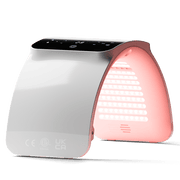
Yes, a full-body red light panel can be used on the face when the device's instructions support facial positioning and provide a controllable protocol for distance, time, and eye protection. You do not automatically need a portable device.
The practical difference is format: a large panel offers broad, hands-free coverage, while a handheld device, mask, compact panel, or other portable format can make localized facial positioning easier. Neither format is automatically safer or more effective for facial skin. The appropriate choice is the one whose documented setup lets you repeat the intended exposure comfortably and safely.
A Panel Can Cover the Face, but Coverage is Not a Facial Protocol
A full-body panel is not limited to body use. Depending on its size and mounting position, it may illuminate the face and upper torso as well as larger body areas. Portable formats, meanwhile, are generally designed for localized areas such as the face.
That distinction is mainly about treatment field and logistics. A panel can expose more skin at once and can be hands-free. A small device may need to be moved across separate areas, but it can be simpler to direct at a particular part of the face or to store between sessions. The comparison in BestQool's overview of portable devices and panels is useful here: broad coverage and localized positioning solve different practical problems.
For facial use, a panel may fit well if you already use it for the neck, chest, or other exposed areas and can stand or sit at the documented facial distance. A portable format may be more practical when your goal is limited to a smaller facial area or when you want a device that is easier to position consistently.
Coverage alone does not establish a facial protocol. A panel that can physically shine on your face is not necessarily intended for facial use at every distance, duration, or output setting.
Compare Exposure Control, Not Just the Device Label

"Panel," "mask," and "handheld" do not describe the dose reaching your skin. They describe the device's format.
When comparing a full-body panel with a portable facial device, check the documentation for:
- Intended facial-use instructions and stated treatment position
- Wavelengths provided by the device
- Irradiance and the distance at which it was measured
- Recommended session duration and frequency
- Treatment area and beam spread
- Timer and output controls
- Heat produced during use
- Eye-protection instructions
The key principle is simple: do not copy a session length from one device to another. Two devices can deliver different exposure levels over the same amount of time. Likewise, moving your face closer to or farther from a panel can change the real-world exposure, but there is no universal face-to-panel distance or conversion rule that applies across devices.
Use the distance, duration, and frequency stated for the individual device. A portable device's protocol should not be assumed to work for a large panel, and a panel routine should not be transferred to a mask or wand.
How Format Affects Repeatability
A panel may make it easy to keep your face, neck, and upper chest within one broad treatment field. But it also requires a repeatable setup: the same general position, the documented distance, and a stable way to avoid drifting closer during the session.
A portable device can offer more localized control. A narrow handheld device may require repositioning to cover multiple facial regions, while a small tabletop panel or flexible format may cover more area without requiring the space of a full-body panel.
Neither approach is inherently more precise. Precision comes from whether you can reliably follow the device's instructions and cover the area you intend to treat.
Eye Position and Heat Can Change the Practical Choice

Eye safety is one of the most important reasons not to treat facial use as interchangeable across formats. Do not stare directly into LEDs, and follow the exact device instructions for shields, goggles, or other eye precautions. The facial red-light safety guidance also emphasizes protecting the eyes and stopping use if vision changes occur.
There is no single eyewear rule that can safely be applied to every panel, mask, or portable device. Do not assume that closed eyes are always sufficient, that goggles are always required, or that a device without visible near-infrared light has no near-infrared output. Near-infrared LEDs can be invisible while active.
A full-body panel can create a broad, bright field in front of the face. That may be manageable when its eye-safety procedure is clear and comfortable to follow. It may be less appealing if you find the required position difficult to maintain.
Warmth also matters. Some higher-output panels can create warmth during longer sessions, and some use fans that add noise. This is not proof that a panel is harmful, but it is a real setup consideration. If facial warmth or flushing makes a session uncomfortable, a localized format or a different documented setup may offer better control.
Use Extra Caution When Personal Risk Factors are Involved
At-home red-light treatment should be paused for individualized advice if you use photosensitizing medication, have a photosensitive condition, have an eye disorder, are pregnant, have a history of skin or eye cancer, or are trying to treat an unexplained symptom. A clinician or pharmacist can help evaluate the relevance of your medical history and medications; these circumstances are not automatically proof that treatment is prohibited.
For facial skin, begin conservatively within the device's instructions and pay attention to how your skin and eyes respond. Stop use if you experience:
- Pain
- Unexpected redness or swelling
- Blistering
- Persistent irritation
- Vision changes
People with darker skin or a history of hyperpigmentation should proceed especially slowly with at-home use. The available material does not establish a specific safe dose for melasma, rosacea, or pigment worsening. If these are relevant to you, professional guidance is more appropriate than trying to adapt another person's panel routine.
Keep Expectations Separate From Device Format
A larger panel does not guarantee better facial results, and a portable device is not automatically less capable. Format influences coverage, positioning, comfort, and routine consistency; it does not by itself determine a skin outcome.
A controlled full-body study using red light in the 611--650 nm range twice weekly for 30 sessions reported improvements in subjective skin feel and appearance, reduced measured skin roughness, and increased intradermal collagen density. Those findings are specific to that study's wavelength range, schedule, treatment area, and protocol. They do not show that every consumer panel, mask, or handheld device will produce the same facial changes.
The broader evidence picture supports modest expectations. Red-light research in dermatology is characterized as strongest for hair regrowth and modest wrinkle reduction, while many other claims are still developing. Skin-related changes, when they occur, are generally incremental and associated with repeated sessions over weeks to months---not immediate or guaranteed.
Choose the Setup You Can Control
A full-body panel can be a facial-treatment option when its documented instructions support facial use and you can maintain the stated position, timing, eye precautions, and comfort level. A portable device can be useful when localized placement, compact storage, or repeatable treatment of a smaller facial area matters more than broad coverage.
Before using either format on your face, verify that its instructions let you answer four questions clearly:
- Can I position it at the documented facial distance?
- Can I follow its timing and frequency without borrowing another device's routine?
- Can I protect my eyes exactly as instructed?
- Can I tolerate the warmth and maintain the position comfortably?
Choose the format that gives you the most reliable control over those conditions---not simply the largest treatment field or the smallest device.


