
Probably less than blue or white light, but not necessarily not at all. Human research on specific monochromatic visible red light around 660 nm found no meaningful melatonin suppression or circadian phase shift. That finding does not establish that every bright red or red/near-infrared (NIR) panel is sleep-neutral.
For an after-work or pre-bed session, the cautious approach is to schedule treatment earlier in the evening when possible, avoid looking directly into the panel, follow the device's eye-safety instructions, and watch for changes in sleep. If your sleep becomes later, lighter, or more fragmented, move the session earlier or pause evening use.
What Research Suggests About Visible Red Light at Night

Light exposure at night can interfere with the body clock and sleep, but wavelengths do not affect the circadian system equally. Blue wavelengths are considered the most disruptive at night, while red light is less likely to shift circadian timing or suppress melatonin, according to Harvard Health's overview of blue light and sleep.
The most reassuring evidence is narrow:
| Exposure | What the Evidence Supports |
|---|---|
| Monochromatic visible red light near 660 nm | Evening exposure did not significantly suppress melatonin compared with baseline or dim-light conditions, and no meaningful circadian phase shift was identified. |
| Mixed red/NIR therapy panels | The visible-red findings cannot automatically be extended to panels that combine wavelengths, produce intense light, or create prolonged exposure at the eyes. |
| Near-infrared light | NIR is invisible and should not be treated as biologically interchangeable with visible red light for circadian questions. |
So, a red-looking panel is not the same thing as a dim red bedside lamp, nor does a wavelength label alone prove that a session will have no effect on an individual's sleep.
Why Timing and Eye Exposure Still Matter

A panel's skin-treatment specifications do not tell you how much light reaches your eyes or how your circadian system responds. Brightness, session timing, duration, distance, device spectrum, whether the panel faces your head, and your own sensitivity all shape the practical decision.
That does not mean an evening session is automatically disruptive. It means wavelength is only one part of the picture.
For lower-risk use:
- Do not stare into a bright panel. Avoiding direct viewing is a sensible precaution and should never override the device's instructions.
- Treat a body area without unnecessary facial exposure when your routine allows.
- Use the documented setup for your device. Do not invent a "safe" distance or duration from a panel's wattage or irradiance rating.
- Keep the rest of the wind-down period dim. The general advice to avoid bright screens for 2 to 3 hours before bed applies to screens, not as a validated cutoff for red-light therapy. Still, it supports the broader goal of reducing bright evening light.
If your session involves the face or upper body, review guidance on eye positioning during full-body red light therapy alongside your device's official safety directions.
A Lower-Risk After-Work Routine

An evening routine should fit your habitual bedtime, not just the time you happen to get home.
For the After-Work Exerciser
If treatment follows a workout, try placing it earlier in the evening rather than making it the final activity before bed. Keep your bedtime consistent while you assess how the routine affects you.
A practical trial:
- Set a stable bedtime anchor. Use the bedtime you normally aim to keep, including on most work nights.
- Start earlier in the evening. Avoid treating a red/NIR panel session as a last-minute substitute for a dark, quiet wind-down.
- Follow the manufacturer-directed session setup. This includes duration, positioning, and eye-safety instructions.
- Avoid direct panel viewing. Position your body for treatment rather than spending the session facing the lights.
- Keep the later routine low-light. Limit bright screens and other unnecessary lighting as bedtime approaches.
- Track your response for several sessions. Note treatment time, bedtime, how long it takes to fall asleep, nighttime awakenings, wake time, and next-day alertness.
If you need help understanding why a device's specified session length may vary by setup, review how irradiance affects red light therapy session length. That information should guide device use, not be interpreted as a circadian-safety calculation.
For the Routine-Driven Pre-Bed User
If the appeal of red light therapy is convenience just before bed, begin cautiously. A visible-red session may be reasonable to trial if your sleep is stable, but a late session is not automatically neutral simply because the light looks red.
Keep your first changes modest: preserve your usual bedtime, avoid stacking the session with bright phone use, and change only one part of the evening routine at a time. That makes it easier to tell whether the session is associated with a sleep change.
For the Sleep-Sensitive User
If you already notice that evening screens, household lighting, or schedule changes affect your sleep, daytime or earlier-evening use is the more conservative choice. There is no validated universal cutoff that says a red-light panel is safe a certain number of hours before bed.
Your own sleep response is more useful than forcing a generic timing rule.
When to Move It Earlier, Pause, or Ask a Clinician
Move treatment earlier---or stop evening sessions---if you notice a consistent pattern of:
- taking longer to fall asleep;
- a later bedtime or later wake time than intended;
- more frequent awakenings or lighter sleep;
- reduced next-day alertness; or
- a stronger feeling of stimulation after treatment.
People with insomnia, delayed sleep timing, shift-work schedules, migraine or light sensitivity, bipolar-spectrum concerns, eye conditions, or use of photosensitizing medication should speak with a qualified clinician before experimenting with an evening routine. Red-light therapy should not be used as a treatment for insomnia, circadian-rhythm disorders, shift-work sleep problems, or mood conditions.
If evening sessions leave your sleep unchanged and you follow verified device and eye-safety instructions, you can continue monitoring the routine. If sleep becomes later, lighter, or more fragmented, move treatment earlier or pause it, then review the relevant BestQool device safety and timing guidance before deciding whether evening use fits your schedule.


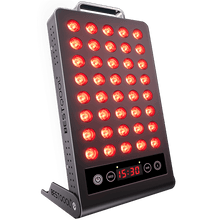
 Small
Small

 Moderate

 Moderate

 Moderate

 Full
Full

