
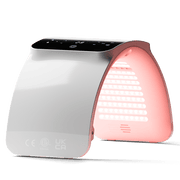
Use the face-to-panel distance and session time documented for your exact model---not a generic number found online. Do not move closer than the manual allows or place your face against the panel unless that use is expressly permitted.
That matters because panels vary in output, beam pattern, treatment area, and eye-protection instructions. A distance that is appropriate for one device may not be appropriate for another.
Let Your Exact Panel Instructions Set the Distance
Before a facial session, identify the panel's exact model and check the manual for your exact BestQool panel, current labeling, or verified model page. Those instructions should control three decisions:

- How far your face should be from the panel
- How long a session should last
- Whether goggles, shields, or another eye-protection procedure is specified
If the instructions give a facial-use distance and duration, start there rather than moving closer to shorten the session. Keep the panel at its instructed distance, and do not assume that contact or near-contact use is appropriate simply because another light device is designed to sit against the skin.
This is also the practical answer when online advice conflicts with your device documentation: follow the documentation for the panel in front of you. General guidance cannot supply one universal distance for every red-light or red-and-near-infrared panel. For more context on why distance and eye instructions matter for panels, see this guidance on facial panel eye safety.
Moving Closer Changes Exposure
Distance is not just a comfort preference. Moving a panel closer can increase the light intensity reaching the face and eyes. That may change the session time needed to reach a planned exposure, but it can also change eye comfort and local facial exposure.
Do not try to estimate that change with a simple distance rule. Close-range LED panels do not behave like a single point of light, and actual exposure can be affected by the panel's beam pattern, treatment angle, coverage, and the way irradiance was measured.

How to interpret an irradiance figure
Some manufacturers provide irradiance, often expressed in milliwatts per square centimetre, at a named distance. That number is useful only if it applies to the distance you actually plan to use.
A common planning convention expresses energy density in joules per square centimetre. In plain language:
- Take the irradiance measured at your treatment distance.
- Multiply it by the session length in seconds.
- Divide by 1,000 when irradiance is expressed in milliwatts per square centimetre.
For example, if a panel's verified irradiance is 0.020 W/cm² at the chosen distance, a planned exposure of 4 J/cm² would correspond to 200 seconds, or about 3 minutes 20 seconds.
That example is math only---not a facial dosing recommendation. A calculated number is not more authoritative than the manufacturer's labeled protocol. Irradiance and beam area can be difficult to define and measure consistently, so a simplified calculation should not be treated as a precise substitute for the model's documented distance and session guidance.
Set Eye Protection Before Turning the Panel On
Do not stare directly into a facial red-light panel.
Follow the eye-protection procedure for your model exactly. If its instructions call for goggles or shields, closed eyes are not a replacement. Some purpose-designed devices used around the eye area may have closed-eyelid protocols, but those protocols do not automatically apply to a general facial panel.

Near-infrared light deserves particular caution because it can provide less obvious visual feedback than visible red light. A light source appearing less bright does not establish that direct eye exposure is harmless or that protective steps are unnecessary.
Use this decision path:
- If the model specifies goggles or shields: use them as directed for every session.
- If the model provides a specific eye-positioning procedure: follow that procedure rather than improvising.
- If you are unsure which protection applies: pause and verify the instructions before use.
- In all cases: avoid looking into the LEDs during operation.
For a fuller discussion of why closed eyes and panel instructions are not interchangeable, read red light therapy eye-safety guidance.
When to Take a More Cautious Approach
Do not try to solve a health-related concern by changing the distance or extending the session on your own. A clinician or eye-care professional can help assess whether facial light treatment is appropriate for your circumstances and whether your medications or medical history require extra precautions.
Ask a clinician first if you have
- Cataracts, glaucoma, retinal disease, or another diagnosed eye condition
- Recent eye procedures or unresolved eye symptoms
- Photosensitivity or a history of light-triggered reactions
- A medication or topical product that may increase light sensitivity; a pharmacist can also help review this
- Pigment concerns or darker spots that worsen with visible-light exposure
- Another medical situation in which individualized advice is appropriate

These are not universal contraindications, and this article cannot establish a condition-specific distance or dose. The safer course is individualized guidance rather than self-adjusting the panel setup.
Stop the session and reassess if you notice
- Eye pain or eye discomfort
- Afterimages
- Blurred vision or other vision changes
- Headache
- Unusual irritation
These symptoms do not by themselves identify the cause, but they are reasons to stop rather than continue or move closer. Seek appropriate medical or eye-care advice for concerning or persistent symptoms.
Set Up Your Facial Session Safely
Before starting:
- [ ] Confirm the exact BestQool panel model.
- [ ] Read its current distance, session-time, and eye-protection instructions.
- [ ] Use the documented starting setup rather than a universal online distance.
- [ ] Do not put your face against the panel unless contact use is expressly permitted.
- [ ] Do not stare into the light.
- [ ] Stop if concerning symptoms occur.
For device-specific clarification, consult the manual or verified model page for your exact BestQool panel, or contact customer support. For eye, medication, photosensitivity, pigment, or other medical-risk questions, speak with an appropriate clinician.


