
Start with your panel's current manual. There is no universal, clinically validated face-to-panel distance for treating facial wrinkles.
If you have a full-body panel with no face-specific instructions, 18--24 inches (46--61 cm) is a cautious general starting range. It is not a wrinkle-treatment rule, and it may not suit smaller tabletop devices, handheld devices, or unusually high-output panels. From there, use the session time paired with your panel's irradiance at that exact distance. Move back, shorten the session, or stop if you develop uncomfortable heat, redness, or eye discomfort.

The reason for this qualified answer is simple: distance, light output, coverage, and treatment time work together. A distance that is sensible for one panel can deliver a very different exposure on another.
Choose the Device Protocol Before a Generic Distance
For facial use, treat the manufacturer's documented distance and session duration as a matched pair. Do not take a time recommendation from one panel and apply it at a different distance---or to a different device.
A practical starting sequence:
- Find the manual for your exact panel. Look for facial-use distance, session duration, and safety instructions.
- Set the panel at the stated distance. Measure from your face to the light-emitting surface rather than estimating from the edge of a stand or frame.
- Use the stated session time at that distance. Do not move closer to shorten the session unless the manufacturer provides instructions for doing so.
Why be this careful? Clinical skin-rejuvenation protocols vary in device specifications, treatment schedules, and study design, so the research does not establish one standardized distance or dose for every home panel. A 2025 review of low-level light therapy for skin rejuvenation concluded that those inconsistencies still prevent standardized treatment protocols.
The commonly suggested 18--24 inch range is best viewed as a conservative fallback for many full-body panels, not as a substitute for device instructions. Smaller targeted panels may be designed for closer placement, while a larger or higher-output panel may call for more distance.
Distance and Session Time Cannot Be Separated
Moving farther from a panel generally reduces irradiance: the light power reaching each area of skin. That means the same ten-minute session does not necessarily deliver the same exposure at 6 inches, 12 inches, and 24 inches.

For a facial routine, the useful question is not simply, "How close can I sit?" It is:
What irradiance does this panel deliver at the distance where my face will actually be?
The total light energy delivered to the skin is commonly expressed in joules per square centimeter, or J/cm². It can be estimated from irradiance and exposure time---but only when the irradiance figure applies to your actual face-to-panel distance.
For example, if a panel delivers 100 mW/cm² at the face, a 10-minute session works out mathematically to 60 J/cm². That is a calculation, not a recommended wrinkle dose. It does not show that 60 J/cm² is appropriate, effective, or necessary for facial wrinkles on every device.
What to check in a panel's specifications
Before relying on an irradiance number, look for:
- The measurement distance: Is the figure stated at 6, 12, 18, or 24 inches---or another distance?
- The measurement method: If disclosed, note how output was measured.
- Peak versus average output: These are not interchangeable descriptions.
- A distance-specific chart: A reading at 6 inches should not be assumed to apply at 18 inches.
- Coverage at your chosen position: Farther placement may improve whole-face coverage, but it generally changes the intensity reaching the skin.
Avoid trying to calculate a new distance from a simple light-source rule alone. Panel geometry, overlapping LED beams, angle, coverage area, wavelengths, and output all affect what reaches the face. The panel's measured irradiance information at the intended treatment distance is more useful than an estimate copied from another device.

If the manufacturer does not disclose irradiance at a stated distance, do not invent a dose from an advertised output number. Follow the documented distance and time if available; otherwise, treat dose comparisons with caution.
Red and Near-Infrared Light Do Not Create Separate Distance Rules
Red wavelengths around 630--670 nm and near-infrared wavelengths around 810--850 nm appear in skin-rejuvenation literature. Near-infrared wavelengths have also been described as reaching deeper tissue than red light.
Neither point establishes that you should move closer for near-infrared mode, use a longer session, or expect a superior wrinkle result. Keep the same manufacturer-directed facial distance unless the manual specifically gives separate instructions for different modes.
More intensity is not automatically better. Photobiomodulation is often described as having a biphasic dose response: too little exposure may not produce a tissue response, while too much can inhibit one. That principle is broad and does not supply an ideal home-panel wrinkle dose, but it is a reason not to treat proximity and longer sessions as a "more is better" strategy. A discussion of low-level light therapy dose response describes this pattern in the wider LLLT literature.
Let Comfort and Even Coverage Guide Small Adjustments
Once you are using the documented protocol, comfort matters.
A very close, prolonged session can create excess heat, temporary redness, or mild discomfort. Red and near-infrared panel use does not involve UV exposure, but that does not mean you should push through an unpleasant session.

Use these signals as practical decision points:
| If this happens | Practical response |
|---|---|
| Your face feels uncomfortably warm | Move back or shorten the session within the device guidance. |
| You develop temporary redness or irritation | Stop the session and avoid increasing intensity or time. |
| Your face is not evenly covered | Reposition for more even coverage rather than moving very close to one area. |
| Your eyes feel uncomfortable | Stop and follow the panel's eye-safety instructions before trying again. |
| You cannot verify irradiance at your distance | Do not create a custom dose; use the documented protocol or seek clarification from the manufacturer. |
Treat Eye Protection as Part of the Setup
For facial sessions, follow the eye-protection instructions supplied for your exact panel. Do not assume that a particular wavelength mix makes eye protection unnecessary. If your manual specifies goggles, shields, closed-eye use, positioning limits, or other precautions, use them as directed.
It is also sensible to pause and seek individualized advice if you have an eye condition or are unsure whether the device is appropriate for facial use.
When to Ask a Clinician First
If you use a medicine associated with light sensitivity and develop unusual burning, redness, or irritation after treatment, consult a clinician. It is not established that photosensitizing medicines necessarily cause reactions to red or near-infrared panels, but any unexpected reaction should be taken seriously rather than increasing exposure.
Ask for professional guidance before continuing if medication, an eye condition, a skin condition, or another health factor makes the protocol uncertain. Do not treat a reaction as evidence that you need to sit closer, use longer sessions, or increase the dose.
Your Pre-Session Checkpoint
Before treating facial wrinkles with a panel, confirm five things:
- The documented facial distance and session time for the exact device.
- The panel's irradiance measurement at that same distance, when published.
- Even, comfortable coverage across the face.
- The device's required eye-safety measures.
- Whether medication, eye, skin, or other health factors warrant clinician input.
For a BestQool panel---or any other model---review the current model-specific manual and published specifications rather than relying on a universal online distance. The best starting position is the one the device documents, with irradiance measured at that distance and a session that remains comfortable and evenly covers the face.


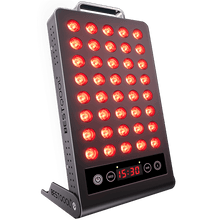
 Small
Small

 Moderate

 Moderate

 Moderate

 Full
Full

