
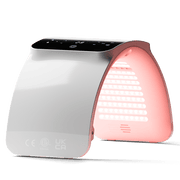
An LED mask and an LED panel can differ in both stated exposure time and total routine time. Neither format has one universal facial-session length. A mask usually keeps the LEDs close to the face once it is fitted, while a panel requires the user to maintain its specified distance and position. That means a shorter advertised session is not automatically faster in practice---or equivalent in delivered light.
The useful comparison is not simply "minutes per session." It is:
- Light-exposure time
- Time needed to position the device correctly
- Whether the face, neck, or décolletage require separate treatment positions
- The device's irradiance at the stated treatment distance
- The manufacturer's instructions for duration, frequency, and eye protection
Separate Exposure Time From Total Routine Time

A listed session time describes how long the LEDs are intended to operate, not necessarily how long the entire routine takes.
For panels, some device instructions describe sessions of 10--20 minutes per body zone at the recommended distance. That range should not be treated as a universal facial protocol, and it does not establish how long any particular mask should be used.
Masks do not have a single evidence-supported "typical" session range that can be compared directly with panel guidance. Research on at-home red-light devices uses different devices, exposure periods, and study questions, so session times from separate products or studies are not directly interchangeable. The American Academy of Dermatology's overview of red-light therapy for skin also notes that important questions remain about the safest and most effective amount of at-home red light.
In practical terms, a panel's stated exposure may be longer, shorter, or similar to a mask's stated exposure. The number of minutes alone does not reveal whether the two devices deliver a comparable amount of light to the skin.
How Device Geometry Changes Routine Time

The physical format changes what the user has to manage during a session.
| Routine Consideration | LED Mask | LED Panel |
|---|---|---|
| Light-to-skin position | LEDs sit at close-contact or near-contact distance once the mask is worn. | The user must maintain the device's specified working distance and angle. |
| Setup | Fitting and securing the mask are the main positioning steps. | Positioning may include setting up the panel, aligning the face with its treatment field, and maintaining the required distance. |
| Face coverage | Designed around facial use, but fit and LED placement can vary by device and face shape. | May cover the full face in one exposure if the face is within the intended treatment field at the specified distance. |
| Neck or décolletage | May require separate treatment if those areas are outside the mask's coverage. | A sufficiently large and correctly positioned panel may include additional areas simultaneously, but this depends on panel size, placement, and instructions. |
| Repositioning | May be limited for a face-only routine because the device is worn. | May be necessary if intended areas are not all within the panel's treatment field. |
A facial mask places LEDs very close to the skin, generally at close-contact or near-contact distance. This can reduce the need to repeatedly judge distance during the exposure. It does not guarantee identical coverage on every face: fit, facial contours, and the device's LED layout still matter.
A panel is a flat light source intended to cover larger areas. Some panel instructions place the working distance in the range of 4--12 inches, but the relevant distance is the one stated in the individual device instructions. Moving closer or farther away can change how much light reaches the skin.
For a face-only routine, a panel may treat the face in one exposure when the entire face is positioned within its intended field. If the neck or décolletage is also an intended area, the total time may remain the same---or increase if repositioning is needed. That is a coverage question, not an automatic advantage of either format.
Why Minutes Do Not Reveal the Delivered Dose
Exposure time is only one part of light delivery. The other key factor is irradiance: the power reaching a given area of skin, usually stated in milliwatts per square centimeter.
Fluence is the total light energy delivered to an area over the session. In plain terms, it depends on both irradiance and time:
- Higher irradiance can reach a given fluence in less time.
- Lower irradiance may require more time to reach that fluence.
- A shorter session therefore does not automatically mean a lower dose.
- A longer session does not automatically mean a stronger or more effective treatment.
For example, 10 minutes at 100 mW/cm² can deliver the same fluence as 20 minutes at 50 mW/cm², assuming the stated irradiance actually reaches the treatment area. That comparison does not establish equivalent wavelength mix, coverage uniformity, facial fit, or outcomes between two devices. It simply shows why minutes cannot be compared in isolation.
Distance is especially important for panels. Doubling the panel-to-skin distance can reduce irradiance to approximately one quarter, which can substantially change the dose received during the same timed session. This is why standing farther away for the same number of minutes is not necessarily following the intended protocol.
A mask's close facial geometry and a panel's user-managed working distance are therefore meaningful timing differences. The mask fixes the general position of its LEDs relative to the face; with a panel, distance and angle remain part of the session itself.
Do Not Extend a Session to "Make up" for Distance or Coverage
It may be tempting to add minutes if a panel was positioned farther away than instructed, if a facial area seemed outside the treatment field, or if another device lists a longer protocol. That is not a reliable substitute for following the correct setup.
A biphasic dose response means that more exposure is not automatically better. Duration should remain within the manufacturer's stated parameters rather than being adjusted from another device's specifications or marketing claims.
Likewise, do not assume that a mask can be worn while walking around, doing chores, or changing position. Whether movement is permitted depends on the specific device's instructions, fit requirements, power arrangement, and eye-protection guidance.
Use a Routine-Fit Checklist Rather Than a Format Verdict
Before comparing mask and panel session times, check the full routine each format requires:
- Available time: How many uninterrupted minutes can you realistically set aside for setup and exposure?
- Treatment area: Is your plan limited to the face, or does it include the neck or décolletage?
- Positioning: Can you maintain the panel's specified distance and angle for the full session?
- Coverage: Does the device's intended treatment field include every area you want to treat without repositioning?
- Protocol: What does the manual specify for session duration, frequency, treatment distance, positioning, and eye protection?
- Movement: Does the device explicitly permit use while moving, or does it require a stationary session?
The practical choice is the format whose complete protocol you can follow consistently. Verify the exact timing, distance, frequency, positioning, and eye-protection requirements in the relevant device manual or support documentation rather than transferring a routine from a mask to a panel, or vice versa.


