

There is no universal minimum number of minutes. The shortest session that is plausibly worthwhile depends on the dose delivered at your skin—measured in joules per square centimetre (J/cm²)—plus your device’s irradiance at the distance you use it, wavelength, treatment area, goal, and schedule.
A 3-minute session can deliver more light than a 15-minute session if the device is substantially more intense at the skin. Conversely, 10 minutes may be too little if the irradiance rating was measured at the LEDs rather than at your treatment distance.
Use this decision path instead of copying a generic “5-, 10-, or 20-minute” recommendation:

- Define one goal and treatment area.
- Confirm the device’s wavelengths.
- Find its irradiance in mW/cm² at your actual treatment distance.
- Choose a conservative, goal-relevant dose only when the protocol and device documentation are comparable.
- Calculate time, follow the device’s instructions, and assess consistency over weeks—not after one session.
Minutes Are Not the Dose: Convert Irradiance Into Session Time
The practical dose calculation is:
Dose (J/cm²) = irradiance (mW/cm²) × time (seconds) ÷ 1,000
Rearranged to solve for time:
Time (seconds) = target dose (J/cm²) × 1,000 ÷ irradiance (mW/cm²)
Illustrative calculation
If a device delivers 25 mW/cm² at the skin and you are aiming to deliver an illustrative 10 J/cm²:
10 × 1,000 ÷ 25 = 400 seconds
That is about 6.7 minutes.
If another device delivers 50 mW/cm² at the skin, the same estimated dose takes:
10 × 1,000 ÷ 50 = 200 seconds
That is about 3.3 minutes.
These are math examples, not universal treatment prescriptions. A calculated time is only useful when the irradiance figure is credible and the target dose is appropriate for the specific goal.
For a broader explanation of why exposure time must be interpreted alongside output and distance, see BestQool’s red light therapy session-duration overview.
Before Calculating, Verify Irradiance at Your Skin
Do not calculate session time from:
- Total device wattage
- LED wattage
- Number of LEDs
- A peak-output figure with no stated distance
- A measurement taken directly against the LEDs when you will stand 6–12 inches away
What matters is irradiance—mW/cm²—where your skin will actually be positioned.
Before relying on a device specification, look for:
- Wavelengths or wavelength bands in nanometres (nm)
- Irradiance in mW/cm²
- The exact measurement distance
- Whether the value is an average across the treatment field or a peak reading
- Treatment-area dimensions
- Whether the device is intended for contact use or non-contact use
- Clear session-length and eye-safety instructions
Distance changes dose. Moving farther away usually reduces the irradiance reaching the skin; body contours, angles, hair, and uneven panel coverage can reduce it further. If you change distance, you have changed the dose calculation.

If a device does not state irradiance at a usable distance—or does not provide clear instructions for use—follow its conservative instructions or choose better-documented equipment. Before using the calculator, learn how to evaluate irradiance and dose at home, including how distance, measurement methods, beam spread, and body contours affect the irradiance that actually reaches your skin.
Choose the Light Before Adding Time: Red vs. Near-Infrared
Wavelength helps determine whether a protocol is even plausible for your target.
- Visible red light is commonly used in protocols aimed at relatively superficial targets, such as facial skin.
- Near-infrared (NIR) light is invisible and is commonly included in protocols intended for deeper structures such as muscles and joints.
- Blue-light acne protocols are not red/NIR protocols. They involve a different wavelength range, mechanism, safety profile, and timing logic.
That does not mean red light is automatically appropriate for every skin concern or that NIR requires a longer session. Time still comes from dose and irradiance at the skin. Wavelength, target depth, device geometry, and the clinical protocol all matter.
If you are unsure how red and near-infrared wavelengths differ, this guide explains the practical differences without treating either wavelength as universally better.
The range of wavelengths and treatment setups in chronic-pain research illustrates why one generic session length cannot be transferred from one device or use case to another; see the systematic review of photobiomodulation trials for chronic pain.
What Can Honestly Be Called a “Minimum” for Different Goals?
For most at-home uses, there is not enough consistency to name one minimum dose—or one number of minutes—that reliably works across devices. The best approach is to match your device’s documented wavelengths, irradiance at skin, and treatment area to a comparable protocol from published research or the manufacturer’s intended use. For specific goals such as skin appearance, acne, androgenetic alopecia, pain, or recovery, check if a human study exists with similar device parameters and follow that protocol’s dose and schedule as a guide, while respecting your device’s safety limits.

Hair-loss research is a good example of the transferability problem: an indexed clinical study may use a particular wavelength, contact method, spot size, scalp pattern, and schedule that cannot be converted safely into panel minutes without comparable output data.
The useful answer, then, is not “use at least 10 minutes.” It is: use the shortest manufacturer-approved session that delivers a defensible dose for a comparable protocol, then repeat it consistently for the protocol’s relevant timeframe.
Longer Is Not Automatically Better
Photobiomodulation is often described as having a biphasic dose response: too little exposure may have little effect, but more exposure is not automatically more effective.
Practically, that means you should not keep extending sessions because you did not notice an immediate result.
Instead:
- Start within the device’s stated use instructions.
- Choose a conservative calculated exposure when credible irradiance data are available.
- Hold distance, time, and frequency steady long enough to assess the routine.
- Change only one variable at a time.
- Reduce time or increase distance if you develop persistent warmth, redness, sensitivity, discomfort, or headaches.
A longer session is not a recovery plan for an under-documented device, inconsistent use, an unsuitable wavelength, or a goal that needs clinical evaluation.
Why Masks, Panels, Handhelds, and Clinic Lasers Cannot Share One Timer
Device category matters because it changes the exposure conditions. Based on available literature:

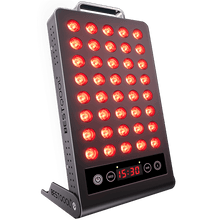
- Handheld devices cover small areas and typical sessions range from 5 to 10 minutes.
- Full-body panels cover larger areas and typical sessions range from 15 to 30 minutes.
- Professional laser or LED systems operate under different output, spot size, and clinical supervision that cannot be directly compared to consumer devices.
Always compare devices through documented wavelength, irradiance at skin, treatment area, distance, instructions for use, and eye guidance—not through the timer alone.
A Minimum-Time Worksheet for At-Home Use
Use this before starting a routine:
- Goal: What single outcome are you trying to assess?
- Area: Face, scalp, a small joint, a muscle group, or a larger body area?
- Wavelengths: What wavelengths does the device actually emit?
- Distance: How far will the device be from the skin?
- Irradiance: What mW/cm² does it deliver at that exact distance?
- Target dose: Is there a comparable, evidence-reviewed protocol—or only a manufacturer instruction?
- Calculated time: target J/cm² × 1,000 ÷ mW/cm²
- Device limit: Is the calculated time within the manufacturer-approved session maximum?
- Frequency: What schedule will you realistically follow for several weeks?
- Tracking: Record distance, time, frequency, skin response, and one goal-specific outcome.
If steps 3–5 cannot be answered from trustworthy documentation, skip the calculator. Use the device only as instructed, conservatively, or do not rely on it for a medical or high-stakes goal.
How Often to Use Red Light Therapy Before Judging It
A minimum session time is only one part of a treatment pattern. If results occur, they generally depend on repeated exposures over weeks rather than one unusually long session.
Set a review point before you begin. For example, commit to the manufacturer-approved schedule for several weeks, then assess:
- Did you maintain the same distance and session length?
- Did you miss many sessions?
- Did the treatment area react with redness, sensitivity, or discomfort?
- Did the goal-relevant measure change—such as photographs taken under the same conditions, symptom notes, or training recovery logs?
- Are you tempted to increase exposure because of impatience rather than a documented reason?
Do not treat a lack of immediate visible change as proof that you need more minutes.
Safety Boundaries That Can Change the Appropriate Session Time
For additional red light therapy safety and photosensitivity guidance, consider how your appropriate exposure may change if you use photosensitizing medication, have a light-sensitive condition, or experience eye or skin symptoms.
Follow the instructions for your exact device, particularly around eyes. Do not stare directly into intense LEDs unless the manufacturer explicitly states that this is appropriate for that device and use case.
Pause use and seek clinician or pharmacist advice before self-treating if you:
- Use a medication or topical product that can increase photosensitivity
- Have a photosensitive condition or a history of unusual reactions to light
- Are considering treatment during pregnancy or over an area under medical care
- Have active skin cancer in the treatment area
- Plan to treat a diagnosed medical condition that requires professional assessment
Red and NIR devices are not UV devices, but “not UV” does not mean every exposure duration is appropriate for every person or treatment area.
Common Reasons a “10-Minute Session” Does Not Deliver What You Think
- Calculating from total wattage instead of irradiance in mW/cm²
- Using an irradiance figure measured at a different distance
- Changing distance but keeping the same session time
- Treating through opaque clothing, dense hair, or a non-transparent covering
- Applying an acne blue-light schedule to a red/NIR device
- Extending sessions repeatedly instead of checking output, setup, and adherence
- Exceeding the device manual’s exposure limit
- Treating a medical issue without a diagnosis or clinician input
The Practical Bottom Line
Do not chase a magic number of minutes.
The shortest red light therapy session that may be worthwhile is the one that:
- Uses a documented wavelength appropriate to the target;
- Delivers a defensible dose at the skin, not at the LEDs;
- Fits the device’s approved instructions and safety limits;
- Is repeated consistently for long enough to assess; and
- Is not increased automatically when results are slow.
Start by reviewing your device’s documented irradiance, distance, wavelength, and safety information. Then use the dose equation to estimate time only when those inputs are credible. BestQool’s session-length planning resource can help translate those specifications into a repeatable routine—but incomplete device documentation is a reason to be more cautious, not to add more minutes.


 Small
Small

 Moderate

 Moderate

 Moderate

 Full
Full

