


In this article3 sections
If the pain persists in the musculoskeletal system, the two commonly applied modalities in the clinic include photobiomodulation, better known as red light therapy, and therapeutic ultrasound. Both techniques are non-invasive and are meant to assist in achieving comfort and functionality, but each modality operates using different physical principles and prerequisites. This knowledge will allow you and your healthcare provider to select the best modality to address your particular problem.
The photobiomodulation devices emit particular wavelengths, including 630 nm or 660 nm red light and 850 nm or 940 nm infrared light, while ultrasound involves the use of high-frequency sound waves through a probe with gel coupling. Below is an evidence-based comparison between the two techniques.

Does Your Diagnosis Support Either Treatment?
The two procedures are commonly used in the treatment of soft tissue and joint ailments such as osteoarthritis in the knees, chronic lower back pain and neck pain, tendinopathy, and myofascial pain. Neither modality treats a structural problem where mechanical manipulation and surgical procedures are needed.
When the purpose of treatment is mild tissue warming and mechanical manipulation, then therapeutic ultrasound is selected. According to research, it is possible for therapeutic ultrasound to deliver thermal and mechanical effects, which are capable of influencing cell signaling and tissue healing processes when done by a professional clinician via continuous probe manipulation. [1]
Photobiomodulation is selected whenever there is an intention of supporting cellular actions associated with tissue healing and the inflammatory process. In comparison to heat therapies, photobiomodulation mainly acts through photobiological mechanisms. This means that it influences cellular action through light rather than causing tissue warming. There are studies that have recorded reduced pain and improvement in function in some of the people suffering from knee osteoarthritis. [2]
The decision of whether to use one modality over the other should be dictated by your individual diagnosis, the stage of your recovery process (acute or chronic), implant presence, skin condition, and your rehabilitation program in general. The majority of the time, these treatment approaches are used as part of a larger rehabilitation protocol that includes exercise and other therapies as well.
How Do Pain and Function Outcomes Compare in Clinical Studies?
Both approaches have supportive evidence available, but not all research is equal in its reliability and consistency.
A randomized comparison study examining chronic non-specific low back pain patients found that laser photobiomodulation therapy with exercises provided a more significant reduction in pain, disability, and lumbar flexion range compared to ultrasound treatment combined with exercises. However, both active interventions proved superior to a placebo group performing exercises only. [3]
Therapeutic ultrasound intervention resulted in a moderately positive effect of pain relief in knee osteoarthritis in the meta-analysis; however, its heterogeneity and generalizability remain uncertain.
Photobiomodulation therapy in musculoskeletal pain patients has also been shown to have a moderately positive effect on pain relief and improved functionality if the right dose and wavelength of light are applied in conjunction with exercise.
Compare Skin Contact, Treatment Area, and Operator Requirements
In terms of administration, there is quite a difference between both types of treatment:
- For therapeutic ultrasound, skin contact is necessary using a coupling gel. The physician should move the sound head constantly over a small area of skin to prevent areas from getting too heated up. The treatment sessions are relatively short (a few minutes per session) and are conducted by a specialist only.
- Red light therapy can be applied at a certain distance or with light skin contact, without using any gel and covering large surfaces of skin with special lamps or devices. The duration of such sessions can be longer (10–20 minutes). [4]
Once the parameters of therapy are set, they can be conducted on your own at home using specific devices that produce certain wavelengths of light (630 nm, 660 nm, 850 nm, 940 nm).
What Can Combination Studies Tell You About Each Treatment?
Several studies have looked at the use of various physical therapy modalities in one rehabilitation program. Some of these modalities include photobiomodulation, therapeutic ultrasound, and exercise. Although both red light therapy and therapeutic ultrasound are known to affect biological processes related to tissue repair and pain control, current research does not conclusively show that the use of several modalities results in more positive effects than the use of an effective modality combined with exercises. Parameters such as dosing and treatment timing play significant roles in the outcomes.
Red light therapy works mostly via photobiological actions, while therapeutic ultrasound has thermal and mechanical effects on the body. The different working mechanisms make it necessary for researchers to find out how these modalities could be complementary to each other. [5]
In reality, many rehabilitation programs have one modality being used as the main approach to treatment, while other modalities are applied only for the purposes of certain medical tasks. In terms of musculoskeletal conditions research and guidelines, therapeutic exercises are considered one of the main approaches to conservative treatment of conditions such as osteoarthritis, while modalities can be used to decrease pain and increase tolerance to physical activities.
Can a Home Device Deliver the Treatment Used in a Clinic?
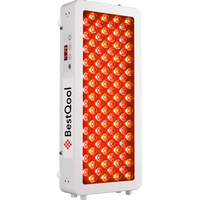
Replication of red light therapy could be achieved through using home panels and devices capable of providing irradiance as required for a particular wavelength. This does not necessarily involve replication of every parameter because what is important is the regular usage, several times a week, over several weeks. BestQool devices utilize the extensively studied red and near-infrared wavelengths and thus could be used in an organized manner upon consultation with the physician.
Replication of therapeutic ultrasound could hardly be achieved at home due to various reasons. Correct frequency, intensity, constant movement of the probe and application of gel are needed for medical-grade devices. Consumer-grade devices fall far short of clinical requirements and may cause uneven heating if used improperly. Therapeutic ultrasound is mostly clinic-based.

Select Treatment With Evidence for Your Condition
Use depending on the relevant evidence related to your diagnosis, access to it, and your overall rehabilitation program:
- Prefer the therapeutic ultrasound if the treatment provider can administer short treatments and low thermal and mechanical stimulation is desirable.
- Prefer red light therapy if large-area treatment, non-contact, and light contact mode of application, as well as the opportunity for regular at-home use between visits, are important for you.
- In any of the cases, combine the treatment method with progressive exercises, muscle building and modification of activities.
Consult with your physical therapist or physician regarding both options. Inquire about the specific evidence for your condition, expected number of sessions, and use of the modality in connection with your treatment goals, including a decrease in pain during activities and improvement of mobility.
If the home red light therapy meets your treatment program, consider devices providing 630 nm, 660 nm, 850 nm, and 940 nm wavelengths available at BestQool. Any of these tools should be used under professional supervision.
Sources
- da Silva ANG, de Oliveira JRS, Madureira ÁNM, Lima WA, Lima VLM. Biochemical and Physiological Events Involved in Responses to the Ultrasound Used in Physiotherapy: A Review. Ultrasound Med Biol. 2022 Dec;48(12):2417-2429. doi: 10.1016/j.ultrasmedbio.2022.07.009. Epub 2022 Sep 15. PMID: 36115728.
2. Zhang R, Qu J. The Mechanisms and Efficacy of Photobiomodulation Therapy for Arthritis: A Comprehensive Review. Int J Mol Sci. 2023 Sep 19;24(18):14293. doi: 10.3390/ijms241814293. PMID: 37762594; PMCID: PMC10531845.
3. Tantawy SA, Abdelbasset WK, Kamel DM, Alrawaili SM, Alsubaie SF. Laser photobiomodulation is more effective than ultrasound therapy in patients with chronic nonspecific low back pain: a comparative study. Lasers Med Sci. 2019 Jun;34(4):793-800. doi: 10.1007/s10103-018-2665-8. Epub 2018 Oct 17. PMID: 30334124.
4. Pagan, C.N. & Gardner S.S. (2026). Red Light Therapy: What Is It?.
5. Spongberg CV, Stack ER, Aprigliano C, Grinis D, Sawicki S, Elway M. What to Look for in Red Light Therapy: A Product Guide Backed by Science. Cureus. 2026 Mar 17;18(3):e105378. doi: 10.7759/cureus.105378. PMID: 42005232; PMCID: PMC13085462.

This article is for general education and is not medical advice. If you have a medical condition, are pregnant, or take light-sensitizing medication, talk to your healthcare provider before starting red light therapy.


Leave a comment