
Yes, but the formats are not interchangeable. A panel is generally the more practical format when you want to expose the back of the neck and upper trapezius area in one stable, hands-free position. Do not assume that a clamp device and a panel deliver the same exposure---or the same result---simply because both use red light, near-infrared light, or both.
Start with the Area You Need to Expose

The relevant treatment category is red and near-infrared light therapy. However, not every device in either format necessarily emits both wavelength ranges, so check the specifications and instructions for the particular device rather than assuming its light output from its shape alone.
For neck-and-shoulder use, the practical question is less "Which format is better?" than "Can this setup expose the intended area without major gaps?"
Break the target area into separate zones:
- Back of the neck
- Left upper trapezius
- Right upper trapezius
- Shoulder cap or outer shoulder
- Side of the neck, if relevant
- Front of the shoulder, if relevant
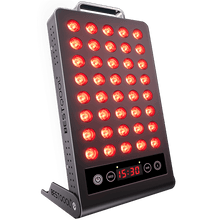
A panel can be mounted behind or slightly above the shoulders and aimed toward the back of the neck and upper trapezius. A 30 × 30 cm panel, for example, can be used on a tripod or clamp-on arm. That arrangement can make a posterior neck and upper-trapezius session hands-free.
That does not mean one panel position automatically covers the entire neck and both shoulders. The side and front of the neck, the shoulder caps, and more lateral areas may fall outside the useful treatment area depending on placement and the panel's footprint.
Compare Coverage and Repeatability, Not Just Mounting Style

Mounting describes how a device is held; it does not prove how much anatomy it exposes.
A panel-style setup allows straightforward assessment of broad posterior coverage because it can remain in one position behind or above the shoulders. The useful benefit is repeatability: if the device can stay at the same distance and angle while covering the intended posterior area, the session is simpler to reproduce.
Use a simple coverage check before treating:
| Question | Why It Matters |
|---|---|
| Can the light reach the back of the neck and both upper trapezius areas? | Broad muscle regions may need more than one placement. |
| Does one position leave obvious gaps? | A gap is a coverage issue, not something automatically fixed by more time. |
| Can you sit or stand comfortably during the session? | An awkward position is harder to use consistently. |
| Can you recreate the same position later? | Repeatable placement makes exposure more consistent. |
| Does the placement bring bright light close to your face? | This may change the eye-protection considerations. |
The available material does not include clinical head-to-head trials showing that a clamp device improves neck or shoulder outcomes more effectively than a panel, or vice versa. The practical advantage of a panel for a broad posterior area is therefore a coverage-and-positioning advantage, not proof of superior clinical results.
Treat Device-Specific Dose as a Separate Question
Coverage alone does not determine exposure. Distance, placement, session length, wavelength, and power density at the treatment surface are all relevant variables.
This is why a routine used with one device should not automatically be copied to another. Follow the device's own instructions for distance and time.
One panel setup described for the neck and shoulders uses a distance of 15--30 cm (6--12 inches). That figure is specific to that setup; it should not be treated as a universal distance for every panel or clamp-mounted device.
A workable approach is to use the device's own instructions and confirm that they allow you to:
- Position the device at its intended treatment distance.
- Keep the target area within the illuminated region.
- Maintain a comfortable, stable posture.
- Repeat the same placement for each session if treating the same area.
If a device's instructions do not provide a practical distance and time for the area you want to treat, changing formats or repeatedly increasing session time does not resolve that uncertainty.
Choose the Format Based on the Treatment Pattern
A panel-style format can be used when your goal is to expose:
- The back of the neck and upper trapezius together
- Both upper-trapezius regions in a stable arrangement
- A broader posterior area during a hands-free session
The deciding issue is whether the setup reaches the area you intend to expose without requiring uncomfortable positioning or guesswork.
Use Extra Care Near the Face and Eyes

Neck treatment can bring a device relatively close to the face, particularly when targeting the upper neck or side of the neck. Eye protection may be needed when a panel is very bright or positioned very close to the face.
There is no universal eye-safe distance supplied for all devices, and the available information does not say that every device requires goggles. Follow the device-specific instructions rather than assuming that a distance suitable for one light is suitable for another.
Temporary warmth or redness at the treatment site can occur. Stop using the device and seek professional advice if you develop unusual skin changes, persistent pain, or other worrying symptoms.
People with photosensitive skin conditions or those taking photosensitizing medication should not use red-light therapy without physician approval. Pregnant people should also consult a doctor before starting treatment.
The available guidance does not provide thyroid-specific instructions. Do not invent a thyroid protocol based on device format; use the product instructions and seek clinical advice if you have concerns about treating the front or side of the neck.
Do Not Use a Device Format Decision as a Diagnosis
Neck and shoulder symptoms can arise from muscles, ligaments, nerves, bones, or spinal discs. Neck problems can also refer pain into the upper back, shoulders, or arms. A light device---whether clamp-mounted or panel-style---cannot determine the cause.
Seek medical care for neck symptoms that are continuous and persistent, severe, radiate to the arms or legs, or occur with headache, numbness, tingling, or weakness. These are assessment signals, not a diagnosis.
Urgent shoulder assessment is appropriate for sudden or severe pain, inability to move the arm, deformity or marked swelling, persistent pins and needles, loss of sensation, temperature changes in the arm or shoulder, pain after injury, severe pain in both shoulders, or feverishness.
For uncomplicated, localized discomfort, the format decision is straightforward: use a panel when one stable position can realistically cover the broad posterior neck-and-upper-trapezius area.


 Small
Small

 Moderate

 Moderate

 Moderate

 Full
Full

