
There is no one correct session length for red light therapy on the lower back. The right time depends on your device's instructions, its irradiance at the distance you actually use it, and the size of the area being treated.
Use the manual's limits first. If your device provides reliable irradiance information for your treatment position, you can estimate the time needed to deliver a chosen energy dose. If it does not, do not try to derive treatment time from LED count, total device wattage, or marketing claims.
A cautious approach is more sensible than simply making sessions longer when relief is slow. Both too little and too much light exposure may reduce potential benefit, and no universal upper session limit has been established for home treatment of the lower back. A review of LED photobiomodulation protocols also found that results depend on factors including wavelength, irradiance, treatment geometry, target depth, and the condition being treated. Review of LED photobiomodulation for musculoskeletal pain

Work Out Time From the Output at Your Skin
Red light therapy dose is usually expressed as joules per square centimeter, written as J/cm². Irradiance is the light power reaching the skin, expressed as milliwatts per square centimeter, or mW/cm².
To estimate a session length:
- Find the device's irradiance at the exact treatment distance you plan to use.
- Choose an intended dose only if it comes from your device instructions or a clinician's guidance.
- Divide the intended dose by irradiance, then convert the result to seconds by multiplying by 1,000.
For a hypothetical example, a device delivering 20 mW/cm² at the skin would require 300 seconds---5 minutes---to deliver 6 J/cm² to one treated area. That example is a calculation, not a recommended lower-back dose. A 6 J/cm² target is not a proven prescription for low-back pain.

The calculation is only useful when the irradiance figure is reliable at your skin. A panel's output can change with distance and positioning, so a number measured close to the device may not apply when you stand farther away. The same issue applies to beam spread and coverage: treating a broad lower-back area is not necessarily the same as treating one small spot.
If your manual does not state irradiance at the recommended distance, follow its treatment-time guidance rather than guessing.
Set Up the Device Before Choosing the Minutes
The device format matters as much as the clock. A wrap, panel, handheld device, cluster, and laser-style probe should not be assigned the same session time merely because they use red or near-infrared light.
| Device format | Practical setup question | What to do |
|---|---|---|
| Flexible wrap or pad | Is it designed for direct skin contact? | Use contact only if the manual permits it. A pad intended for contact should not be treated like a distant panel. |
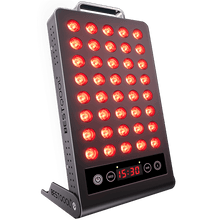
| Panel | What is the specified treatment distance? | Position it at the manufacturer's stated distance and use irradiance information for that distance, not a closer or farther one. |
| Handheld, probe, or cluster device | How large is the beam or treatment head? | Treat each lower-back area methodically and reposition as needed. Do not assume one placement covers the full target area. |
A conservative consumer-safety approach suggests beginning with a short session per area (e.g., a few minutes) and increasing gradually only if the manual permits it and your skin remains comfortable. This is a precautionary starting point, not a proven lower-back pain protocol.
Before beginning, decide what counts as one treated area. If the beam or pad does not cover the full lower back, use separate positions rather than extending one exposure in the hope that light will cover beyond the device's intended treatment zone.
Red, Near-Infrared, or Both?
Red and near-infrared wavelengths are generally discussed differently:
- Red light is generally used for more superficial targets.
- Near-infrared light is generally selected for deeper musculoskeletal targets such as muscle or joints.

That depth distinction does not establish that near-infrared light, red light, or a combination will improve lower-back pain. It also does not tell you how long to treat.
For lower-back symptoms that appear related to deeper muscle or joint structures, near-infrared capability may be relevant to the intended target. But wavelength choice should not substitute for an assessment of the cause of pain---especially when symptoms suggest nerve involvement, significant injury, or another condition needing medical care.
The available evidence does not establish a specific red-light session duration for acute low-back pain, sciatica, muscle strain, or lower-back arthritis. Consider at-home light therapy an optional adjunct, not a replacement for appropriate evaluation or established care.
What the Low-Back Research Can---and Cannot---Tell You
Evidence for LED photobiomodulation in nonspecific low-back pain is conflicting.
One triple-blind, placebo-controlled trial in chronic nonspecific low-back pain used 12 sessions over 4 weeks, or three sessions weekly. The active protocol delivered 220.05 J per session. However, the available record does not provide the treatment area, irradiance, or minutes per session needed to translate that protocol to a home device.

In that study, the active treatment did not show a clinically important improvement in pain intensity or disability compared with placebo at 4 weeks.
The useful takeaway is not that every home routine should run three times weekly, nor that a larger total energy number is better. Instead:
- Use the manufacturer's schedule as the starting boundary.
- Keep a repeatable routine rather than escalating session time repeatedly.
- Reassess whether the approach is helping instead of using it indefinitely.
- Do not treat a research schedule for chronic nonspecific low-back pain as a protocol for sciatica, acute injury, arthritis, or another diagnosis.
Ask a Clinician Before Treating the Lower Back If Any of These Apply
Get medical guidance before self-treating if you have:
- A photosensitivity disorder or take a medicine that may increase light sensitivity.
- Pregnancy, particularly when treating the low back, pelvis, or abdomen. This is a precaution because robust safety evidence is limited; it is not proof that treatment causes harm.
- Active cancer or a suspicious lesion in the treatment area. Obtain approval from the oncology team or treating clinician before direct treatment.
- Reduced sensation or neuropathy. You may not reliably feel excess heat or irritation, so added caution and skin checks are important.
- Recently burned, actively infected, bleeding, or damaged skin in the area.
Medication lists are not complete. If you are unsure whether a prescription or over-the-counter medicine may increase photosensitivity, ask the prescriber or pharmacist.
Stop the Session Instead of Pushing Through
End treatment and seek guidance if you experience pain during use, intense burning, blisters, persistent rash, visual symptoms, severe headache, dizziness, or a clear flare in your symptoms.
Mild warmth or brief redness does not have a universal "safe" duration, so avoid treating discomfort as a sign that the session is working. Inspect the skin before and after treatment, particularly if sensation is reduced. Do not look directly at LEDs, and use eye protection when your device instructions require it.
Use your manual's time and distance limits first, verify irradiance at the distance you will actually use, and choose a conservative routine you can repeat consistently rather than chasing longer sessions. If you are considering a specific device, review its current manual and verified specifications; if the cause of your pain is unclear or symptoms worsen, seek clinical assessment before continuing.


 Small
Small

 Moderate

 Moderate

 Moderate

 Full
Full

