
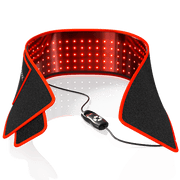
Red light therapy belts and wraps share the same core maintenance priority: protect the light-emitting assembly, power components, and internal wiring from unsuitable moisture, pressure, and damage. That means a device's manual takes priority over general care advice. Available guidance includes detailed instructions for one neoprene wrap, but not equivalent belt-specific instructions. It is not safe to assume that a cleaning method, disinfectant, storage position, or removable accessory approved for one wearable applies to every other belt or wrap.
Compare Components Before Comparing Formats

Start by identifying which parts of the wearable are electronic and which, if any, are separate accessories. The light-emitting panel, embedded wiring, controller, charging port, and attached power leads require different care from a removable cover or other non-electronic component.
| Component to Identify | Why It Matters for Cleaning and Maintenance | What to Confirm in the Manual |
|---|---|---|
| Skin-contact surface | This is the area most likely to need routine surface cleaning. | Approved cloths, cleaners, and drying instructions |
| Light-emitting panel | May contain LEDs, flexible wiring, or surfaces that should not be pressed. | Whether LEDs are accessible and how to clean around them |
| Straps and closures | May collect residue or wear through repeated fastening. | Whether they are removable and how they should be cleaned |
| Cover or liner | May have separate care instructions from the device itself. | Whether it is removable, cleanable, or disinfectable |
| Cable, controller, or charging port | These parts should be protected from liquid and strain. | Charging, cord handling, and inspection guidance |
| Flexible panel | Its construction may determine whether it can be folded, rolled, or stored flat. | Required storage position and packing method |
One documented wrap, for example, uses neoprene construction, embedded LEDs, and a Velcro strap. A clear plastic cover is also available for that particular wrap and is described as cleanable and disinfectable. That does not establish that all wraps have such a cover---or that a belt's fabric, strap, liner, or closure can be removed or washed.
Use a Shared Cleaning Routine First

For either format, the lowest-risk starting point is a simple routine that avoids putting liquid directly onto the electronic wearable.
- Turn the device off and unplug it before cleaning, where applicable.
- Use a dry, soft microfiber cloth for routine removal of dust and lint.
- If the model permits deeper cleaning, apply a small amount of approved moisture or cleaning solution to the cloth---not directly to the device.
- Do not spray liquid onto the wearable.
- Let the device dry as instructed in the manual before reconnecting power or storing it.
General device-care guidance permits a lightly dampened cloth with water or a mild, non-abrasive soap solution for deeper cleaning, while cautioning against direct application of liquid. It also advises against harsh chemicals and alcohol-based cleaners because they may enter internal electronics and cause damage. These general precautions are outlined in BestQool's RLT device-care guidance.
The routine is shared, but the exact cleaning method is not necessarily shared.
| Care Question | Belt | Wrap |
|---|---|---|
| Can the skin-contact surface be wiped? | Check the model's approved cleaning method. | Check the model's approved cleaning method. |
| Can liquid be applied directly? | Do not assume so. Use the manual. | Do not assume so. One documented wrap should not be submerged. |
| Can the device be disinfected? | Only if the manual specifically allows it. | One documented wrap permits disinfecting wipes, but that approval is model-specific. |
| Can textile-looking parts be washed? | Do not assume they are washable or detachable. | Do not assume the wrap body, strap, or panel is washable. |
The key distinction is between wiping a surface and laundering or soaking the device. The available guidance does not establish that any belt or wrap can be machine-washed, immersed in water, sprayed with cleaner, or treated with bleach or alcohol.
Treat Disinfectants and Removable Parts as Exceptions
A disinfecting wipe approved for one wrap is not a universal instruction for all wearable light devices. The documented wrap may be wiped with disinfecting wipes between patients, but general device-care guidance separately warns against harsh chemicals and alcohol-based cleaners.
Those instructions are not necessarily contradictory: they apply to different designs and approved care procedures. The safe rule is straightforward:
Use disinfectants only when the specific device manual explicitly permits them.
The same principle applies to covers, liners, straps, and closures. If a device has a removable component, its care may be separate from that of the light-emitting assembly. A removable cover may be designed for cleaning, while the electronic panel beneath it may not be washable or suitable for the same cleaning agent.
Where LEDs or diode surfaces are accessible, avoid pressing on them or touching them with fingers during cleaning and handling. General guidance notes that pressure can affect internal LED components. Do not infer that every belt or wrap exposes LEDs in the same way; follow the instructions for the surface actually present on the device.
Store Flexible Panels and Cords According to Their Construction
Storage is an area where format can matter, particularly when a wearable contains a broad, flexible light panel.
One documented flexible wrap should be stored flat whenever possible and should not be folded. The stated reason is that folding can pinch internal wires and damage LED diodes. That is an important wrap-specific example, but it does not establish that every wrap---or any belt---must be stored flat.
Instead of transferring a storage rule from one format to another, check whether the manual directs you to store the device flat, folded, rolled, or packed in a particular way.
| Storage Area | Practical Care Decision |
|---|---|
| Flexible light panel | Follow the model's stated storage position; do not assume folding or rolling is acceptable. |
| Straps and closures | Follow the manual for storage of straps and closures. |
| Charging or power cord | Unplug by holding the plug rather than pulling the cable. Avoid tight coiling, which can contribute to internal wire breakage. |
| Storage environment | Keep the device in a cool, dry location away from direct sunlight, damp conditions, and extreme temperatures. |
| Protective storage | If the manufacturer permits it, a protected case or original box may help prevent scratches and accidental bumps. |
For devices with external cords, cable care is a meaningful maintenance point regardless of whether the wearable is called a belt or a wrap. A compact device with a battery may have fewer external leads during use, but it can still have a charging cable or port that needs to stay dry and undamaged.
Inspect Before Reuse and Pause When Something Changes
Cleaning is only part of routine care. Brief inspection helps identify problems before the device is used again.
After Use
- Disconnect and store any applicable cord without pulling or tightly wrapping it.
Periodically
For devices with an external power cord, general guidance recommends checking the full length of the cord and plug once a week for fraying, cracking, or exposed wires. Also inspect connections for looseness and check whether the device powers on consistently.
Battery-operated wearables may have different inspection points, so their manual should determine the appropriate routine.
Stop Using the Device Until It is Checked If You Notice:
- A loose connection or inconsistent power-on behavior
- Fraying, cracking, or exposed wiring on an applicable cord
- Many LEDs in one area failing
- Unusual noises, smells, or heat
- Visible moisture intrusion or physical damage
The available guidance does not define an acceptable number of failed LEDs or provide a universal repair procedure. When a fault is suspected, pause use and consult the device manual or the manufacturer's support channel rather than attempting an unsupported repair.
Use the Manual as the Final Comparison Tool
The most useful belt-versus-wrap comparison is not a general rule about format. It is a component check:
- Identify the skin-contact surface.
- Determine whether fabric, straps, covers, or liners are separate from the electronics.
- Locate the LEDs, flexible panel, controller, ports, and cords.
- Follow the model-specific instructions for cleaning agents, moisture exposure, storage shape, and charging.
- Pause use when damage, heat, failed lights, loose connections, or uncertainty is present.
For a BestQool device, use the applicable product manual or official support pathway for model-specific cleaning and maintenance instructions.


