
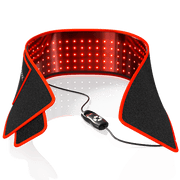
Choose by lumbar fit and repeatable setup---not by output numbers alone. A flexible mat may be easier to keep close to the curved lower-back area and use hands-free if its current documentation confirms its size, fastening method, and contact instructions. A panel may fit better if you can place it securely at the specified distance and angle for every session. Neither format should be assumed to cover the whole lower back or provide symptom relief without verifying the exact model and using it appropriately.
Start with the Shape and Area of Your Lower Back

The lower back is curved rather than flat. That matters because the practical question is not simply whether a device reaches the lumbar area, but whether its lighted surface remains positioned over the area you intend to use.
A flexible format can reduce gaps around the waist and flanks when it sits flat across the lumbar curve. BestQool's flexible-wrap lower-back guidance also emphasizes that placement must remain centered and stable: a device that rides up, shifts, or arches away from the body changes the area actually exposed.
A panel works differently. Its distance from the body affects both coverage and intensity: closer placement generally concentrates stronger light over a smaller area, while greater distance generally spreads gentler light across a wider area. Actual coverage and irradiance still depend on the individual model and its specified measurement distance, as explained in BestQool's home-use guidance.
| Format | Lower-Back Fit Question | Practical Check Before Use |
|---|---|---|
| Flexible mat | Can it lie flat from just above the pelvis through the intended lumbar area without bunching or slipping? | Confirm dimensions, active lighted area, attachment method, and direct-contact instructions. |
| Panel | Can it be held or mounted at a stable distance and angle over the intended area? | Confirm the model's distance guidance, usable setup, and whether your position keeps the panel steady. |
Do not assume a flexible BestQool mat covers more of the lower back than a panel. The available documentation does not establish current mat dimensions, active area, or a measured lumbar-coverage comparison.
Treat Panel Specifications as Setup Information
Some BestQool panel specifications can help identify setup constraints, but they do not establish which format is more effective for lower-back discomfort.
The supplied manual groups several panel models together rather than giving separate values for every model:
| Manual-Covered Panel Group | Direct Skin Contact | Listed Irradiance | Listed Power Consumption |
|---|---|---|---|
| BQ40 and BQ60 | Stated as safe for skin contact | 45--70 mW/cm² | 50--100 W |
| Pro100, Pro200, and Pro300 | Stated as not safe for direct skin contact | 90--93 mW/cm² | 160--465 W |
These grouped figures have important limits:
- They do not provide separate irradiance, wattage, measurement distance, or LED-count values for each model.
- They do not establish usable lower-back treatment area.
- They do not show that a higher listed irradiance or electrical power consumption will produce better symptom outcomes.
- They do not provide a direct comparison with a flexible BestQool mat.
Electrical wattage describes power consumption, not the dose delivered at the skin. Irradiance can be useful only when the stated distance and measurement conditions are comparable. A panel with a larger number on a specification list is therefore not automatically the better fit for your lower-back setup.
The same manual lists 660 nm red light and 850 nm near-infrared light for BQ40, BQ60, Pro100, Pro200, and Pro300. No flexible-mat wavelength specification is available in the supplied documentation, so it should be confirmed in the current product page and manual rather than inferred from a product category or image.
Verify These Details Before Comparing a Mat with a Panel
A format-level comparison is useful only after the current model documentation fills in the missing details. Before treating a flexible mat and panel as true alternatives, check the following for the exact BestQool devices under consideration, including current BestQool panel options.
Coverage and Fit
- Overall device dimensions
- Active or lighted area, if separately stated
- Whether the flexible device is intended to sit against skin or over clothing
- Fastening, strap, or attachment details
- Whether the device can remain centered across your lumbar area without slipping
Positioning and Controls
- Panel distance guidance and whether it applies to lower-back use
- Whether a stand, door hook, cable, or other mounting arrangement is included or supported
- Timer settings and session limits
- Wavelength settings and controls
- Irradiance measurement distance and method
Practical Ownership Details
- Cleaning instructions and approved cleaning products
- Storage instructions, including whether the flexible device should avoid over-flexing
- Warranty coverage for that exact model
- Current return terms for the sales channel you are using
If any of these details are missing, pause before deciding. A panel's footprint is not necessarily its treatment area, and a mat's physical size is not necessarily its active lighted area.
Match the Format to the Position You Can Repeat

The more suitable format is often the one you can position safely and consistently without making every session a setup problem.
Lying Down
A panel can be used during a lying-down back session when it is stably positioned over the intended muscle area and does not place direct pressure on the spine. BestQool's lying-down back-use guidance favors positioning over surrounding lower-back muscle areas rather than aiming directly at spinal bones.
For a panel, confirm how it will be supported before starting. The available guidance does not verify a particular BestQool stand, mounting method, or panel size for this arrangement.
A flexible mat may be worth considering for lying-down use only when its manual confirms that close placement, body contact, and the intended position are allowed. Do not assume those instructions from the fact that the device is flexible.
Sitting or Standing
A panel may suit a seated or standing routine if you can hold a consistent distance and angle without twisting, straining, or repeatedly readjusting. General guidance describes panels as commonly used at about 6 to 24 inches, but that is not a model-specific BestQool instruction. Follow the distance in the manual for the panel you own or are considering.
A flexible format may be more practical for users who need a hands-free arrangement, provided it can remain stable and flat across the lumbar area. A snug fit should not be compressive.
Session Duration
For the panel models covered by the supplied manual, do not exceed 30 minutes in one session or 60 minutes total in a day. Those limits do not automatically apply to a flexible mat. Use the mat's own current instructions rather than transferring panel limits across formats.
Keep Expectations Modest
Current research reviews indicate that red and near-infrared light therapy has limited support for modest short-term pain relief and functional improvement in chronic low-back pain. That does not mean a BestQool panel or flexible mat can diagnose the source of pain, correct an underlying condition, or guarantee relief.
Consider either format a possible self-care adjunct rather than a substitute for evaluation when pain is severe, persistent, worsening, or associated with numbness, weakness, or radiating symptoms.
Stop a session if pain becomes sharp, numb, or radiating, or if you experience an unusual skin reaction, lightheadedness, or heat that does not settle after adjusting the setup. Seek medical guidance rather than increasing session length or frequency to push through concerning symptoms.
Review Safety and Care Instructions for the Exact Device
Panel and flexible-mat instructions should not be treated as interchangeable.
For the manual-covered panels, the safety guidance warns against looking directly at near-infrared LEDs for more than two minutes and requires goggles for near-infrared facial use. Follow BestQool's safety and eye-use guidance for the exact device and mode, even when using it on the lower back.
The same panel manual identifies pregnancy and photosensitizing medications as situations requiring medical consultation. Medication-related light sensitivity varies, so do not rely on a partial list as a complete contraindication check.
For a skin-contact flexible device, cleaning guidance calls for wiping contact surfaces after each session with a soft, lint-free cloth and avoiding direct liquid application or submersion. Cleaner compatibility varies by model; consult the current device cleaning and maintenance guidance and the device-specific manual before using alcohol or other cleaning products.
Use This Format-Fit Checklist
Before comparing current BestQool models, confirm:
- Coverage: Does the documented active area reach the lower-back region you want to address?
- Position: Will you use it lying down, sitting, or standing---and can that position be repeated comfortably?
- Space: Can a panel be safely positioned at its required distance, or do you need a close, hands-free format?
- Stability: Will a flexible mat stay centered without riding up, bunching, or arching away?
- Maintenance: Are you comfortable with the documented cleaning and storage requirements?
- Safety: Have you reviewed the exact manual's eye guidance, contact restrictions, duration limits, and photosensitivity cautions?
Compare the current verified product pages and manuals before making a format decision. Contact BestQool support for model-documentation questions, and consult a healthcare professional for decisions about persistent, severe, unexplained, or changing lower-back pain.


